Much of the contemporary artist’s work consists of writing applications to institutional funding partners. Not always do these efforts bear fruit… but last February, I got an affirmative email from the curating committee of AboAgora, the annual event that invites people engaged in arts and sciences to meet in the city of Turku. The encouraging message was that they had accepted my proposal, and I was welcome to conduct a workshop at the upcoming symposium in August. My intention was then to remodel and develop last year’s Mapping on the Beach in Palanga – and my obvious challenge was how to bring a stretch of sandy beach into the Sibelius museum, venue of AboAgora?
After a lot of emailing back and forth with the organizers, I decided to craft ‘gameboards’ with wooden strips along the edges, so that they could hold at least a moderate amount of sand… Gluing all those strips took some sunny summer days, but in the end there were seven boards ready to roll, and we set off for Turku.


Crafting boards from surplus material and crossing the Baltic sea towards a rising sun
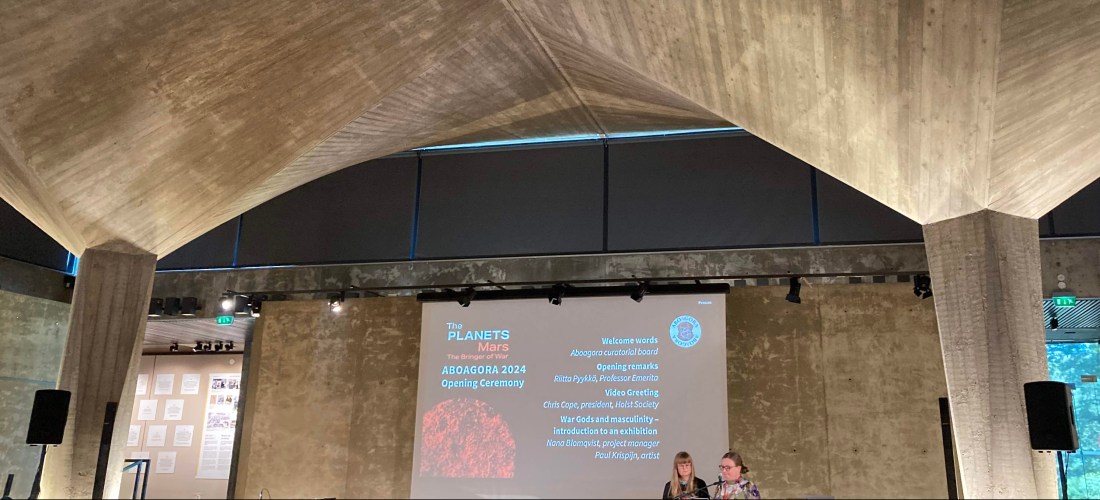
Arriving early in the morning of August 28th, I found my way to the Sibelius museum – a stunning piece of architecture designed by architect Woldemar Baeckman, inaugurated in 1968. The AboAgora, in its turn, is a resourceful collaboration between the University of Turku, Åbo Akademi University, the Arts Academy of Turku University of Applied Sciences, Åbo Akademi University Foundation and Turku University Foundation…


Concrete impressions from the Sibelius museum
In this distinguished context, I couldn’t help but feeling a bit odd, unpacking the curious bundle of wooden hexagons from its plastic wrappings and collecting the bags of sand that had kindly been acquired by the project staff; dear researcher/coordinator Petra Piiroinen, here’s a shout-out to you – you’re a true professional, and a very delightful person, too!


Unwrapping workshop material in the museum’s atrium
The AboAgora 2024 program marks the beginning of a new thematic cycle, The Planets (referring to the orchestral suite of the same name by composer Gustav Holst). Spanning over seven years in total, this first event was dedicated to Mars, the Bringer of War. A challenging subject, indeed – but I can’t think of a better way to approach the theme than the opening panel session, dealing with the environmental impacts of war and post-war recovery. The lectures and talk by panelists Timo Vuorisalo, Emma Hakala and Ruslan Gunko turned out to be a powerful call to well-informed action, referring to past wars in the Balkans as well as the ongoing Russian aggression in Ukraine.
PhD researcher Ruslan Gunko lecturing on environmental and human resilience in present-day Ukraine
Other highlights from the first days of AboAgora was the panel session on A De/Colonial Present, where researchers and PhD students – with roots in Finland, Palestine, Sàpmi, Botswana and Kanaky – reflected on the legacies of colonialism as a driving factor in today’s conflicts; their viewpoints carried further in a lecture and discussion with professor Koen De Feyter, a long-time champion of human rights in public international law. And, not to forget, the Extended Reality installation by Love Antell at the site of Ismo Kajander’s subtle monument, conceived in 1994 and commemorating local events during the Finnish Civil War in 1918; later that evening followed by a lecture on academic activism by physicist Syksy Räsänen.


above: XR work by Love Antell around Ismo Kajander’s memorial for victims of the Finnish Civil War;
all photos here by Pekko Vasantola
below: Syksy Räsänen on Truth, Love, Sense and Nonsense in science and activism
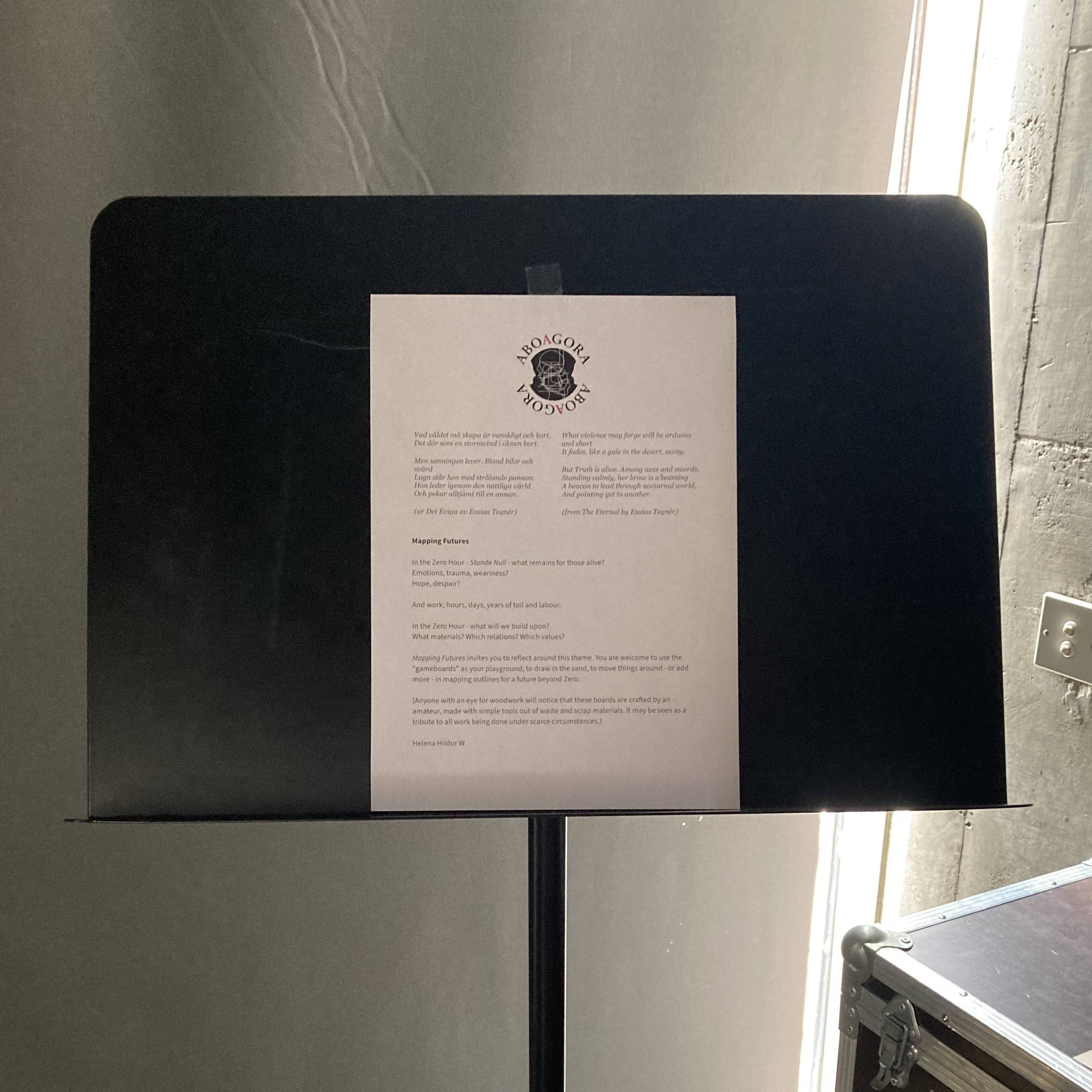
What about Mapping Futures, then? Well, it didn’t take place until the third and final day of Aboagora 2024…
 Helena Hildur W.