Duplicity / Duplicität Symposium (day three of three)

art, recent work, time-out

… and how could the spirit of the second day be carried forward now – bursting with intellectual and emotional energy as it was?

The answer turned out to come almost by itself, with a change of pace: from yesterday’s parallel strings of concise case studies swiftly followed by verbal exchanges of Q’s and A’s, to extended presentations creating space for a deeper listening; for resonance, outwardly and inwardly…


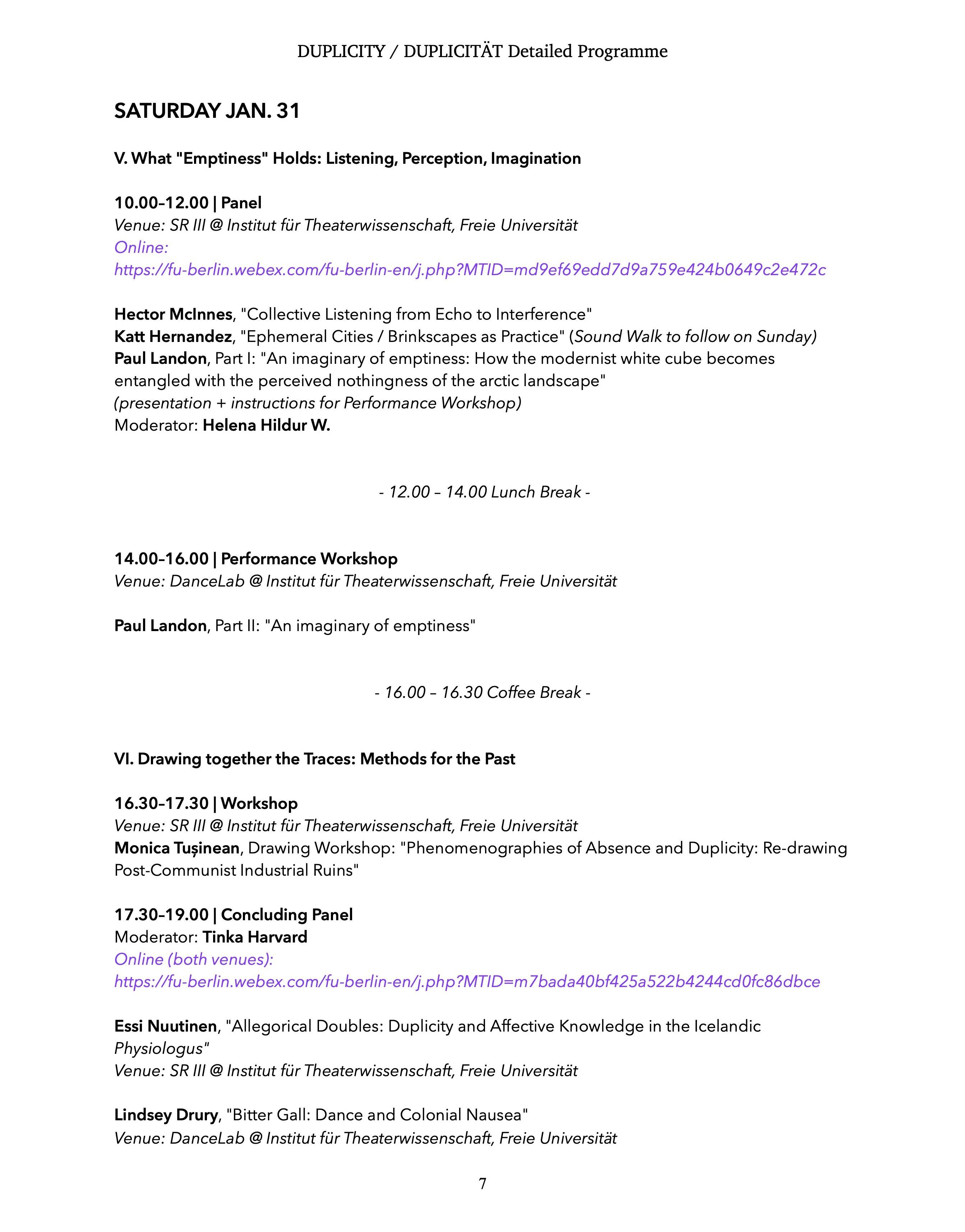
The first feature of Saturday’s programme, sound artist Hector MacInnesCollective Listening from Echo to Interference, carried us from Berlin to the the Isle of Skye, inviting us to roam and rest within a delicately composed soundscape of voices: repeated calls for contact, interlaced with distinct impressions and reflections on records, intimacy, and distance – evoking feelings of loss and sadness, imbued with a sense of care. A tentative call for solidarity?

Above: Hector MacInnes in dialogue with the group, after the Collective Listening experience
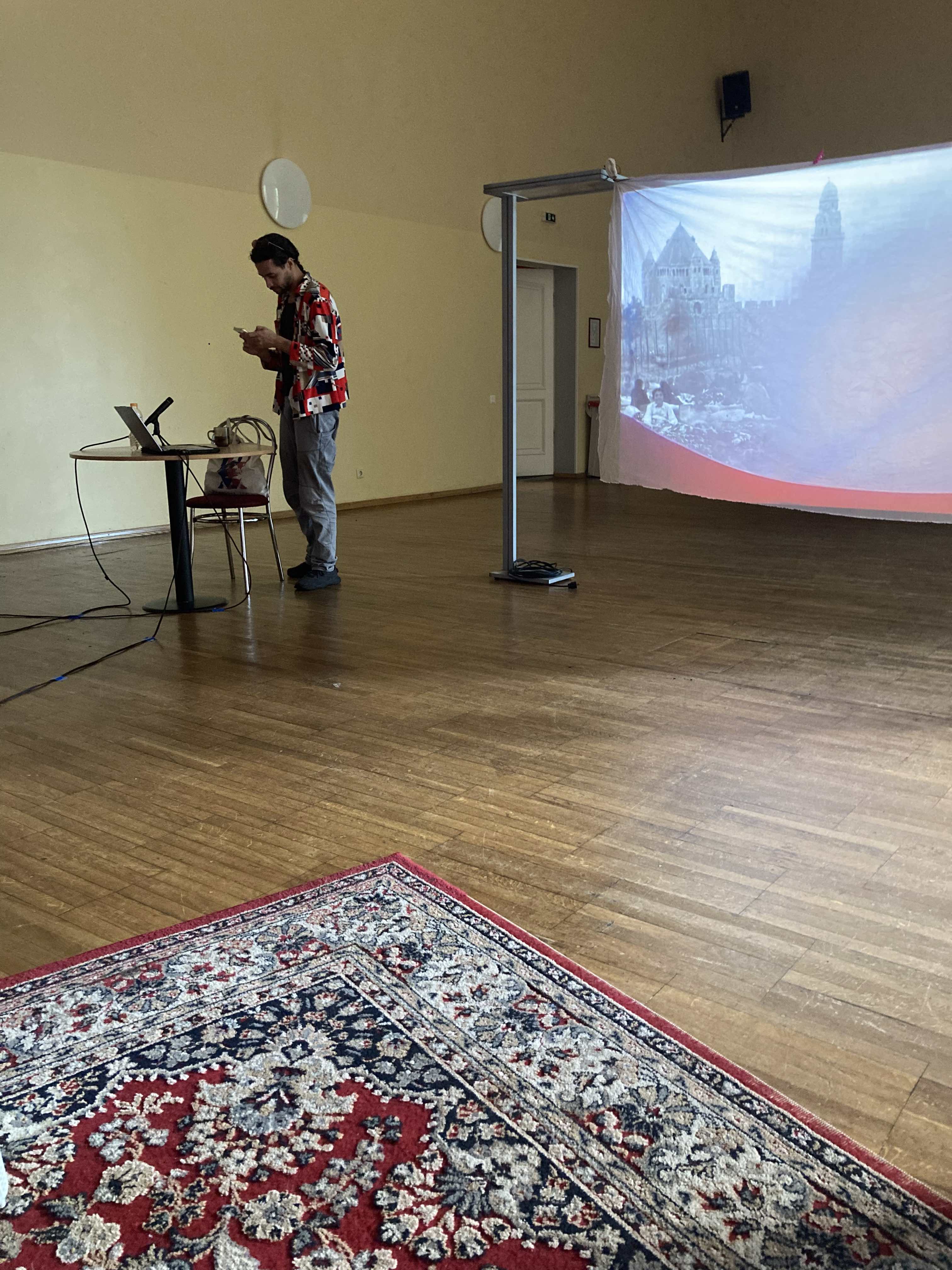
Below: Katt Hernandez waiting to present Brinkscapes as Practice (left);
“Kungens Kurva strange utility hut”, photo credit Katt Hernandez (right)


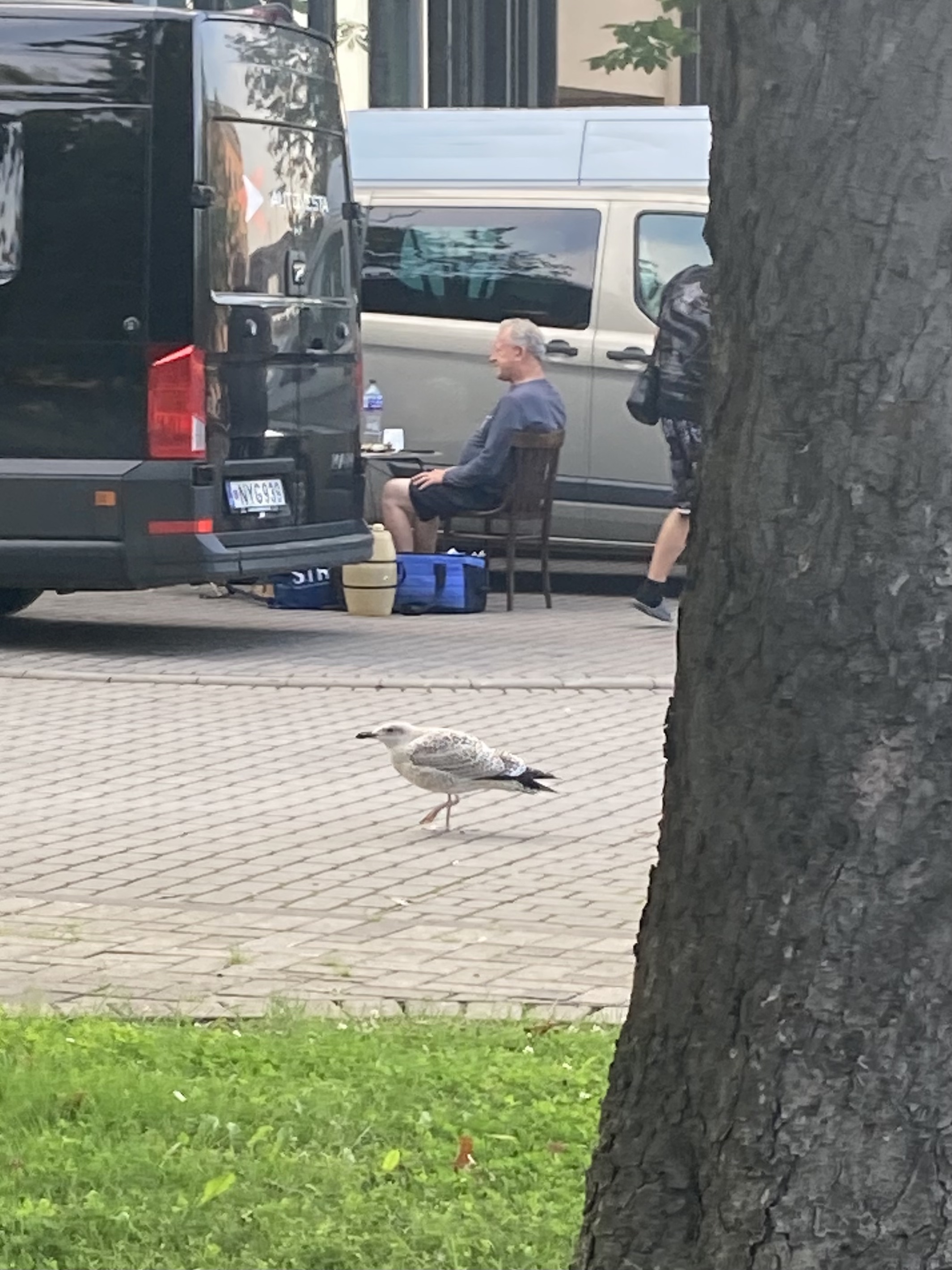
Next, musician and composer Katt Hernandez performed a dérive in urban peripheries, cutting through notions about desolate wastelands by addressing the warehouses, shopping malls, and vast parking lots as comforting sites of everyday human presence and protective anonymity, fondly naming them brinkscapes. The rhythmical sequence of pictures, speech, and silences unfolded as if tuned to inaudible music – eventually set free to sound by the fiery and tender voice of Katt’s violin.

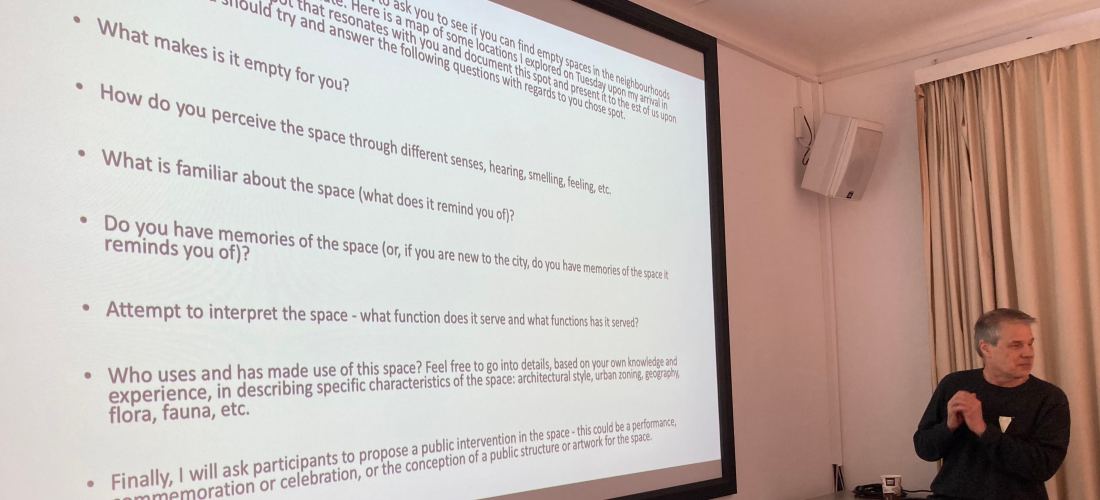
The journey continued as media artist, professor Paul Landon took us to Arctic landscapes in the Cold War era, where military demands employed the “perceived nothingness” of supposedly uniform expanses of dazzling snow, as the DEW (Distant Early Warning) system was erected across Alaska and Canada; a massive effort turning self-sustaining ecosystems into a backdrop for the demonstration of power and cutting-edge technology.

For the extended lunch break, Paul sent us on a mission:

– Go for a walk in the neighbourhood and look for an empty space that resonates with you; document what you find, so that you can present it to the group; stay with your chosen spot for a while, trying to perceive, understand and interpret it; from this experience, think of a public intervention to amplify, alter, celebrate or comment on its particular emptiness.

And so we did.

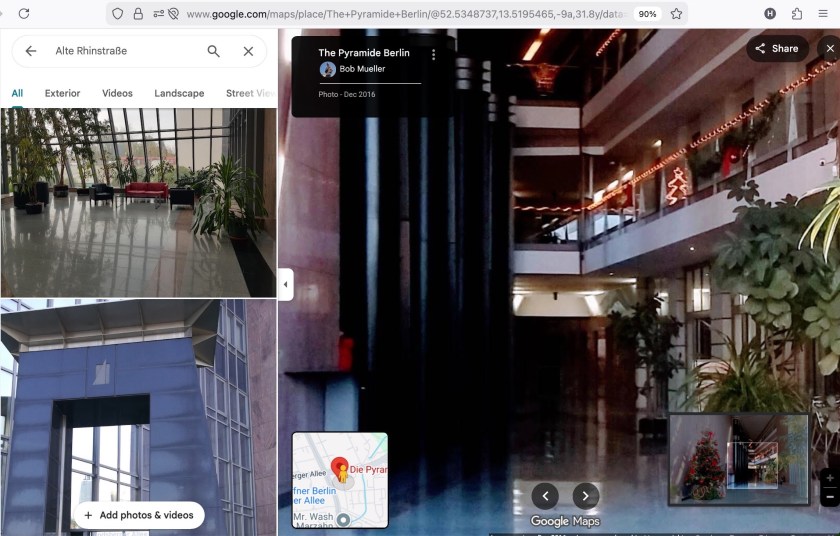
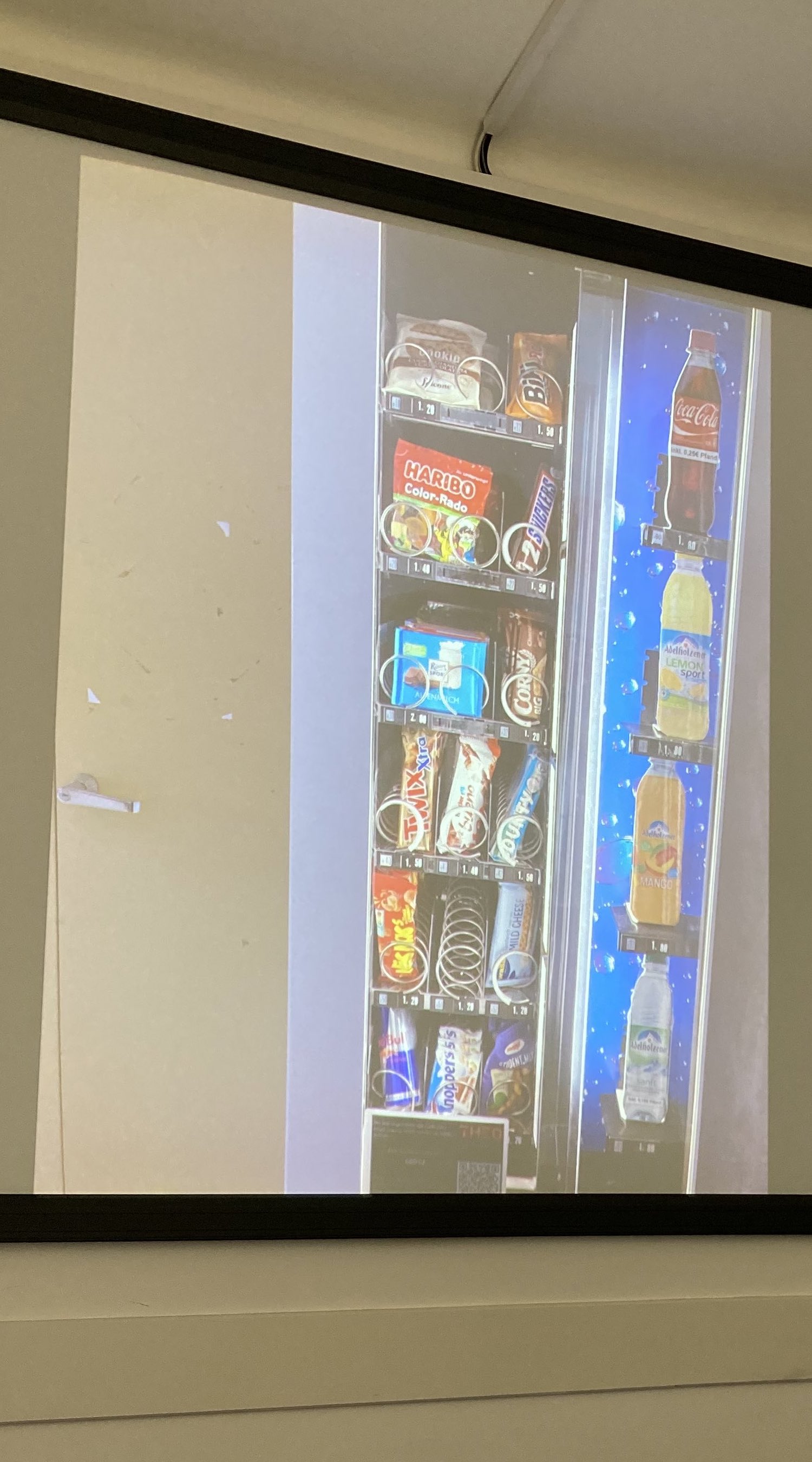
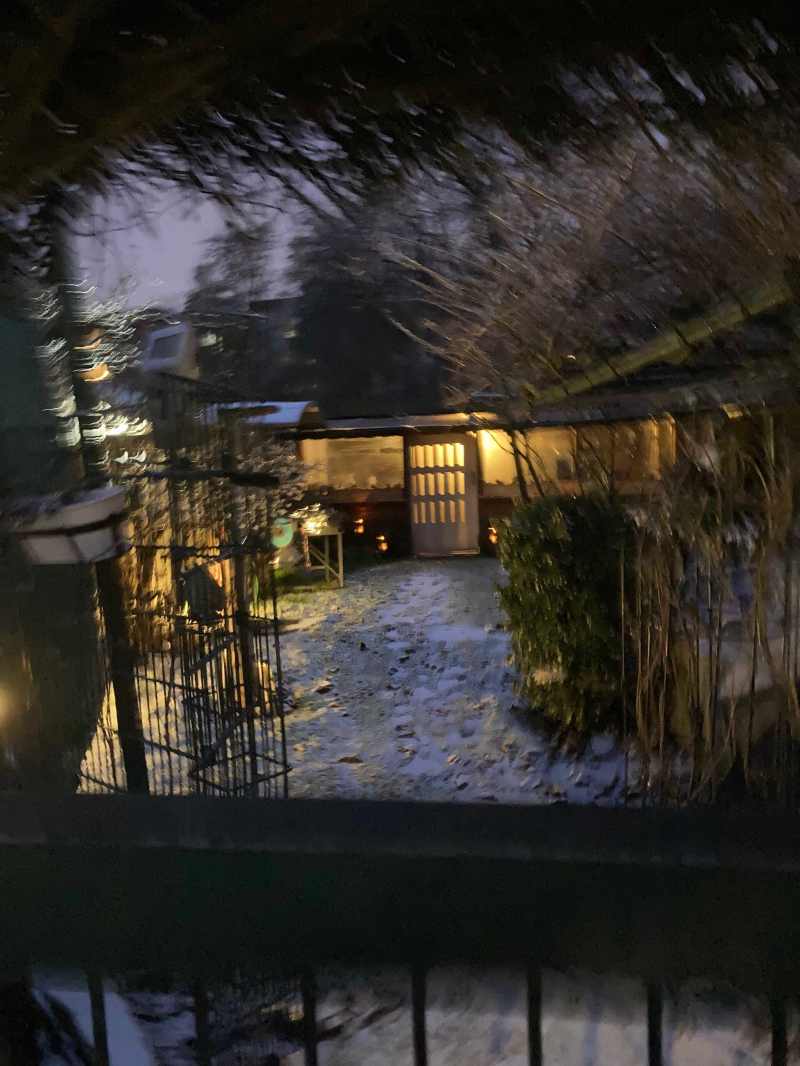
Two hours later, the group reassembled to share the documented emptinesses: an inaccessible yard, a snow-covered balcony, a construction pit, a beanie hat lying in the street, lost from the head it used to protect…

Above: Paul Landon sharing pictures from his personal collection of emptiness
Below: emptiness captured by Caitlin McHugh

…a gap in the flow of consumer goods in a vendor machine…

We shared photos, and more: we shared, unguardedly, our sustained attention, our awareness towards qualities and emotions, our personal renderings – stirring interest, reflections, compassion, and friendly laughter – in a flow already present yesterday, now broadening and deepening like a river.

For my own part, this workshop remains a highlight; first, spending time on my own in the midst of these intense days, and then returning, respirited, to co-create with to peers, now being friends.

Duplicity “emptiness” excursion along Grünewaldstrasse – Paulsenstrasse – Rückertstrasse – Brentanostrasse
(photos by HHW.)

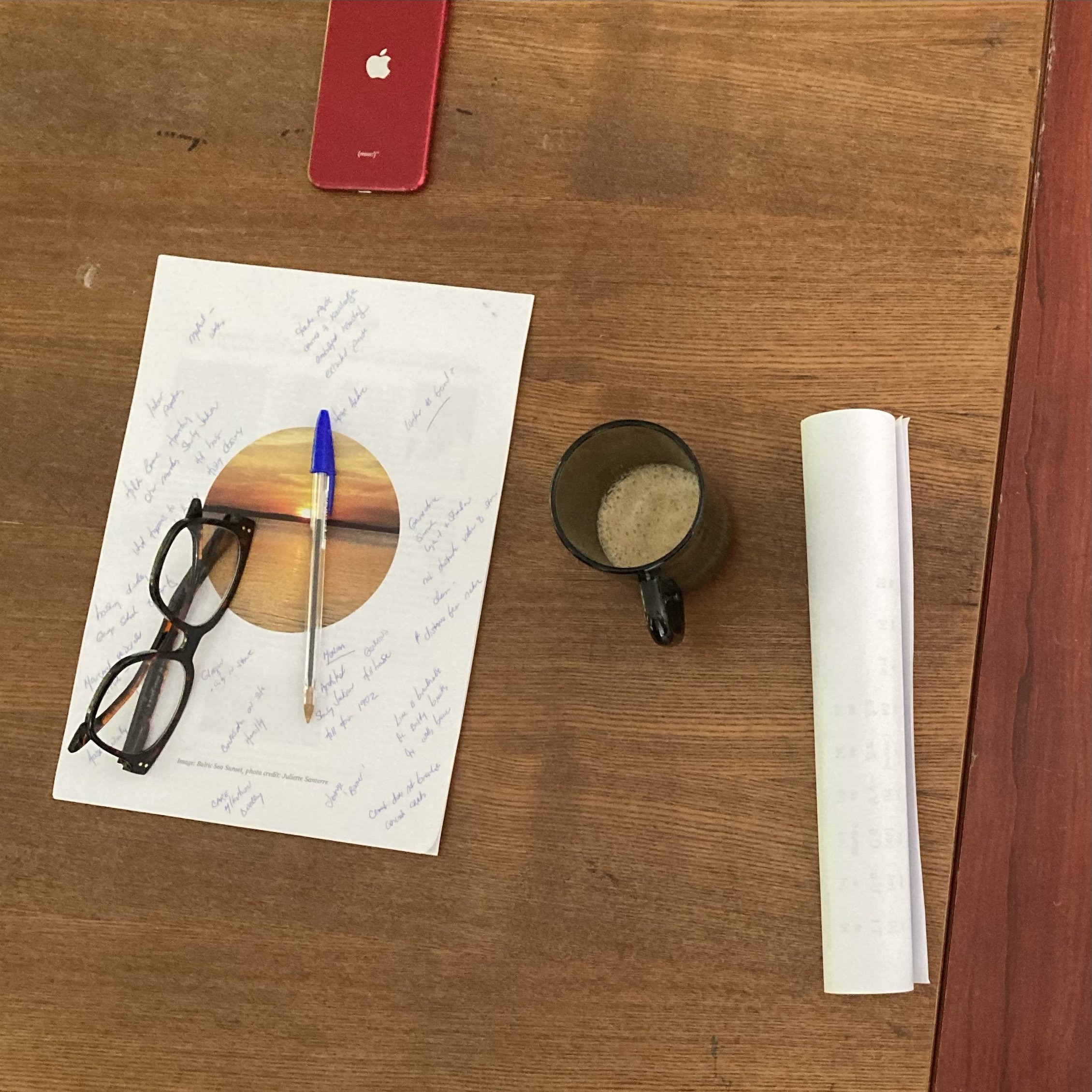
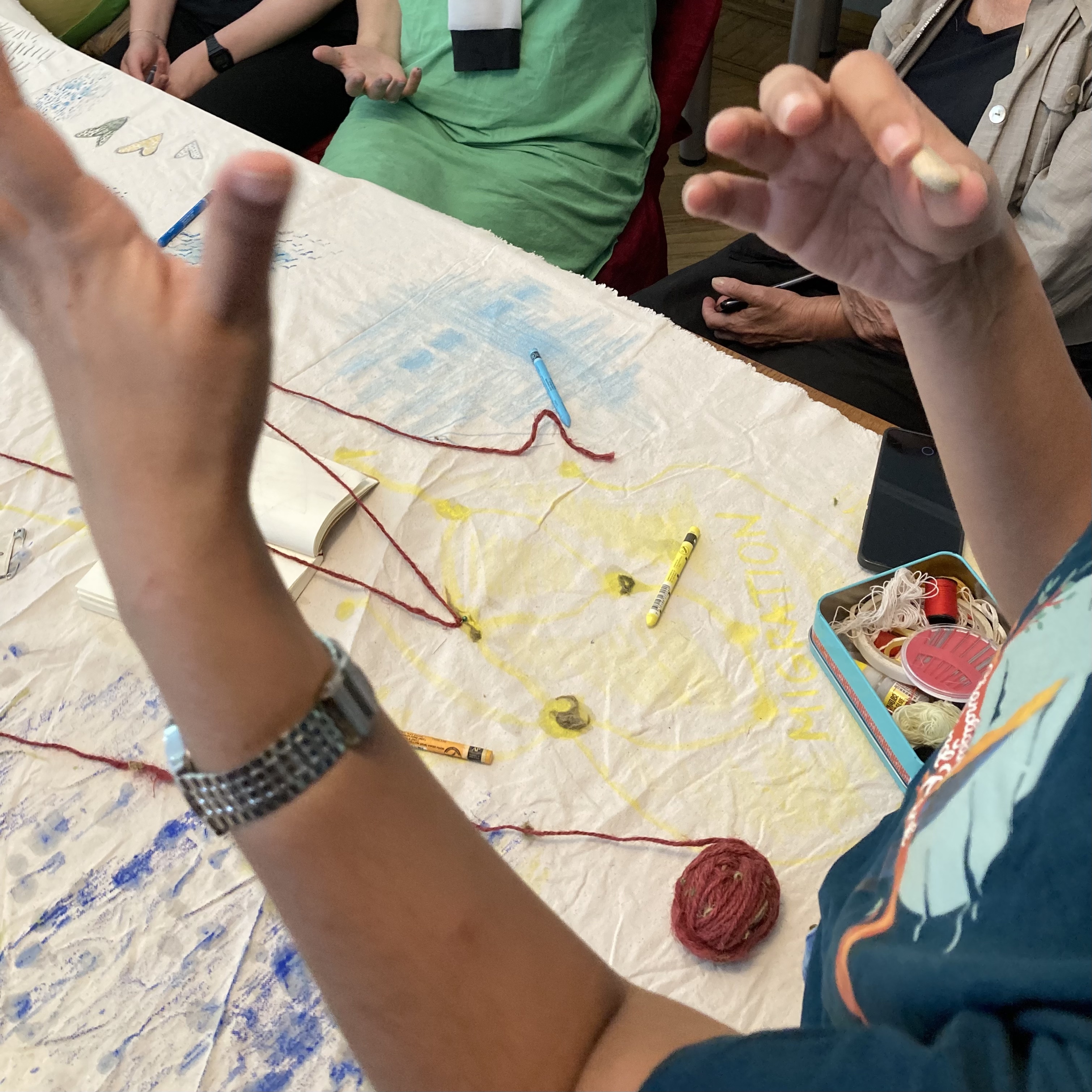
A coffee break, then another workshop: Phenomenographies of Absence and Duplicity. Re-drawing Post-Communist Industrial Ruins by architect Monica Tușinean. Drawing and tracing paper rolled out all along the table, graphite pens and thick black markers distributed, instructions given…

Above: re-imagining Romanian industrial heritage sites by drawing “phenomenographic vignettes”,
workshop by Monica Tușinean
Below: Essi Nuutinen gives us monsters

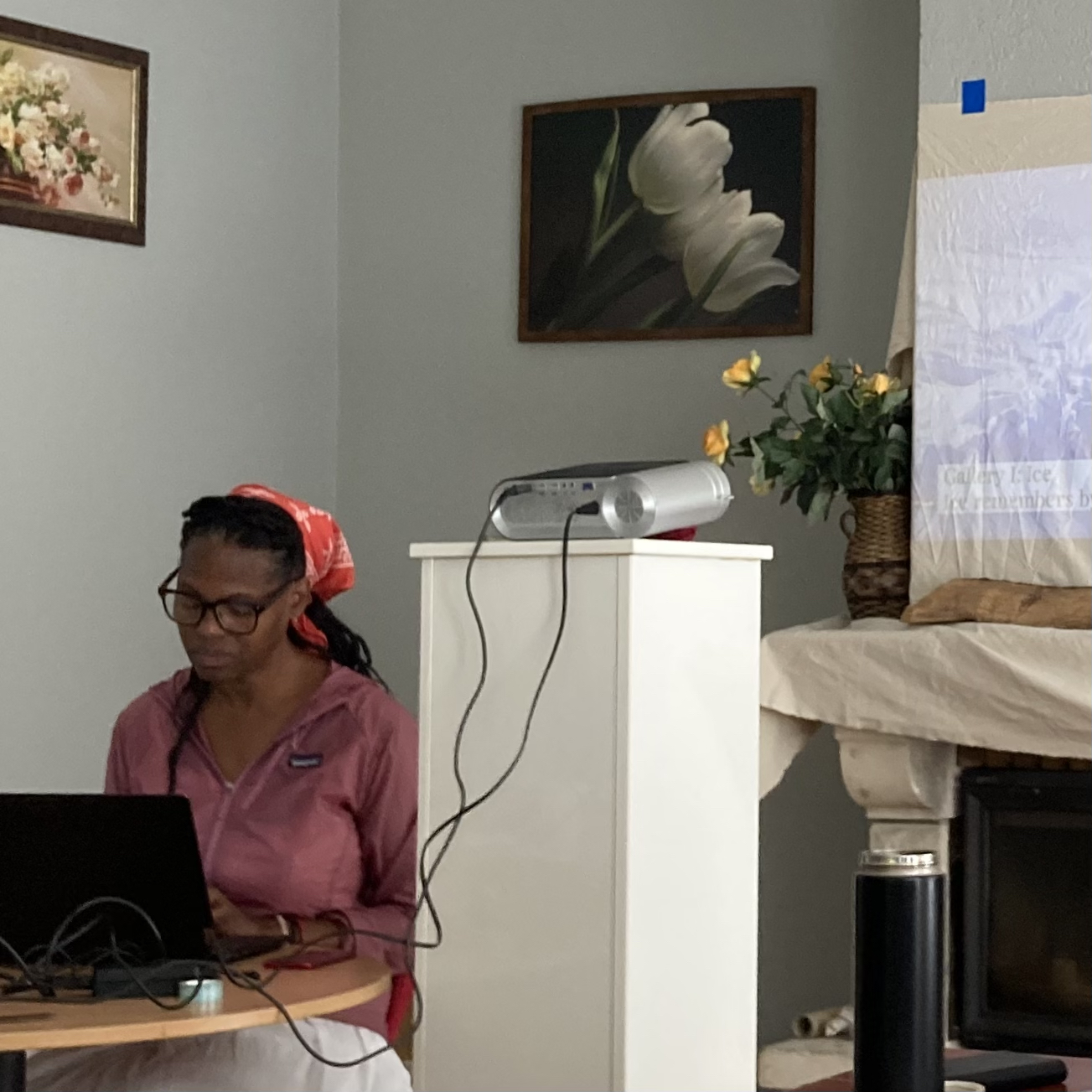
The playful excitement of the drawing workshop was gently redirected into focused common attention by Tinka Harvard, serving as moderator for the programme’s last section. As eyes turned back to the projection screen and the room fell silent, Essi Nuutinen introduced us to the Icelandic finngálkn, or onocentaur; a hybrid human-animal being, signifier of inherent duplicity and vehicle for imaginative moral thinking; a creature of folklore and Christian allegories appearing in the mediaeval book known as the Physiologus. The Icelandic manuscript in itself carries a story of transformation, as it went from being a valued keeper of knowledge, to having its pages torn apart and perforated by hundreds of tiny holes – surviving the centuries repurposed to separate coarse meal from finer… a sieve. A membrane. 

After moving upstairs to another venue – the DanceLab – the intertwined themes of ethos, body, and mediaeval history were continued by Lindsey Drury, in her performance lecture Bitter Gall: Dance and Colonial Nausea. History inherited as the “past-in-body-present”; the body, a receptacle torn by conflicting forces; ethos, the values and practices that sifts out the self. 

This slideshow requires JavaScript.

From Lindsey Drury’s performance lecture Bitter Gall: Dance and Colonial Nausea

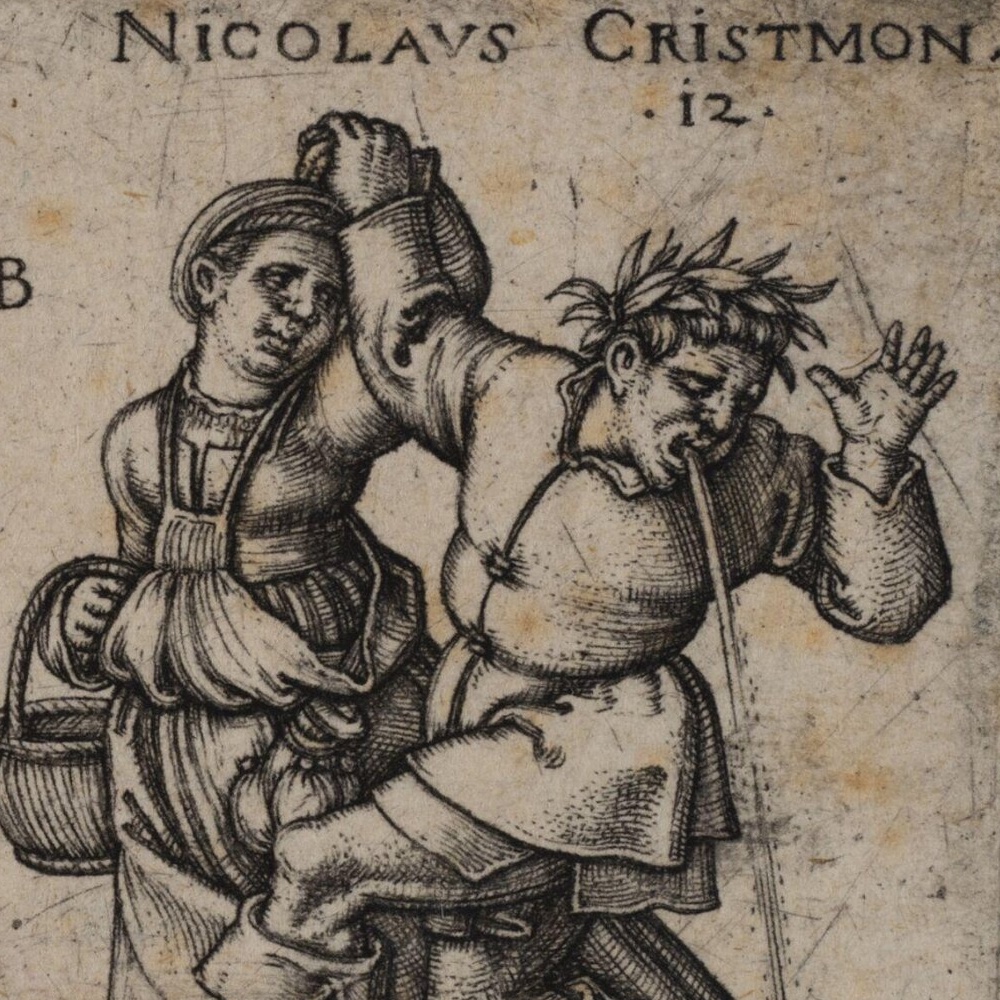
In Sebald Beham’s engraving The Peasants’ Feast, the woman beholds the spewing peasant with a steady gaze, while leading him forward in dance; her expression does not tell of any judgment.

I cannot reduce this performance lecture into words; I will not even make an attempt. But it stays in my sieve, like the coarse and nutritious elements of stone-ground wholemeal – not to be disposed of, not to throw up, but to be digested over time. I will carry it with me, as a part of who I am, for times to come. 


Duplicity / Duplicität Symposium (day two of three)

art, recent work, time-out

Come the second day of this adventure… beginning at 10am sharp with Elsewhere as structure: a panel on coloniality, migration and distance, with two of the speakers present online from Southeast Asia. Urban ethnographer Dr. Elisa Bertuzzo opened the panel with another flip of perspectives, recounting how colonizers of the past proudly filled Europe’s novel, prestigious botanical gardens with “exotic” plants – while today’s immigrants are accused of spreading “invasive” species when growing kitchen vegetables from their home places in South European backyards. PhD student, architect, and designer Lu Lin shared her work on dual belongings and cross-cultural design proposals, carried out between China’s Wenzhou region and Italy, together with immigrants and returnees. Concludingly, Dr. Theol. Shiluinla Jamir reflected on Lifestyle as Resistance (an intriguing essay by Prof. Veena Talwar Oldenburg in 1990), raising questions on how moral life is performed in a socio-spatial sphere of “remoteness”, and what it could be to lead a good life.
From the “Elsewhere as Structure” panel: hybrid meeting preparations;
two slides and a close-up from Elisa Bertuzzo’s presentation;
a mapping exercise shared by Lu Lin (all photos by HHW.)


After lunch, the programme divided into three parallel tracks in the Graduate Students’ Panels. I sadly missed out on the Epistemologies and the Erasures panels, as I followed four presentations on Embodiments – by Sophie Schultze-Allen, Caitlin McHugh, Tinka Harvard and Cadenza Zhao – insightfully moderated by Prof. Paul Landon and artist Jody Wood, with beautiful exchanges also between the panelists.

Sophie Schultze-Allen on “Decolonial Ecologies in Dance”, and feedback snapshots from Cadenza Zhao’s presentation on “Embodiment of Duplicity” (all photos by HHW.)

After a coffee break – offering some time to share reflections more informally – we all gathered to listen to presentations on Distance, Performance and Documentation by PhD student and theatre director Omid Mashhadi (Dokumentartheater Berlin), and visual artist Dr. Kerry Guinan (Centre for Art and the Political Imaginary, Gothenburg-Stockholm); again, generating many thoughts as well as lively exchanges.

This slideshow requires JavaScript.

Slide from Mashhadi’s rehearsal work with Ukrainian refugees at the Dokumentartheater Berlin;
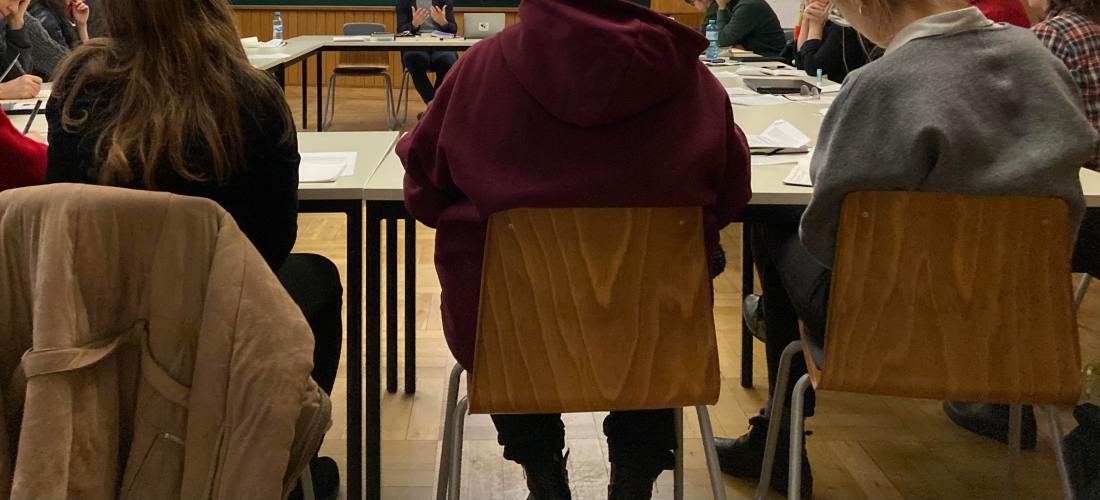
participants taking notes;
a slide with content creators from Nepal, Egypt and Ukraine on live video stream, from Guinan’s work “Portraits”;
snapshots from discussion between Mashhadi and Guinan (all photos by HHW.)

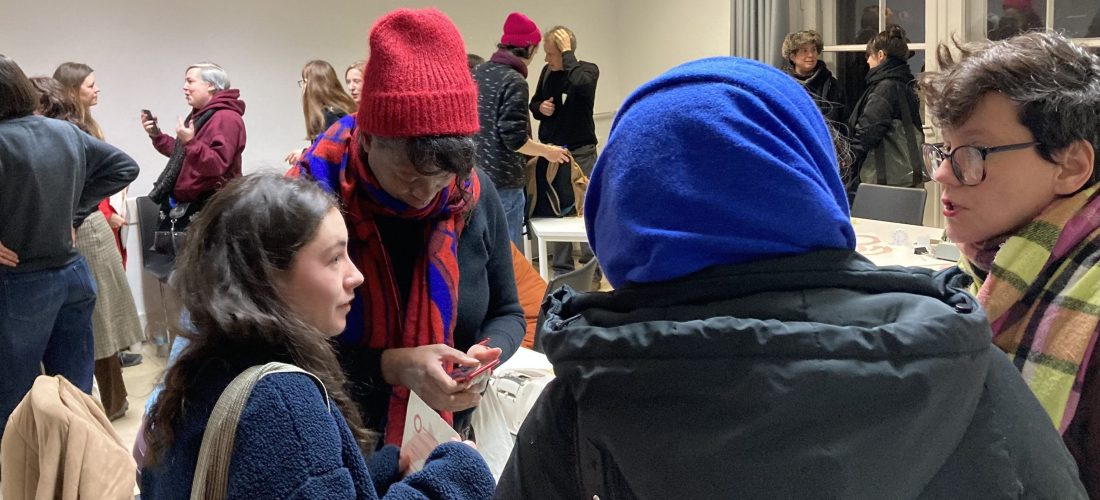
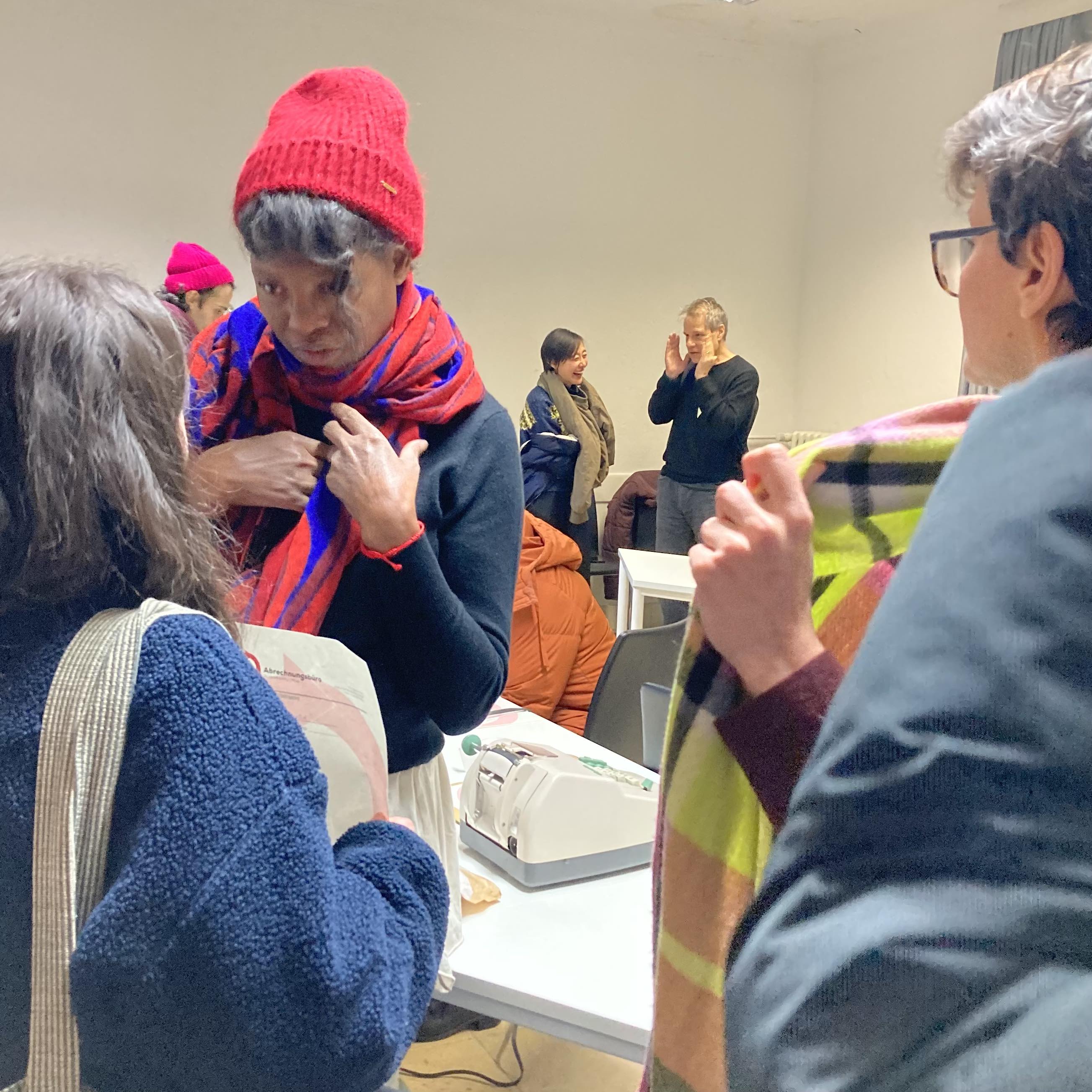
To complete this abundance of experiences and perspectives, we were finally invited by artist Jody Wood to calculate our Virtual Credits and Residual Guilt Reserve in her workshop Abrechnungsbüro – an engaging, thought-provoking and fun exercise, followed up by a conversation between the artist and philosopher-writer Lieke Knijnenburg. Aptly moderated by PhD student Sofia Attolini, it also involved participants, and continued well into the Berlin evening, during dinner at a nearby Chinese family restaurant…

Above: “Abrechnungsbüro” snapshots
Below: social practice artist Jody Wood and composer Olga Krashenko in following discussion
(all photos by HHW.)

…and we still have a full day ahead in this symposium. More to follow…

Duplicity / Duplicität Symposium (day one of three)

art, recent work, time-out

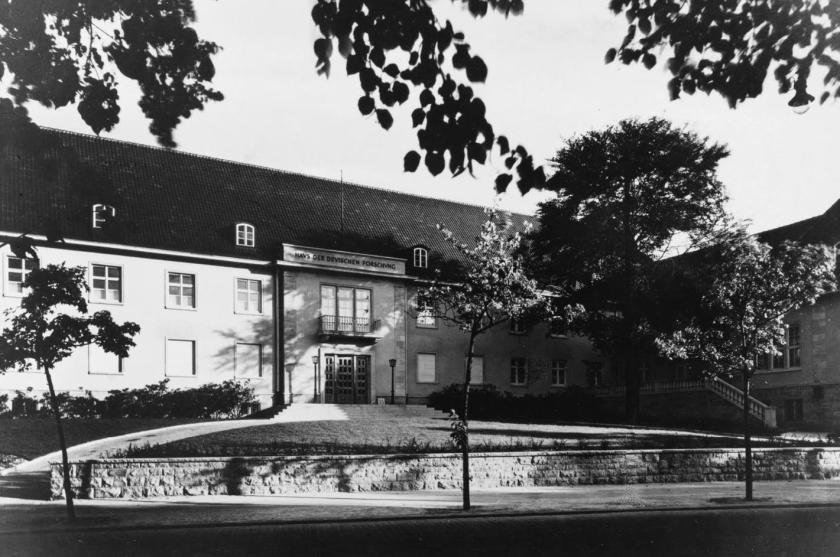
Time is almost 2 pm, and we’re at the Institut für Theaterwissenschaft of the Freie Uni. Berlin: a building once known as the Haus der Deutschen Forschung –  in the years of WWII containing a lecture hall and a library, a ballroom, a casino, fifty offices and an air raid shelter; and, according to journalist Ernst Klee, housing a “cover-up community”, where an enormous ‘degree of agreement between politics and science'” took place. 
Zur Geschichte des Instituts für Theaterwissenschaft

Today, on January 29th, 2026,
the coffee table is set outside the DanceLab, and name tags are waiting to be written and attached. People arrive, crossing the imposing foyer to find their way, continuing upwards via the symmetrical double staircases, heading for our more modest localities on the top floor. The footsteps and voices, the greetings and questions and answers tell of uncertainties as well as excitement.

Within an hour, we have welcomed most of our participants. It’s time to move; we’re going to the Berlin-Brandenburg Office for Everyday Culture, where the recently installed director Jonas Tinius will host the first session of the Duplicity symposium…

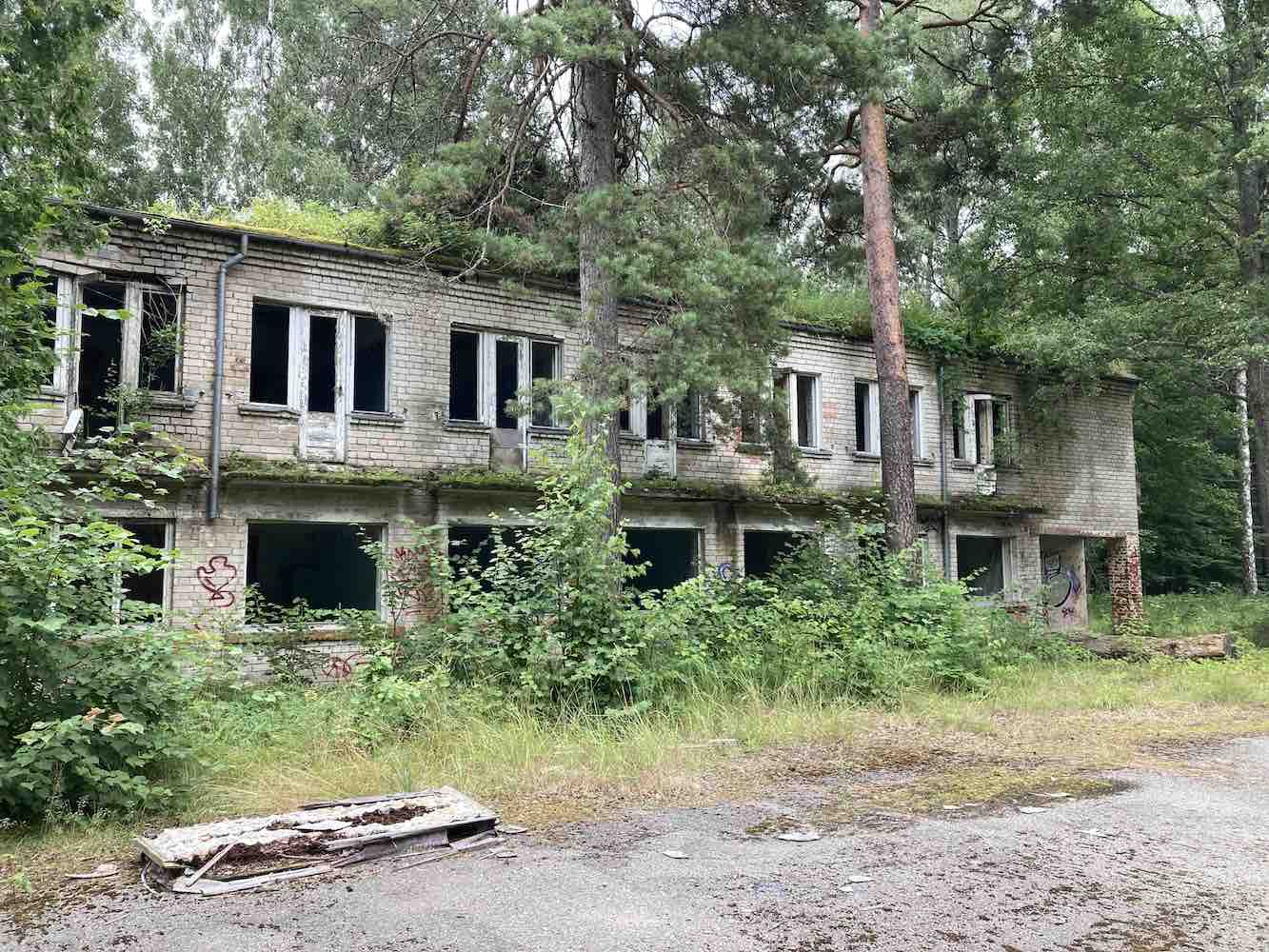
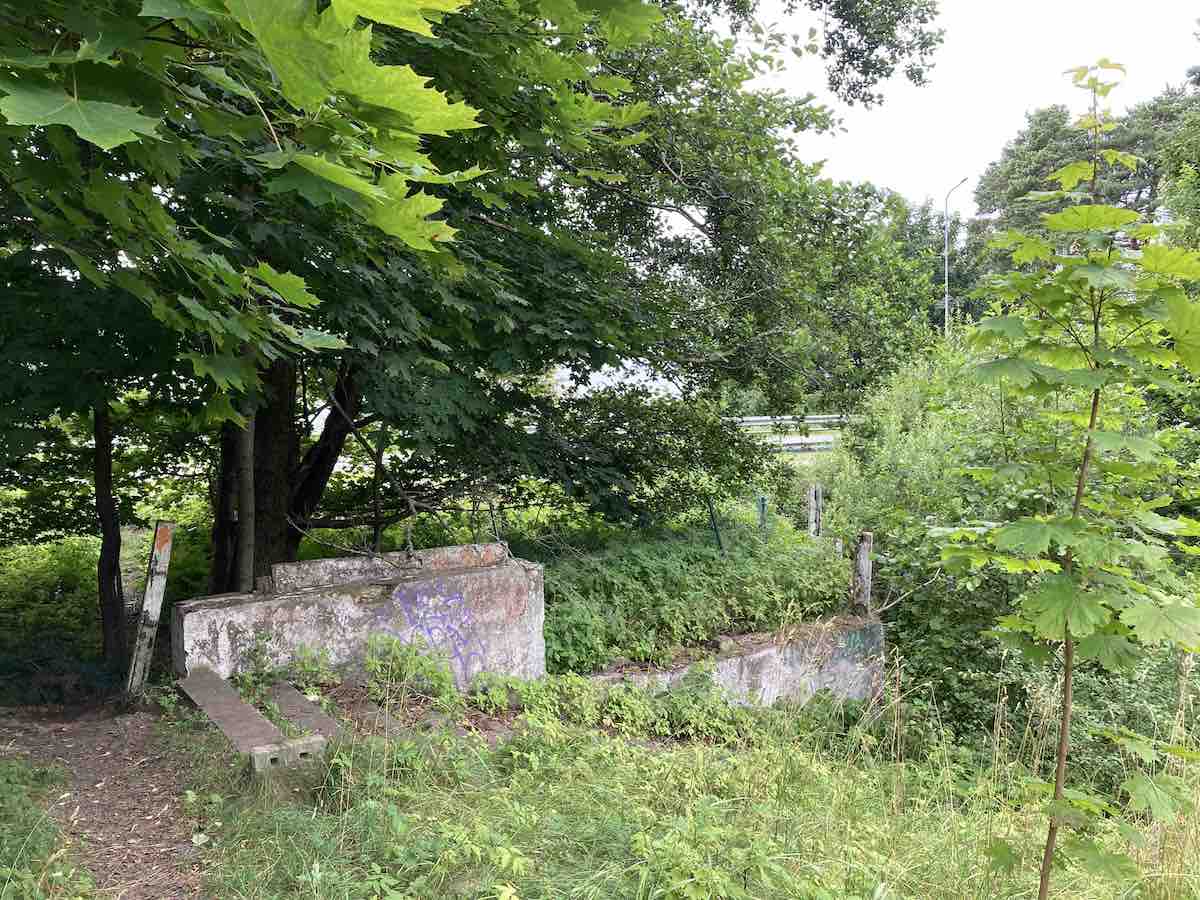
Due to EU General Data Protection Regulations, I’ll share only a few photos from the actual session here; Dr. Orlando Vieira Francisco (i2ADS Research Institute in Art, Design and Society, University of Oporto) presenting on Formenvielfalt-Farbenvielfalt: New Ecologies from the Museum to Artistic Research – an artistic line of thought, which (to my understanding) touched in a very personal way on the polarity between form and colour / drawing and painting / discerning and integrating… followed by Dr. Monica Tușinean (architect and researcher at the University of Stuttgart), sharing her work on post-communist industrial ruins in Romania – from which I borrow a slide (below). 

Slide with hare borrowed from Monica Tușinean’s presentation “Phenomenographies of Absence and Duplicity”


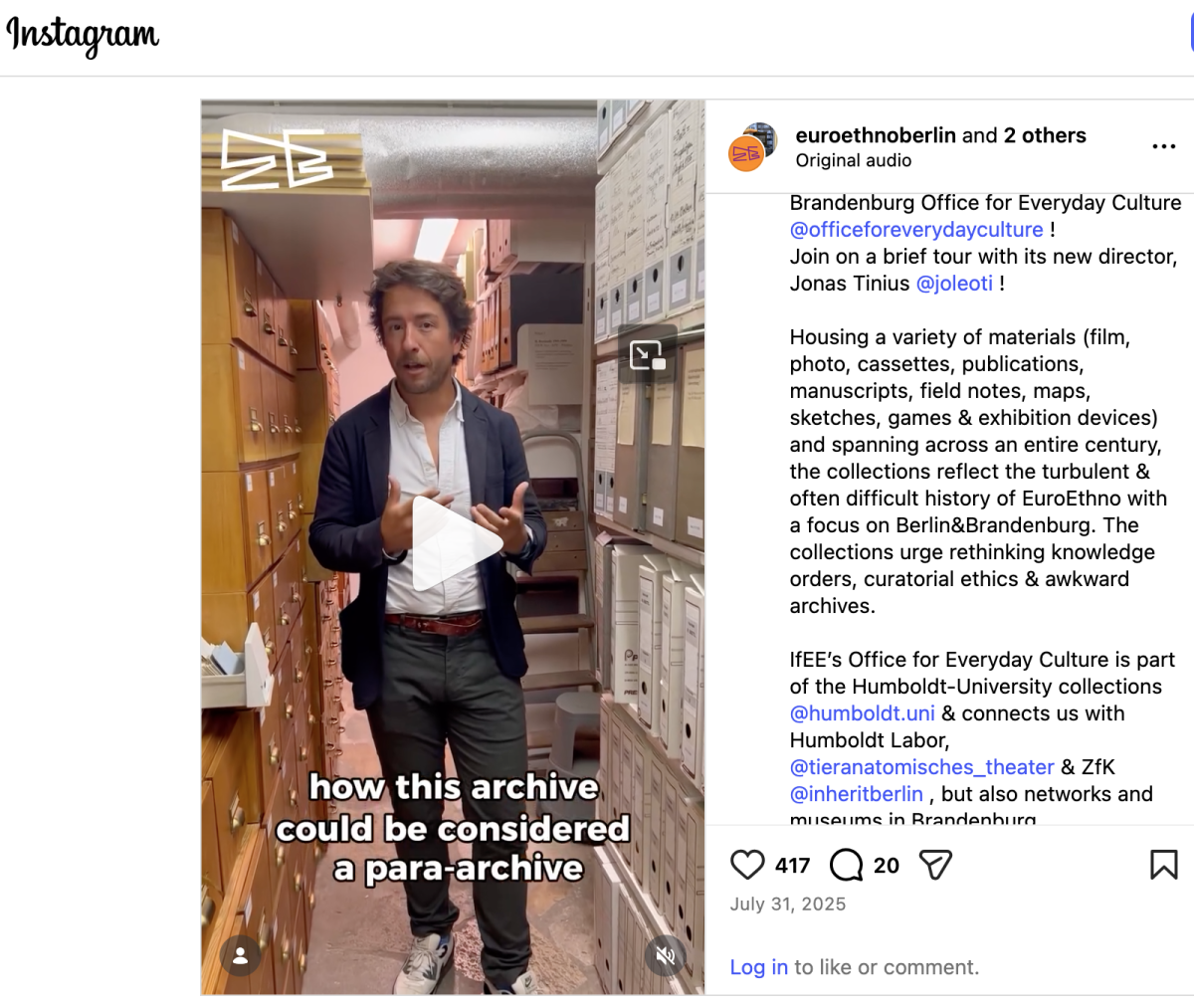
Dr. Jonas Tinius both opened and closed the panel, first by presenting the (Para-)Archive as a site for investigations into how archives come into being; and, eventually, by taking the whole audience on a guided tour in the Archive’s enchanting basement.

Click the link, and follow Jonas Tinius along on an earlier tour in the Archive’s basement:
euroethnoberlin Landesstelle Re-Opening! 

For those of us foreseeing (and lucky) enough to have reserved a space, the evening continued in a Wedding apartment with performance artist and cook Joël Verwimp’s In-home dinner and artist presentation WHEN IS A SHIRT? Collective Futures of Fascism.

This slideshow requires JavaScript.

Joël Verwimp, “WHEN S A SHIRT? Collective Futures of Fascism” performance
Photo credits: Essi Nuutinen

Duplicity / Duplicität Symposium (Day 0)

art, time-out, upcoming

After a final round of proofreading, the whole batch of programmes is printed out; and so is the letter that will be read out loud to accompany Joël’s in-home performance tomorrow. Coffee, tea, snacks and fruit are purchased and brought to the Freie Uni. Signs showing the way to all locations are made and printed, and mounted on doors and signposts inside the building. The nametags and pens are ready for use. Joël has done his shopping, too, and now prepares the performance dinner.

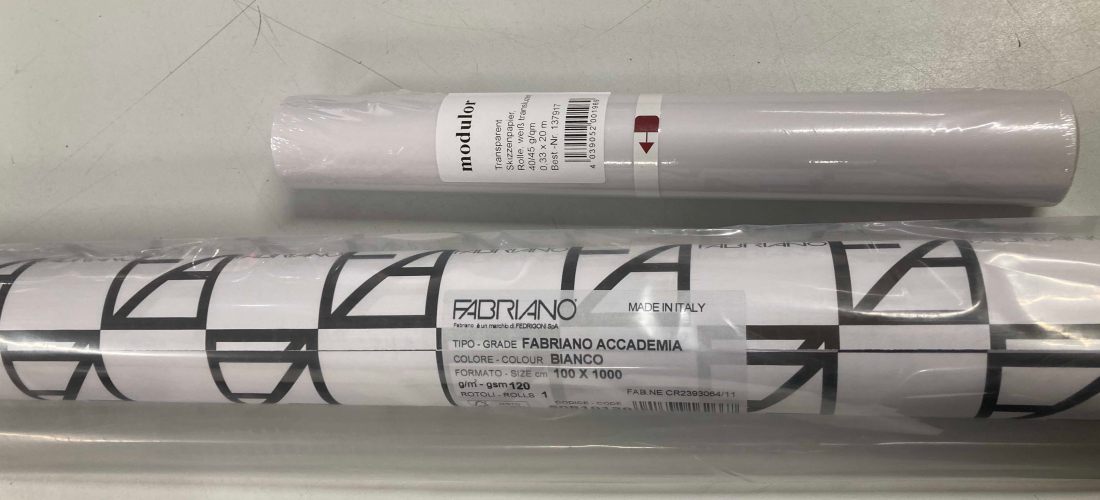
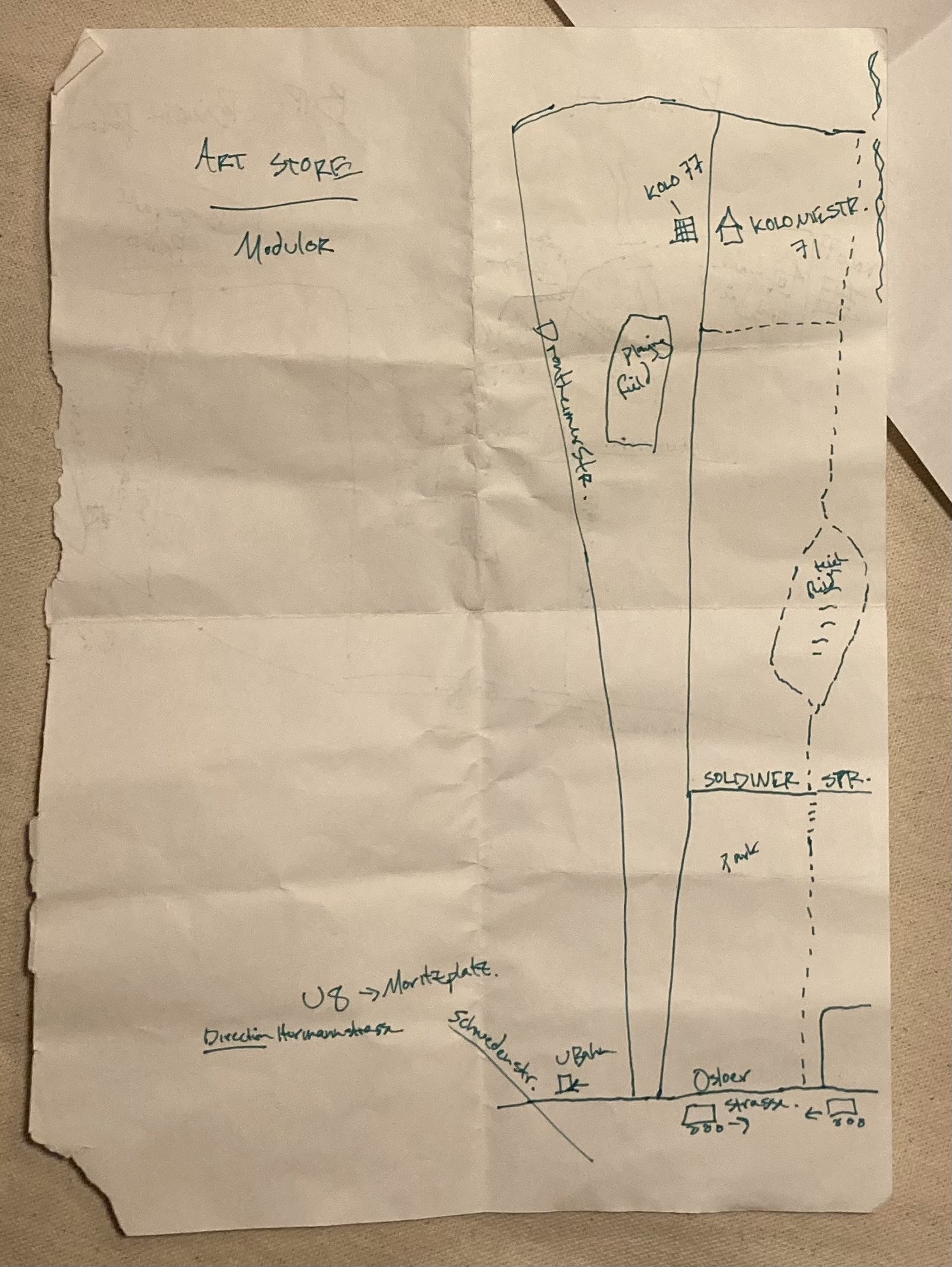
One more thing: Monica’s workshop requires two rolls of paper; one normal drawing paper, and one transparent, the kind that architects use. Tinka and I head out in the city to find it; it’s already dusk, as we slip along a rivulet through an area of allotment gardens. We find the store and pick up the paper rolls – Monica confirming over the phone they’re the right ones – and then start on our way back… but in our excitement, we keep walking on and on, missing a left turn and crossing the river before we find ourselves back on the map again.

This city of Berlin – in itself a cluster of townships, gathered around the river Spree and her smaller siblings, sprawling out towards the lakes and wetlands – may be more imbued with history than any other place I’ve visited. Also, much of what I remember from central Stockholm in the 1960’s and 70’s  is still present here; the small backyard workshops and industrial buildings; the old, sometimes (not always) dilapidated houses with stone tilings, glass mosaics and flights of stairs disappearing into darkness; the ruderal spaces – neither parks nor gardens, but tiny spots of wilderness living on by their own – and the geographical proximity between vastly different urban structures and communities, that one may experience in just passing from one block to another.

Yes, a long and busy day… and tomorrow, it will begin for real.


Duplicity / Duplicität Symposium (Day 00)

art, upcoming

Tuesday morning begins with breakfast at Lindsey’s, then a slippery walk on pavements all covered with black ice. Yesterday, S-bahn trains were cancelled due to ice on the tracks; today, luckily, they’re back in traffic. The trip from Wedding to Steglitz takes approximately 40 minutes, then another walk from Rathaus Steglitz to the Institut für Theaterwissenschaft at Freie Universität Berlin. Here, the sidewalks are carefully sanded since our path coincides with the direction to a meeting point and facility for the community of blind Berliners. Gratefully, we trod along following a gentleman finding his way by help of the white stick.

This is my first visit to the Freie Uni. (and, in fact, to Berlin). I try to make myself familiar with the venues booked for the symposium, as Lindsey prints the first copies of the event programme. It’s difficult to imagine that all these things are actually going to take place here; that all these people will soon show up in person… Still two days to go.

For the afternoon, I decide to visit Haus am Waldsee further out in the Southwest part of the city, to see the exhibition we’ve added as an option for Sunday’s programme: Weathering by Beverly Buchanan.

Leaving the Freie Uni, I see a man writing something in the snow covering the windshield of a yellow car, then continuing to the next one to leave another message, before he strolls on along the road… Arriving at the Rathausplatz, I realize today is January 27th – the International Holocaust Remembrance Day. 

The Haus am Waldsee turns out to be a museum of modest proportions, a patrician villa within a large English garden, dedicated mainly to contemporary art since 1946. The ongoing exhibition – works by Black American Artist & Diva Beverly Buchanan (1940-2015) and London/Amsterdam-based artist Ima-Abasi Okon touches me deeply. Buchanan’s equally headstrong and compassionate way of moving forward as an artist, bringing forth the dignity of vernacular architecture in rural US Georgia (and thus, of its builders and dwellers) and carrying out toilsome projects rooted in experiential understanding of power structures and history; paired with the walls painted by Okon with bee pollen soaked in water, in a colour floating between dirt and gold, and conveying a heavenly scent through the light-filled spaces.

This slideshow requires JavaScript.

In the evening, Remoteness team member Tinka arrives from New York City and we move into the hostel apartment that Lindsey has provided for us. Tomorrow will be a busy day…

Duplicity / Duplicität Symposium (Day 000)

art, recent work, upcoming

Still a couple of days to go before the opening on Thursday. Preparations…

This slideshow requires JavaScript.

Ice on the tracks delayed train traffic throughout Denmark and Germany yesterday, and offered plenty of time to make name tags from scrap paper and safety pins.

Finally, a warm welcome and a tasty meal in Berlin, followed by the final (?) proofreading of the symposium programme.

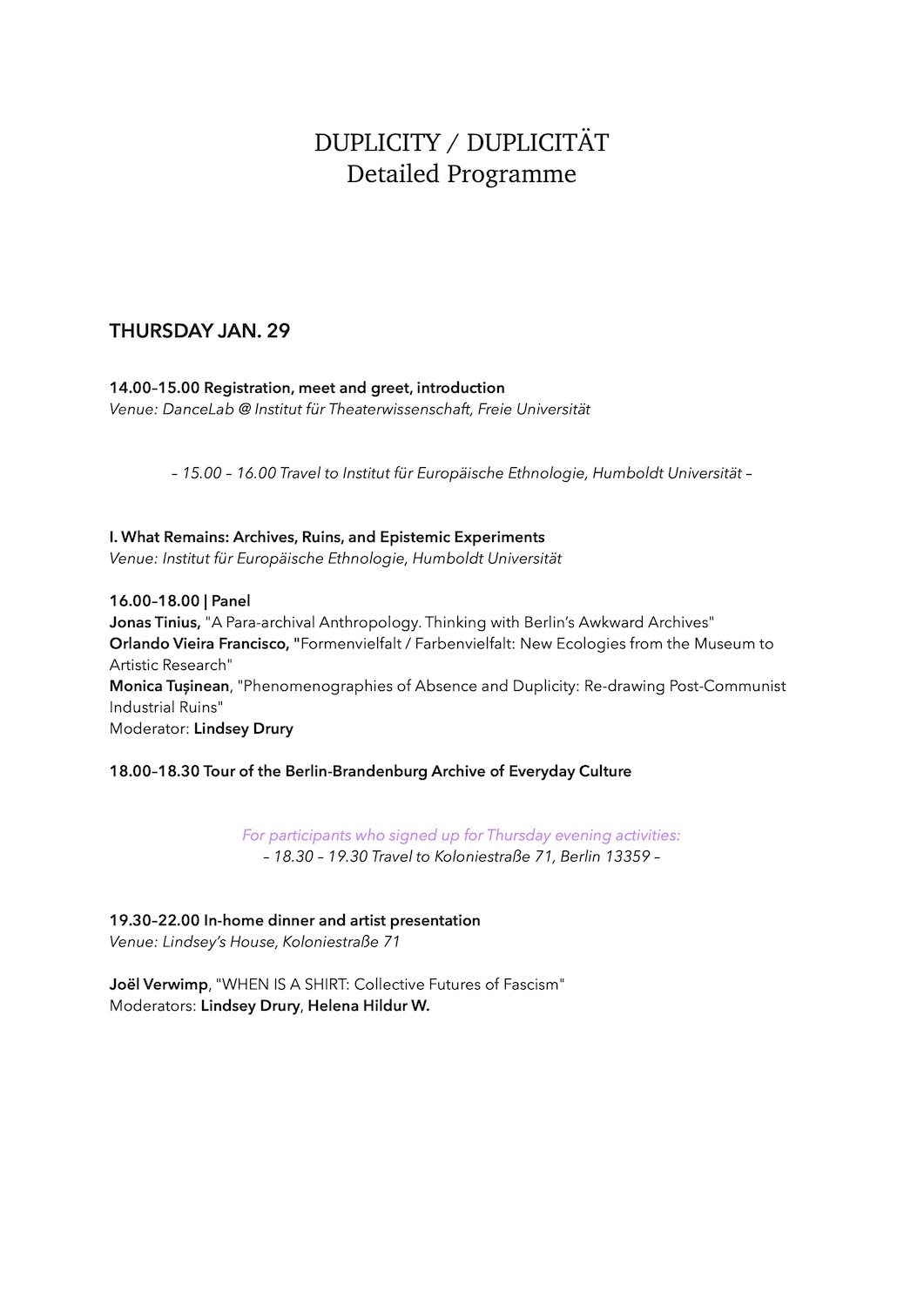
Download the full programme here:
Duplicity/Duplicität Winter Symposium Programme

Looking forward: 2026

uncategorized

Looking forward, I see hope.

No matter how chaotic, violent and confusing the present, the Earth still travels with the Universe. Snow still falls in the North – sometimes. Birds come to the feeder.

I am connected to people living under conditions of war, of oppression and of poverty; they resist. As long as they do, I cannot give up.

I see acts of care and kindness. I have the freedom to support others; to contribute to my neighbours, to the human and the more-than-human.

I see hope, like the full moon shining in the winter night; like snow lightening the darkness; crystallizing swiftly like ice fractals.

2025: Looking back

art, painting

Looking back, I see the flow of time. I light a candle in the stillness of the winter night. Countless starry points shine back at it from inside my heart, connecting me with somebody just across the road, as well as with other, more faraway places… with Stockholm, Fulltofta and Toulouse; with Kyiv, Järna, and Ermetzhof; with Bengaluru, Berlin, and New York; with Tyresö, Tokyo and Turku…

A constellation of love, friendship, creativity and care.


January: the past year began with the maps of Robertho and Frank finally completed. I was invited to write an article on the Mapping Praxis project, for a “special issue” of an art journal, and took it as an incitement to collect my thoughts on maps and mapping.

*

February: with the mapping text more or less finished, I realized that the journal that issued the invitation might not be quite the high-standard scientific publication that it claimed to be. In the end, I decided to withdraw the article, to instead take up the more rewarding work of making another map… This one, again, presented me with new challenges. The story of “I” – my partner in dialogue – was layered in ways that the preceding ones weren’t; I chose to add an underlying lining, visible only in certain places; and to insert “zoom-in” spots, using the sketchwork that “I” had provided me with during our first conversation. It took quite a few tries, and some emailing, to make the map resonate with the emotions and conceptualizations of my conversation partner.
And on February 22nd, I had the honour to meet street artist Gamlet Zinkivskyi from Charkiv on one of his sparse visits outside Ukraine – giving an artist talk at the “Ukraine Culture Now” event.

*

March: in the first days of the month, the Praxis of Social Imaginaries study circle held its last gathering at the Sigtuna Foundation. Parallel with reading and discussing Olaus Magnus’ A Description of the Northern Peoples, ideas of how to launch a continued study circle emerged from informal conversations…
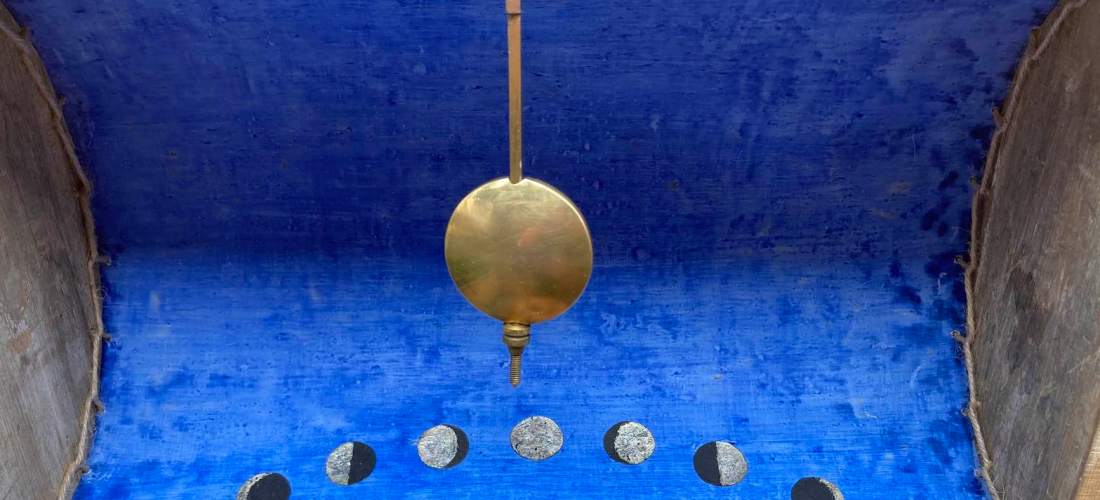
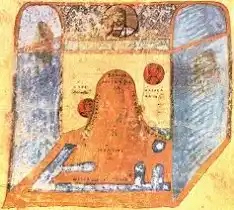
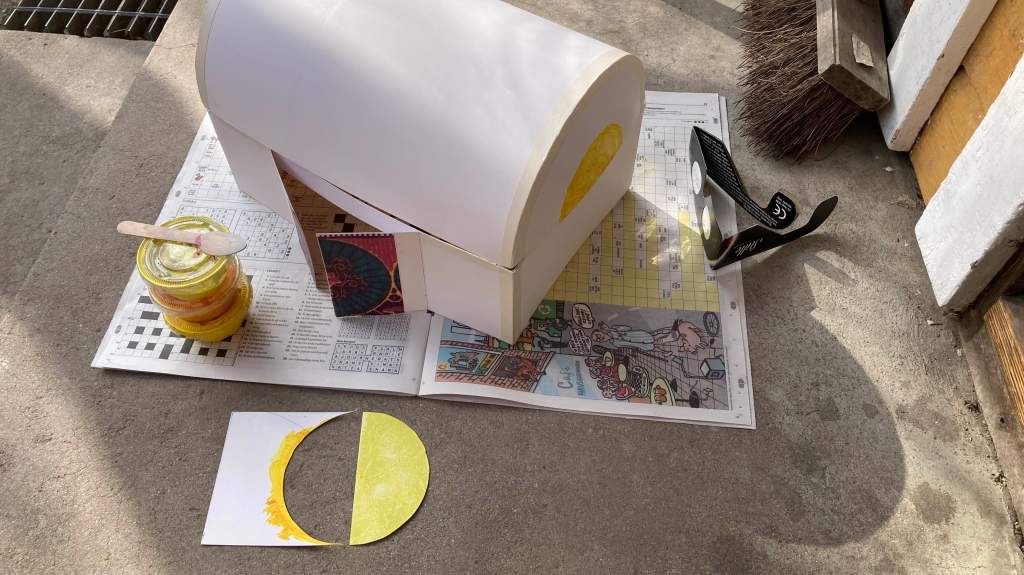
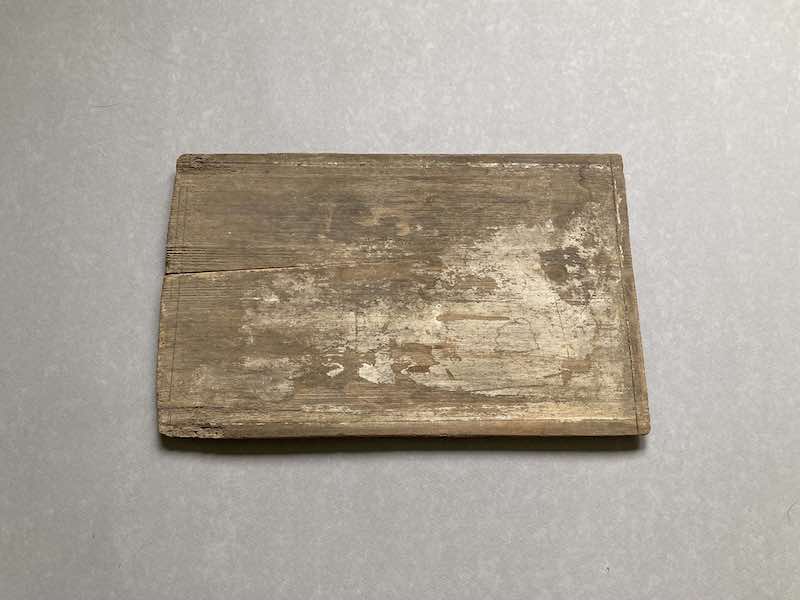
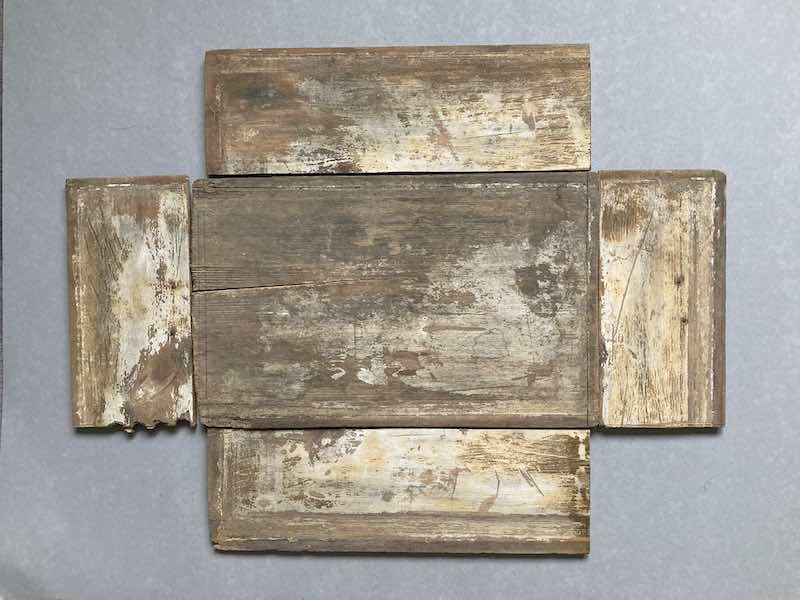
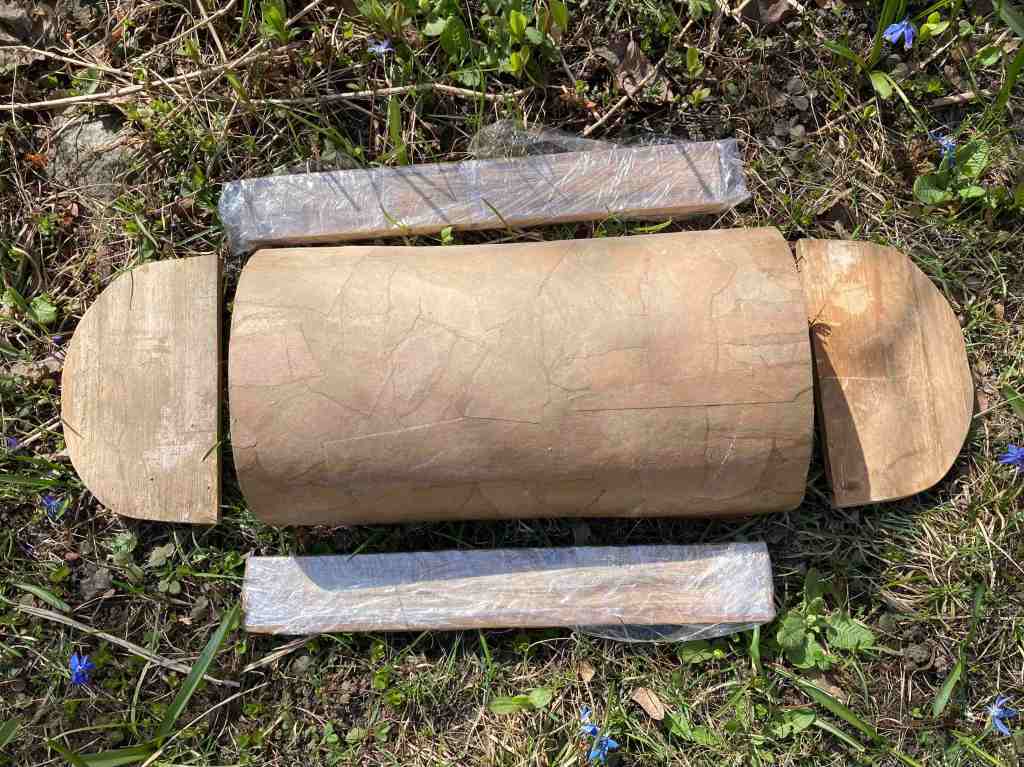
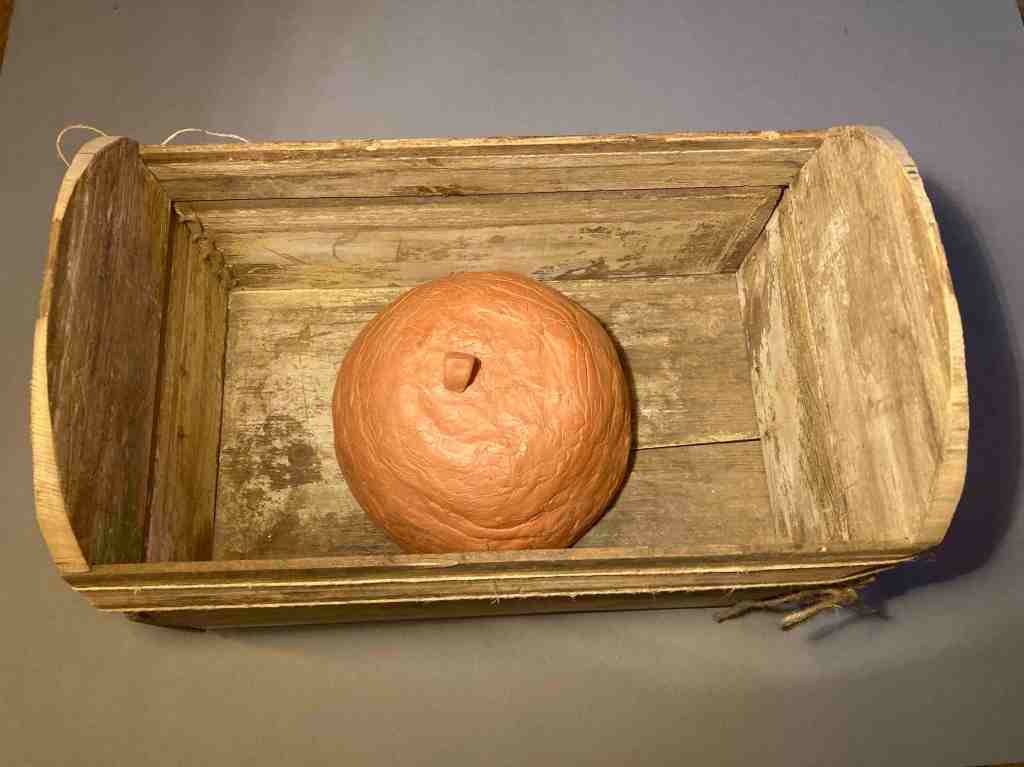
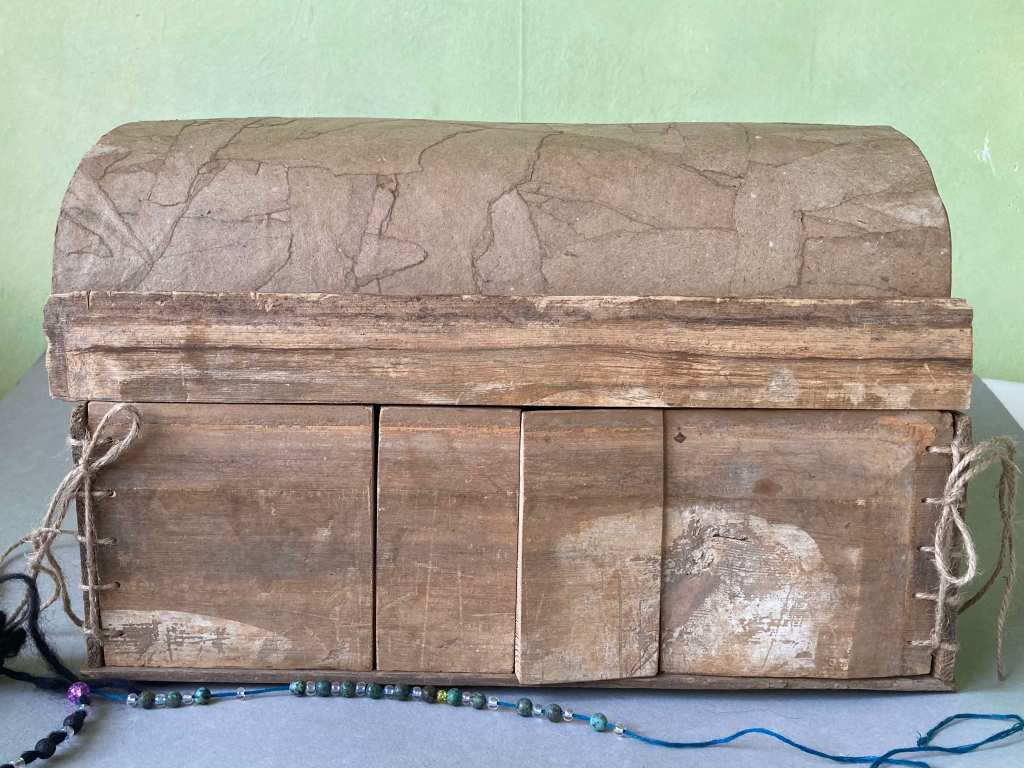
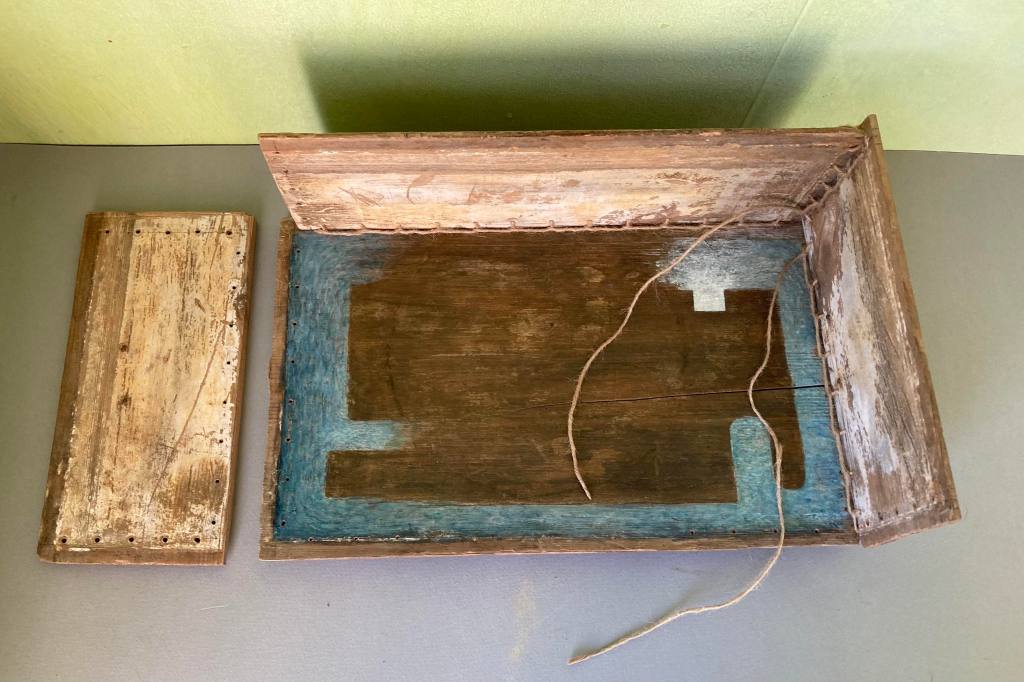
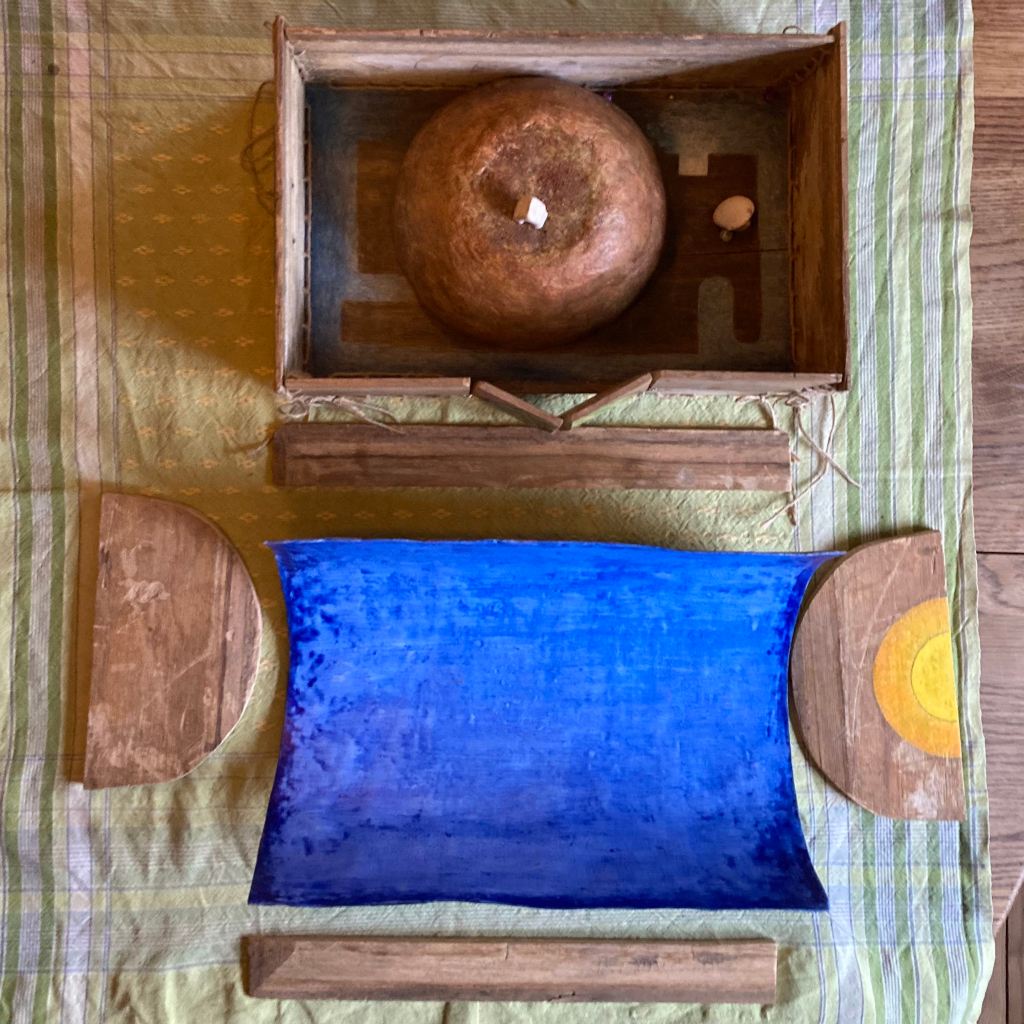
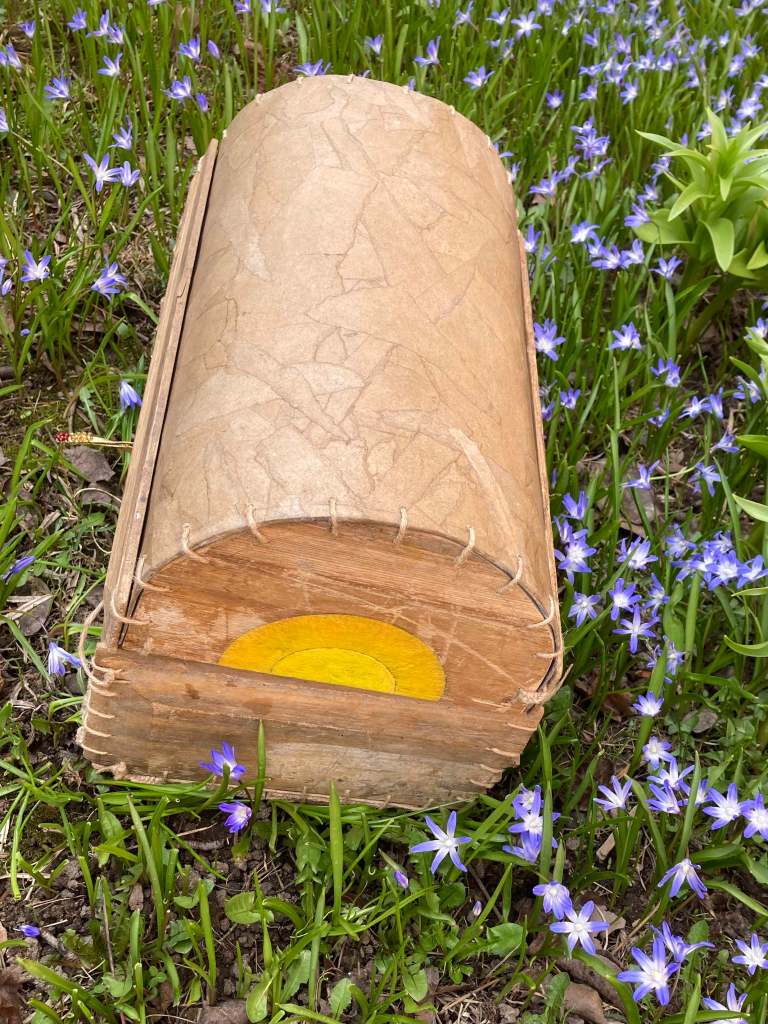
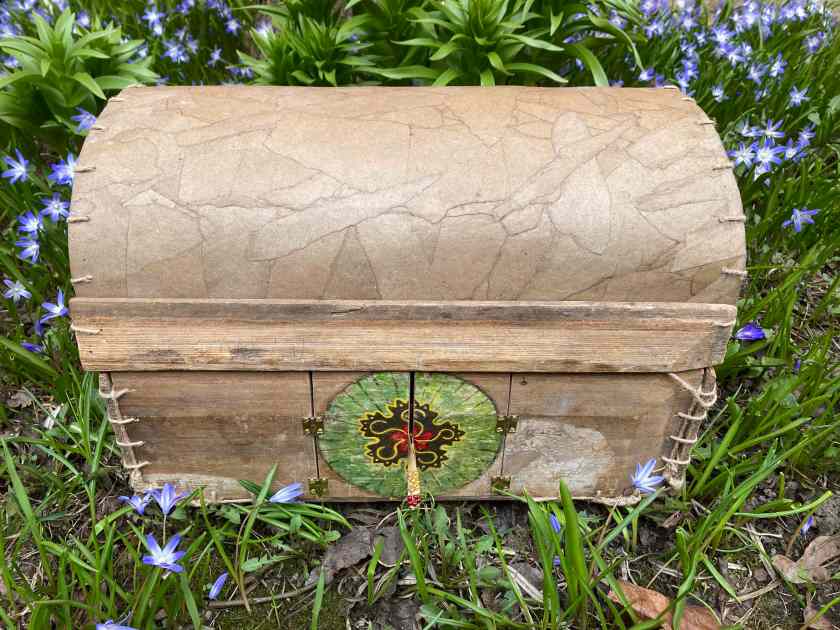
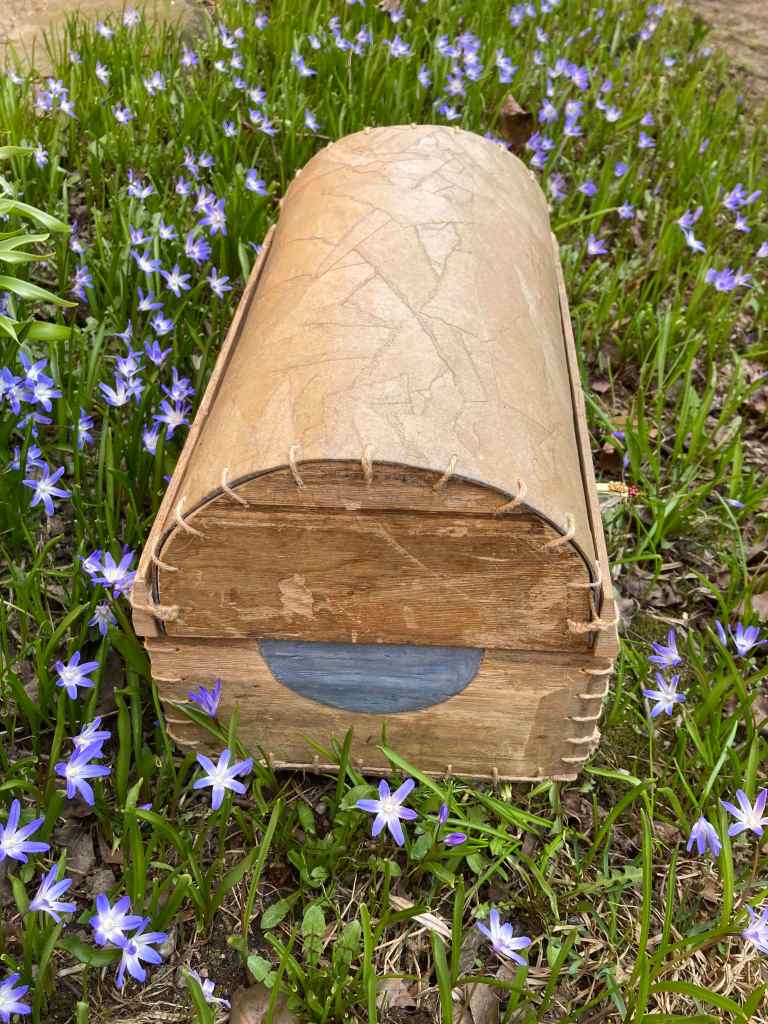
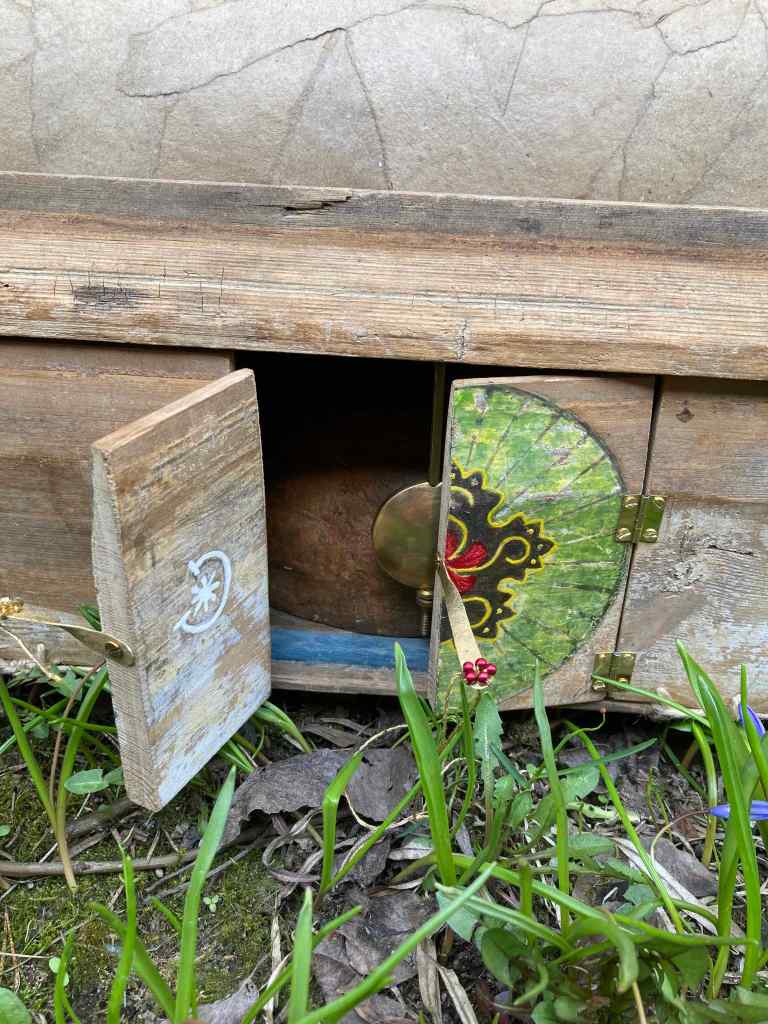
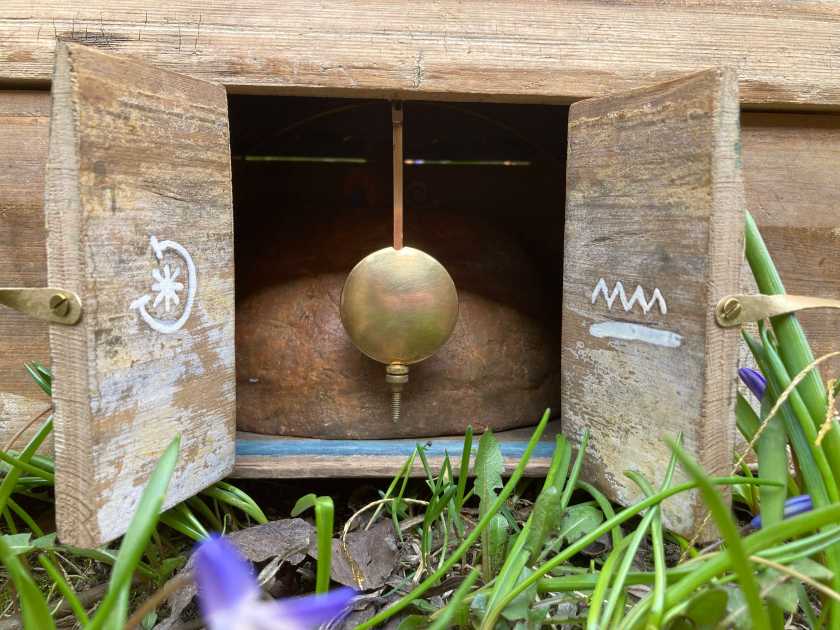
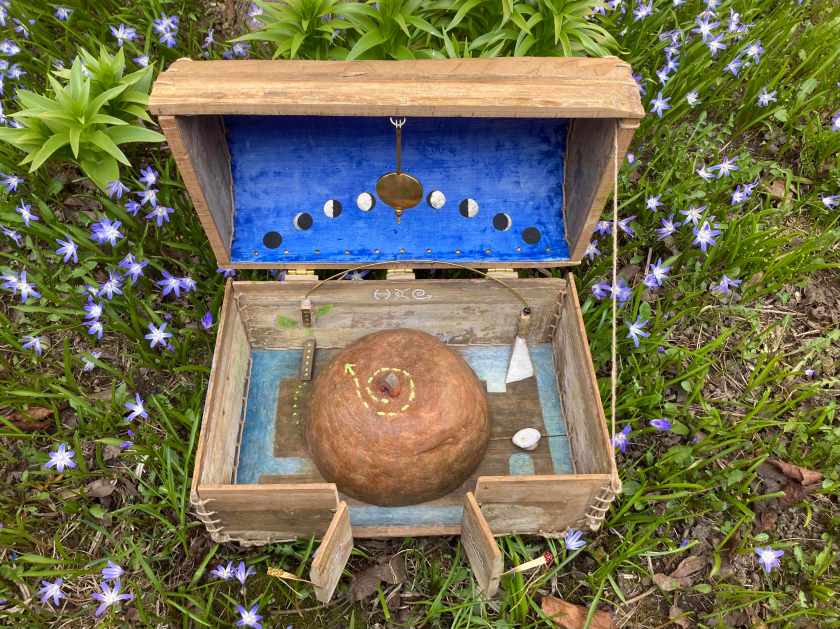
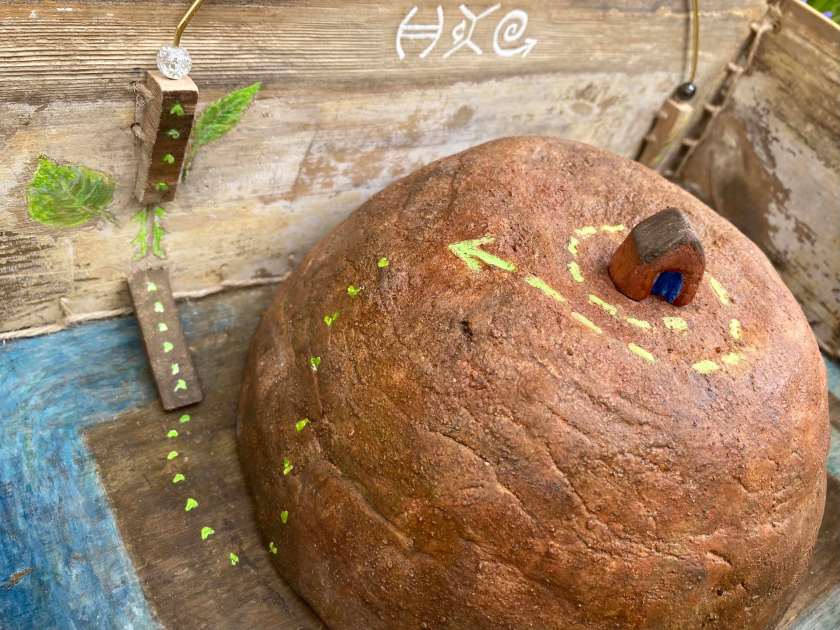
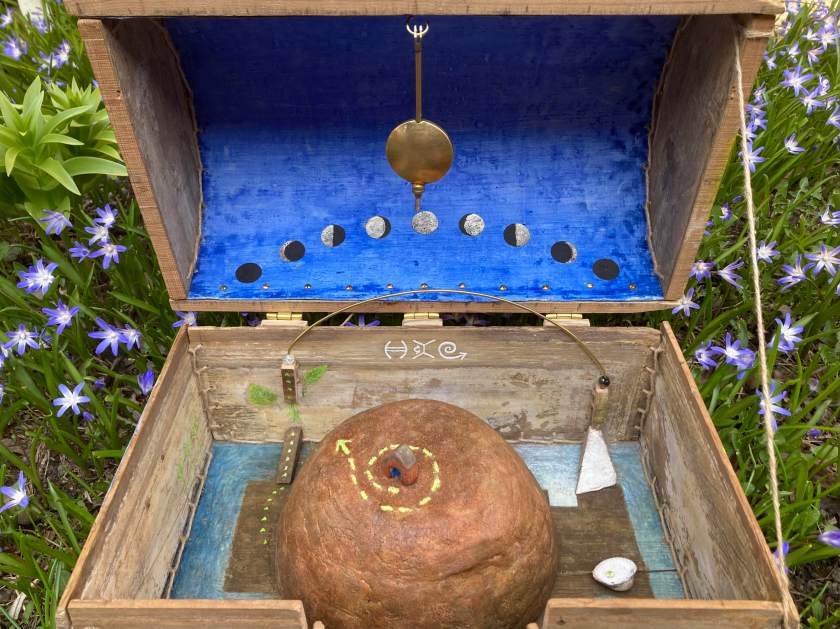
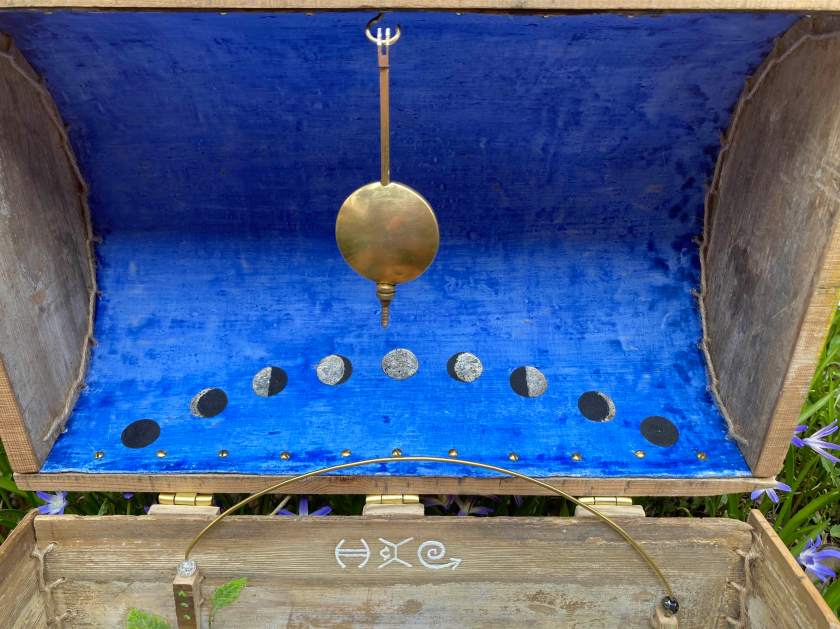
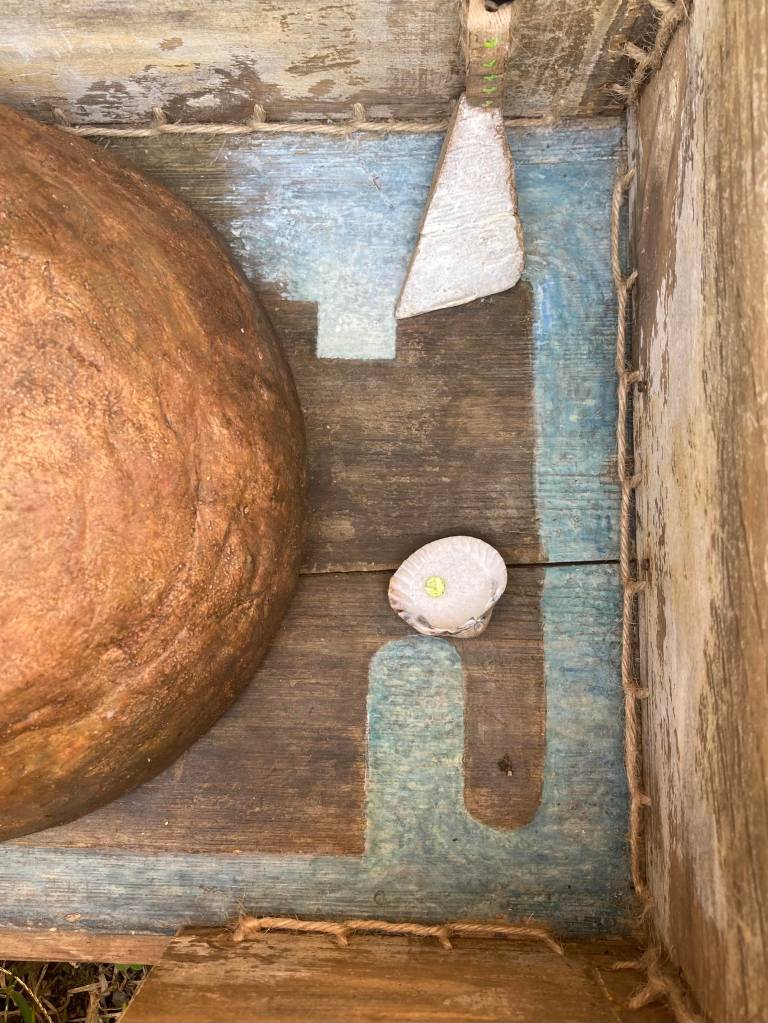
On the last day of the gathering, I was approached by fellow participant Titi, wanting to share her story for another embroidered map – a task that I happily welcomed. I also had the opportunity to reconnect with Obinna, and ask him some complementary questions about his itinerary (which was now next in turn for a visualization). This time, the challenge came explicitly from my partner in dialogue: Obinna’s map had to be a three-dimensional one, since his native place is in the mountainous parts of Southeast Nigeria. Recalling the chest-like world model of the 6th century traveler and Christian monk Cosmas Indicopleustes, I immediately began working with it on returning home. A partial sun eclipse happened on March 29th, and I could watch it while making a cardboard maquette… which sparked the idea of “half a yellow sun” on the gable of the chest (I then hadn’t read the book with the same title by Chimamanda Ngozi Adichie).

This slideshow requires JavaScript.

*


April: a six weeks’ teaching commission began, leaving little time for the Mapping Praxis project. As spring flowers came to bloom, I managed to make the vaulted papier-mâché lid of the chest, though.

And to learn to know the folk high school class was – as always – a joy; this type of education very much promotes care, curiosity and collaborative approaches… My presentation on the institutional theory of art (aka the art world theory) was met with immediate and creative response.

*

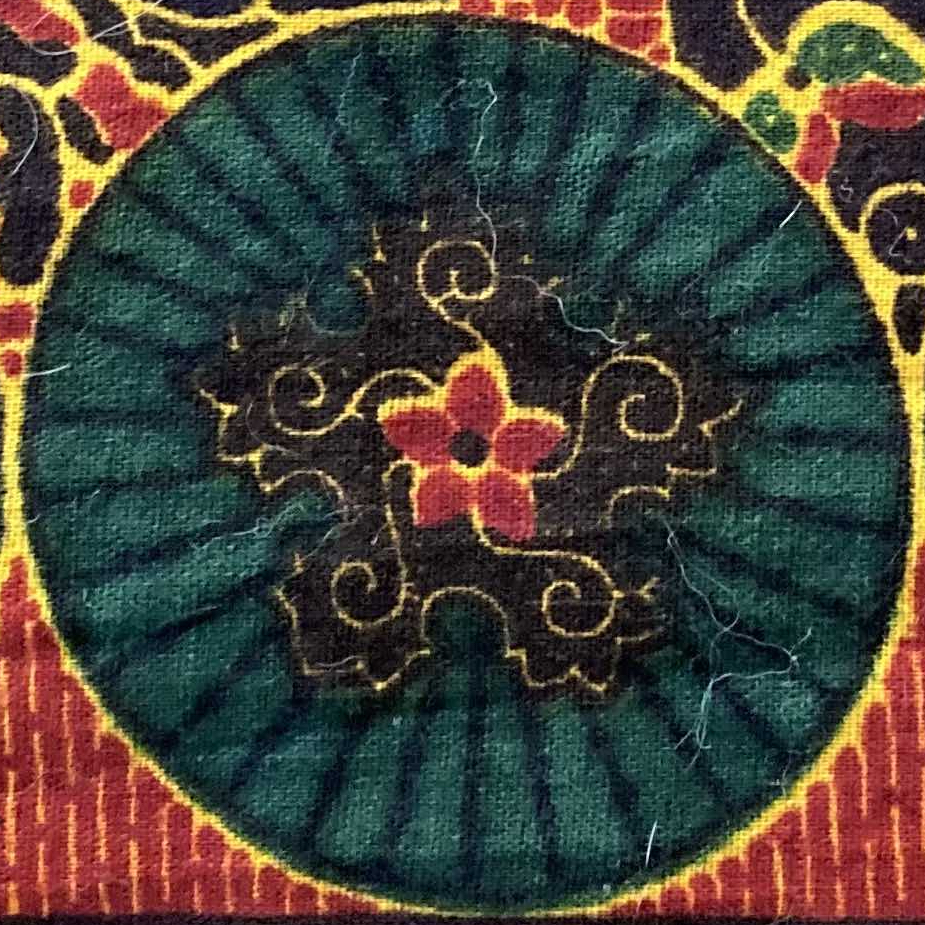
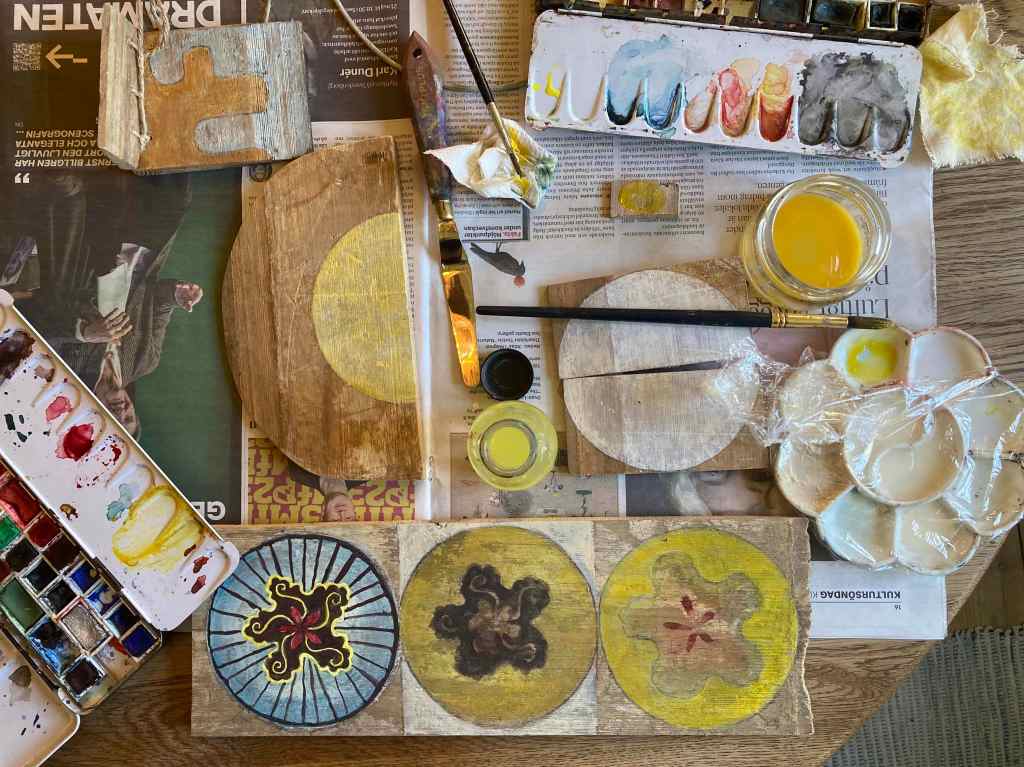
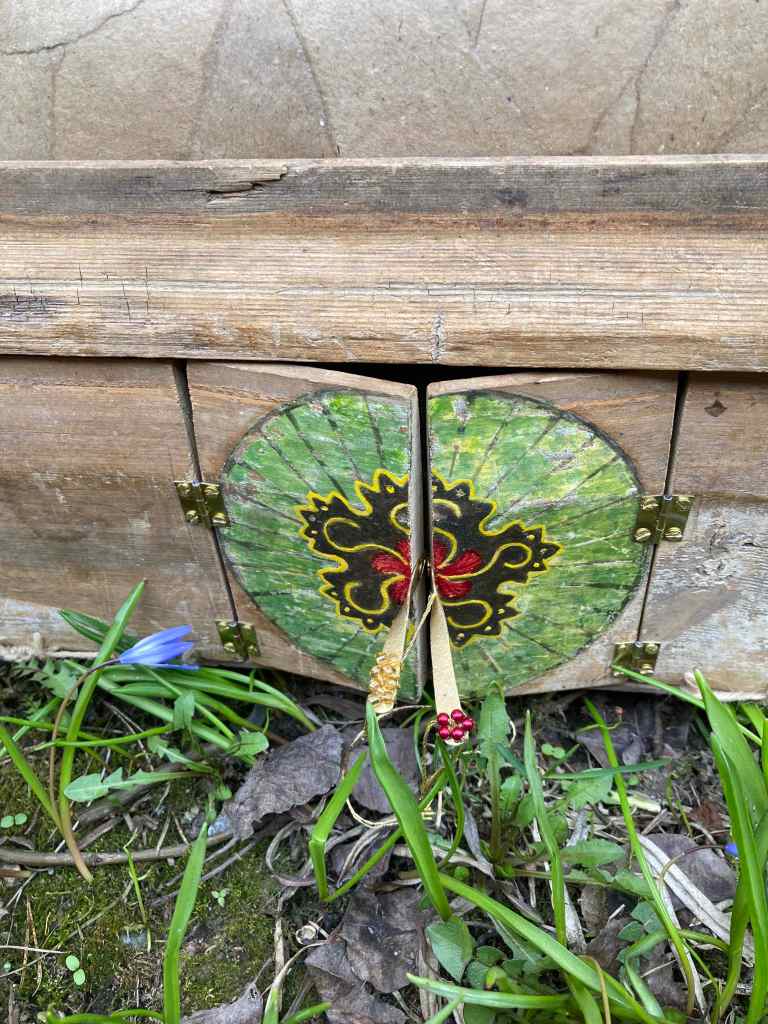
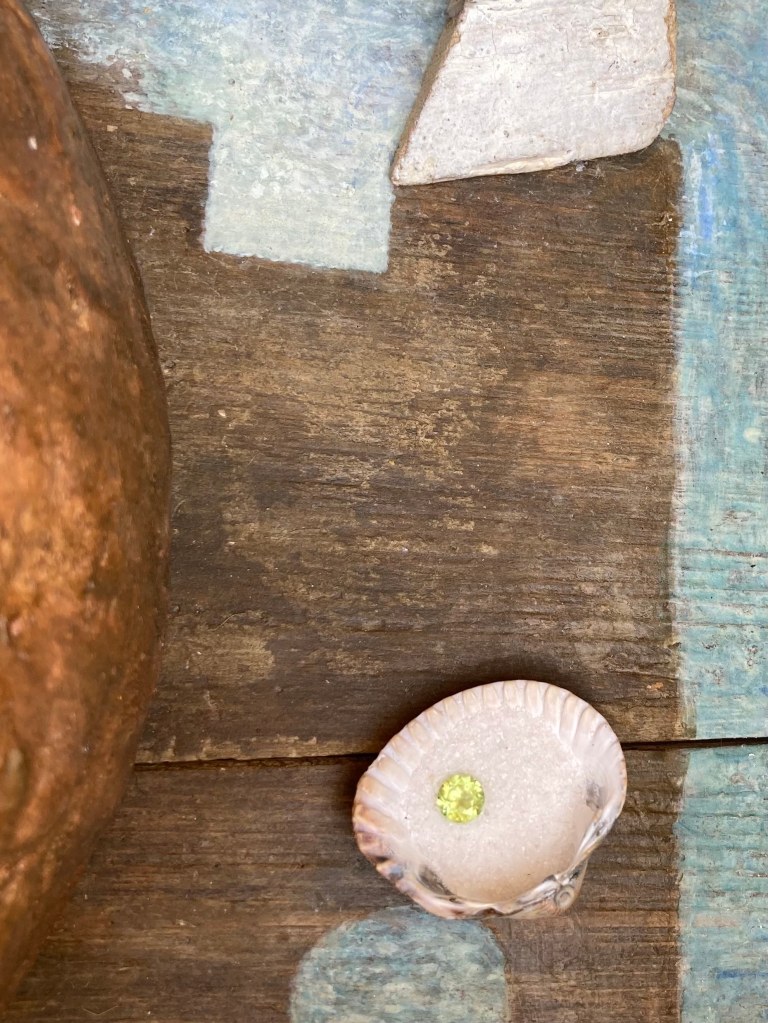
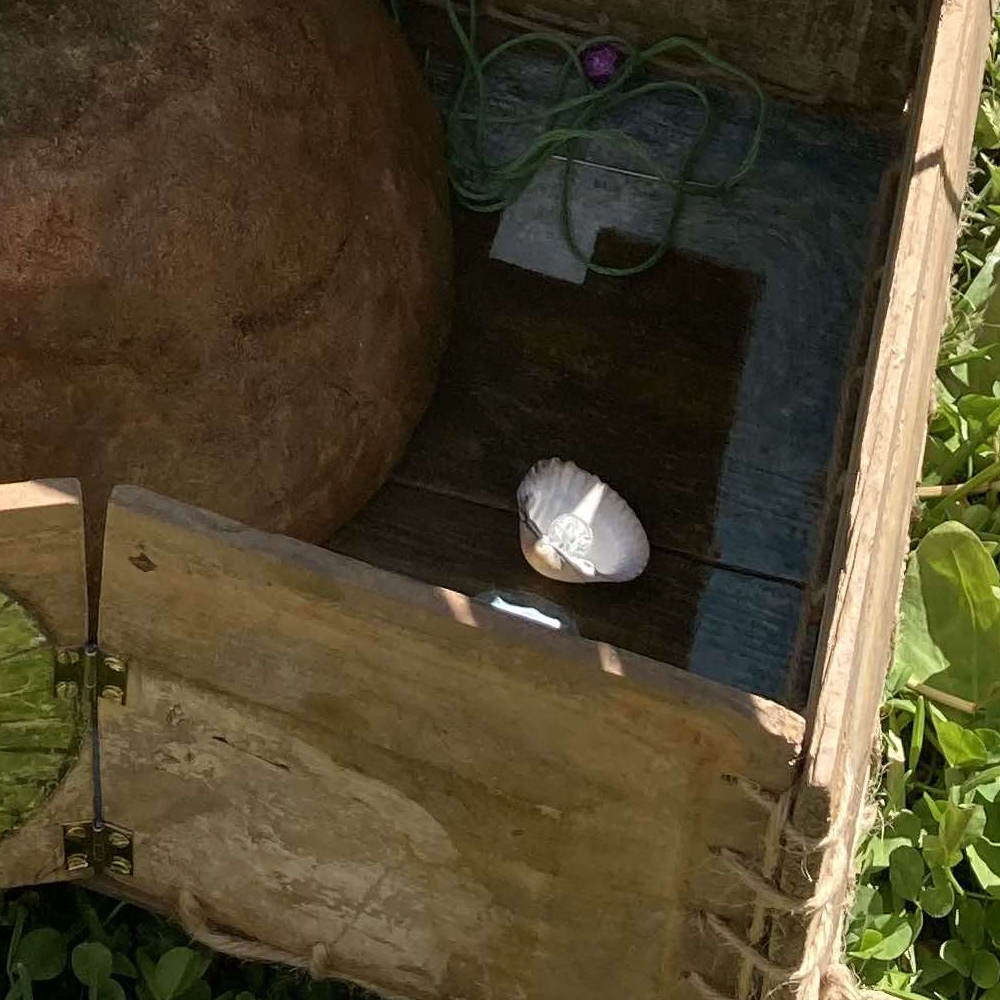
In mid-May, the teaching commission was finished, and I could go back to the mappings. Now Obinna’s chest was assembled, and a 3D mountain was made to fit inside. I decided to use egg tempera for the painting, and tried out a floral design, borrowed from an African textile and reminding of a hibiscus flower. It turned out that Obinna highly approved of Chimamande Ngozi Adichie’s novel – and so, the sun was there to stay on his map.  
As the planning for a continuation of the Praxis circle proceeded, I also attended Researching Imaginaries;  an online lecture programme launched by the Centre for Art and the Political Imaginary at HDK-Valand (Gothenburg University) and the Royal Institute of Art (Stockholm). The programme stretched over five days, presenting interfaces between politics and contemporary art ,explored by artistic researchers from Eastern and Southern Europe as well as the Nordics.

*

June is a very busy time in the garden. Nevertheless, the lid of Obinna’s chest got painted, too – in lapis lazuli blue.


*

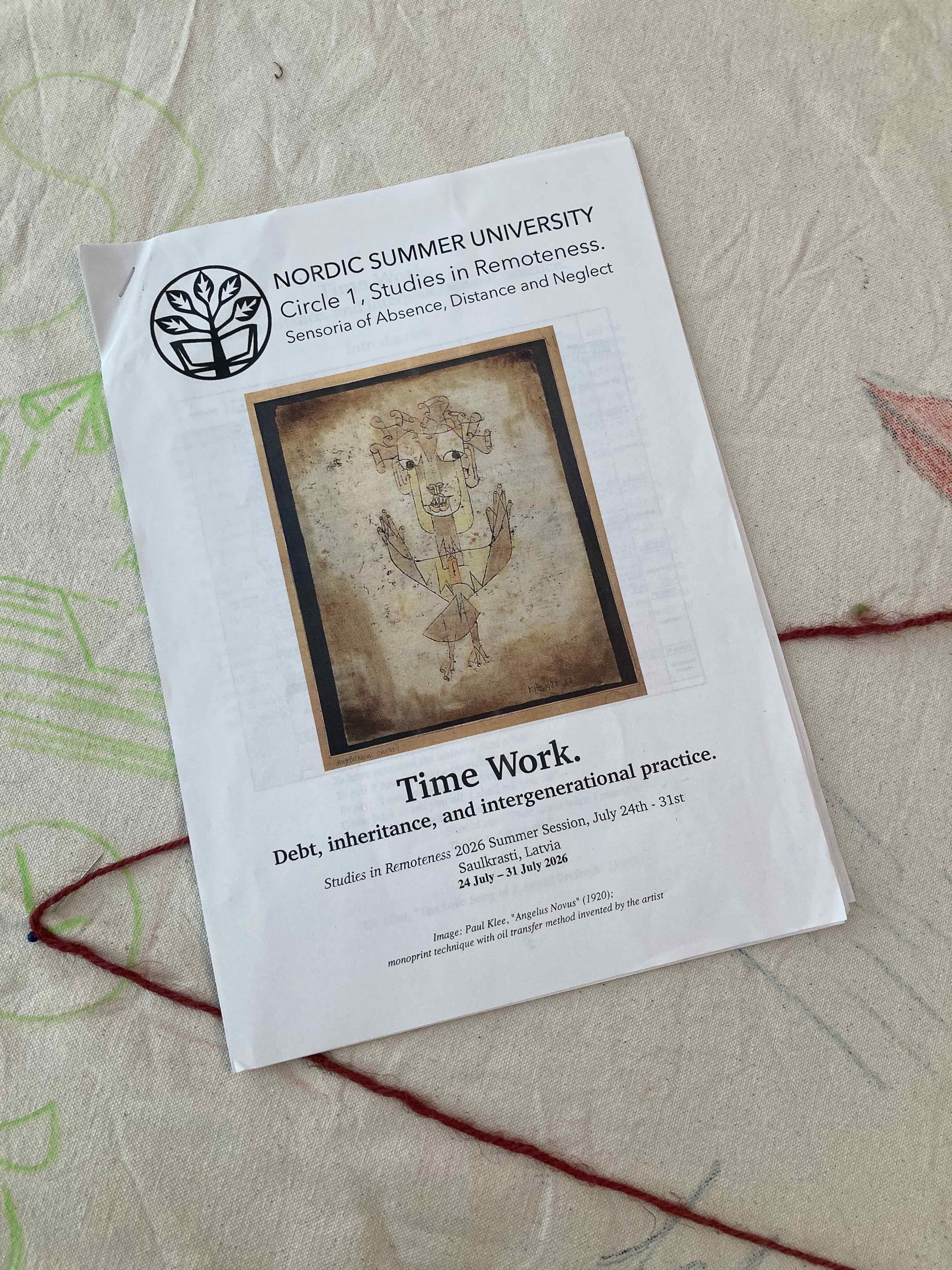
July: traveling to Jyväskylä for the Nordic Summer University Summer session 2025, where our proposal for a new study circle, under the title of Studies in Remoteness, was finally presented. Initiated by Dr. Lindsey Drury and the working team in early March, the proposal now got approved by the NSU Board, and by the General Assembly of NSU members on July 26th. Along with Lindsey, I found myself study coordinator for the three coming years.

*

In August, I took a day in Åbo / Turku, to meet again with Obinna, Titi and Dorcus of the Praxis circle. Returning home, I had gathered more information to be visualized in the Mapping Praxis itineraries. I could also improve “I’s” itinerary with some tiny animals made out of wood… and finish my reading of Half a Yellow Sun.

*


September: the lapis lazuli lid of Obinna’s itinerary somehow called me back to studio painting; I took a couple of weeks off from the
Mapping Praxis project, and spent time with a blue / orange Human Being Image.

*

October: the Remoteness team was gaining momentum, with bi-weekly online meetings. It remains the working group, where study planning and connected tasks are constantly processed; meanwhile, the executive bits are mainly the work of coordinators. In October, we published our very first Call for Participation for the 2026 Winter Session – a three days’ symposium set to happen in Berlin in late January.
The last days of October – during the autumn break – I spent in Igelsta primary school, doing maintenance work on Star Roads, the commission I had for the city of Södertälje in 2018. Seven years later, there’s still no deliberate damage done to it, but quite some wear and tear. (After all, these kids are teenagers!)

The autumn break stretched into the first days in November, and I worked through the weekend to finish my work before school started again. Unexpectedly, I found myself sharing the space with several dozens of young basket players – as it turned out that the city of Södertälje proudly hosted an annual basket cup finale for schoolkids, and Igelsta was one of the venues. We went along well, though, and I accomplished my task in time (more or less).

Sadly,  one of these days a young person was killed nearby the school . No basket player, certainly, but a former student at Igelsta school – one of the kids that may have been sitting in the space that I now was renovating. On the short walk from the school to the train station, I passed a place where candles were lit for him. I stayed a while, sharing the moment with some of his friends.

May peace be upon his memory. May no other kid have to suffer his fate.

*

December: I had three short-term commissions for the folk high school this autumn – the last one being to give an introduction to lino cutting. I took this as an occasion to refresh my experience in lino print, and realized that this technique could be useful for the making of Titi’s itinerary. As for Obinna’s map, I now had to look into the ancient Nigerian Nsibidi scripture, which I knew nothing about before.

*

A year passed. Encounters, conversations, experiences and emotions finding their way into images and objects – while Earth still travels silently and swiftly with the Universe.

Studies in Remoteness I

art, upcoming

The first call is out – come join us in Berlin!

CALL FOR PARTICIPATION:

DUPLICITY / DUPLICITÄT: Betwixt Intimates and Strangers

NSU Circle 1 Winter Session 2026
Institut für Theaterwissenschaft, Freie Universität Berlin
January 29-31, 2026

Due date for session proposals: 1st December, 2025
Due date for non-presenting participant registration: 9th January, 2026

This opening symposium of the collaborative research project Studies in Remoteness explores remoteness as connected with duality, in-between spaces, self-conflicted states, and epistemic ambiguity. We will examine remoteness as a way of being situated (perhaps conflictedly) between apparently different identities, geographies, and epistemologies. Even as the word ‘duplicity’ suggests masked deceitfulness, its implication of the two-sided and two-faced provides a means to query the dichotomies (distant and near, intimate and stranger) experienced by those labelled “remote”.
We particularly invite proposals that engage with voices and worldviews often marginalized or erased in dominant knowledge systems.

Photo © Salad Hilowle, from the exhibition Homeplace;
courtesy Cecilia Hillström gallery (Stockholm)

Event Structure
The symposium begins with a welcome evening on the 29th, and is then divided into two themes over two full days (30th-31st). Sessions will include presentations, readings, discussions, and creative workshops that draw from cultural studies, performance histories, and artistic research practices. Participants are invited to lead thematic sessions, but do not have to do so to participate. Within the context of Berlin, the symposium will further inquire the ways that duplicity informs observation by investigating the cityscape as an intricate weave of depths and surfaces, concealments and revealments.

Thursday, Jan. 29th: Welcome evening
Introduction, presentation round and get-together dinner.

Friday, Jan. 30th: Inquiring Art, Politics, and Performance in Berlin
How does duplicity inform, arise from, or interact with the politicization of art in Berlin? What is concealed (made remote) and revealed (made available) in the process?

Saturday, Jan. 31st: Intangible Goods/Invisible Architectures: Performing Deindustrialisation
How does duplicity inform people’s everyday lives? How does it affect the city’s inhabitants – architecturally, aesthetically, as well as in work and everyday practices? What is made remote, and what is made available in economic transactions, public infrastructures, and the wider built environment? How can we research peoples’ experiences of this, and the impacts upon their lives?

Participation fee
Participants need to pay a €30.00 membership fee to the Nordic Summer University; for participants with institutional support, the amount is €55.00. In certain cases, this fee may be waived or reduced. Housing and food are self-organized, and the organizers have reasonably priced recommendations for registrants.

How to Apply
if you wish to lead a thematic session (research and/or artistic presentation, reading session, hands-on or discussion session) – please submit an application (up to two pages) with a session abstract and facilitator bio by December 1st, 2025.
if you wish to simply participate – please send us a letter of intent, and a bit of information about yourself, by January 9th, 2026. Earlier applications are encouraged, as the symposium is first-come-first-served. Students may receive ECTS credit (further information available by request).

Applications can be sent to to one of (or both) the following email addresses:
lindsey.drury[at]fu-berlin.de
helenahildur[at]gmail.com

Studies in Remoteness is coordinated as a study circle within the Nordic Summer University by the scholar Lindsey Drury and artistic researcher Helena Hildur W, in cooperation with – among others project members Tinka Harvard, Shiluinla Jamir, and Essi Nuutinen.

Read more:

Duplicity/Duplicität 
Almost any place on this planet labelled “remote” by one person is to another an intimate home. Almost any stranger met on the street is, to someone, a most intimate friend. No place or person, then, is ontologically remote. Instead, remoteness emerges as a condition paired with its opposite. Remoteness is duplicit.

Duplicity often carries connotations of trickery – as a disguise that renders the reality of a person or situation inaccessible; remote. The term duplicity thus gestures toward performance. Yet, acts of pretend, staging, or performance aren’t merely façades behind which reality lurks; they also offer ways of conjuring real contexts for social engagement. Antonin Artaud’s Le Théâtre et son Double, Friedrich Nietzsche’s Die Geburt der Tragödie, and Hannah Arendt’s The Origins of Totalitarianism all tie art and performance to politics by addressing duplicity as a political and creative force that divides and connects, hides and reveals, undermines and sustains – to transform. Artaud, particularly, makes the radical proposal that perceivable reality is a respondent Doppelgänger of the theater (rather than the other way around).

As anthropologist David Graeber described, politics is a fundamental social imaginary – “that dimension of social life in which things really do become true if enough people believe them” – but to participate effectively, one must never acknowledge this fact (2011: 94). Graeber used this assertion to connect politics to artistic practice, further arguing that, “for the art world to recognize itself as a form of politics is also to recognize itself as something both magical, and a confidence game – a kind of scam” (ibid). While the term “scam” typically implies deceit or fraud, this symposium considers the “scam” as a kind of strategic duplicity that enables both art and politics to function – not in spite of, but through their resistance to absolute transparency. The imagined, the artificial, and the staged become crucial mechanisms by which social and political truths take shape. While “scams” are negatively connotated (perhaps most easily attributed to quacks, charlatans, imposters, grifters, and snake oil salesmen), in this symposium, we look at the so-called “scam” as a duplicity that, precisely by undermining any chance for so-called ‘transparency’, allows art and politics alike (and in connected ways) to function.

In Berlin, this dynamic can be exemplified in Adrian Piper’s 2017 participatory performance The Probable Trust Registry at Hamburger Bahnhof, which invited viewers to sign contracts with themselves, committing to ethical principles such as aligning their actions with their assertions. Though the contracts were non-binding, the work adopted the aesthetics of bureaucratic authority – golden desks, formal presentation, institutional context – to lend them weight and seriousness. In doing so, the work “pretended” (in German, vorgehabt) in the original etymological sense – to put forward or give forth (especially of) illegitimate claims – demonstrating how acts of imagination and presentation have historically blurred into claims of power, identity, and truth. Piper’s performance reveals how duplicity can create the conditions for sincerity. The work thus operated in the tense space between the real and the unreal, using the artifice of officialdom not to deceive, but to make truth socially legible.

The city of Berlin’s architecture is shaped by a history of small industry and local craftsmen. Many of the city’s spaces have been transformed into a postindustrial landscape of corporate offices, bars and restaurants, arts organisations, storefronts, and living spaces. The city is physically marked, by consequence, with visible duplicity of the original intent and current use of its architecture. A realm of urban aesthetics has emerged that explores the way this duplicity can be exposed and concealed. This architectural duplicity is expanded into political space via buildings like the Reichstag and much problematised Humboldt Forum, both of which play with the partial presence and absence of historical materials in the ways they have been reconstructed.
A similar ethics of in/visibility permeates the performance and presentation approaches within urban service industries, where the labour of vast numbers of workers is labelled as “intangible goods”. The service industry is informed by a complex history of labour deeply engaged with performances of concealment and revealment. Like theatres, for example, restaurants are organized into a “back of house” site of preparation and production which facilitates a “front of house” space of presentation and consumption. The relationship between these two sites is often central to the restaurant’s approach to the dining experience: a working kitchen exposed to the meandering eyes of restaurant patrons is representationally different than a restaurant that conceals cooks and their labour behind a wall and a swinging door, only to be visible as inferred craft within completed dishes. Duplicity, then, is not simply deceptiveness – but it renders parts of life and work remote in order to curate economic interactions.

This symposium invites reflections on duplicity as an aesthetic, ethical, constructive, and political practice: how it structures relations of trust and suspicion, performance and belief, transparency and opacity. We welcome participants who wish to explore the multiple registers of duplicity, and interrogate its role in shaping both everyday life and collective futures!

***

About Study Circle 1:

Studies in Remoteness does foundational theoretical, artistic, and historical work toward initiating a new field of interdisciplinary research in critical remoteness studies. To unpack the geopolitical, environmental, and cultural dimensions of ‘remoteness’ – particularly, in the circumpolar North – we will center Indigenous scholarship and critiques of extractive colonialism, as well as artistic and embodied approaches, in a series of six symposia across the Baltic rim between 2026-2028.

The project turns its attention to the notion of “a place far away”– be it the regional peripheries or cartographic borderlands between nation states; the residential areas of Indigenous/minoritized communities; historical testimonies and lacunae; sub-cultural meeting spots or your neighbour’s kitchen. Theorizing modernity by turning to its so-called outskirts, the project inquires sensoria of absence, distance, and neglect that have blossomed along the frontiers of colonial empires and sedimented among the margins of modern infrastructures of “global connectivity”. With lingering attention, Studies in Remoteness intends to unsettle conditions of obscuring or exoticising – resolutely acknowledging histories, topographies and epistemologies with an eye to how these might come into “intense proximity”, as coined by Okwui Enwezor.

As a three-year collaborative research project, Studies in Remoteness brings together a network of scholars, artists, and activists to engage in community-based research practices. By establishing a co-creative space for community building and artistic practices – open for the sharing of facts, questions, concerns and practices – we believe that our work will prove enduringly relevant.

***

Studies in Remoteness Nordic Summer University webpage
Studies in Remoteness Freie Uni Berlin webpage

Featured image (above):  Feierabend. Nordufer Ecke Fennbrücke, Berlin-Wedding, November 2022
(People walking home from work. Nordufer corner of Fennbrücke, Berlin-Wedding)
Attribution: Babewyn via Wikimedia Commons – thank you, Josh, for your generosity and your beautiful photos!