…yes, day 4 out of three – because the programme got so rich, that it just didn’t fit within the settled time frame.
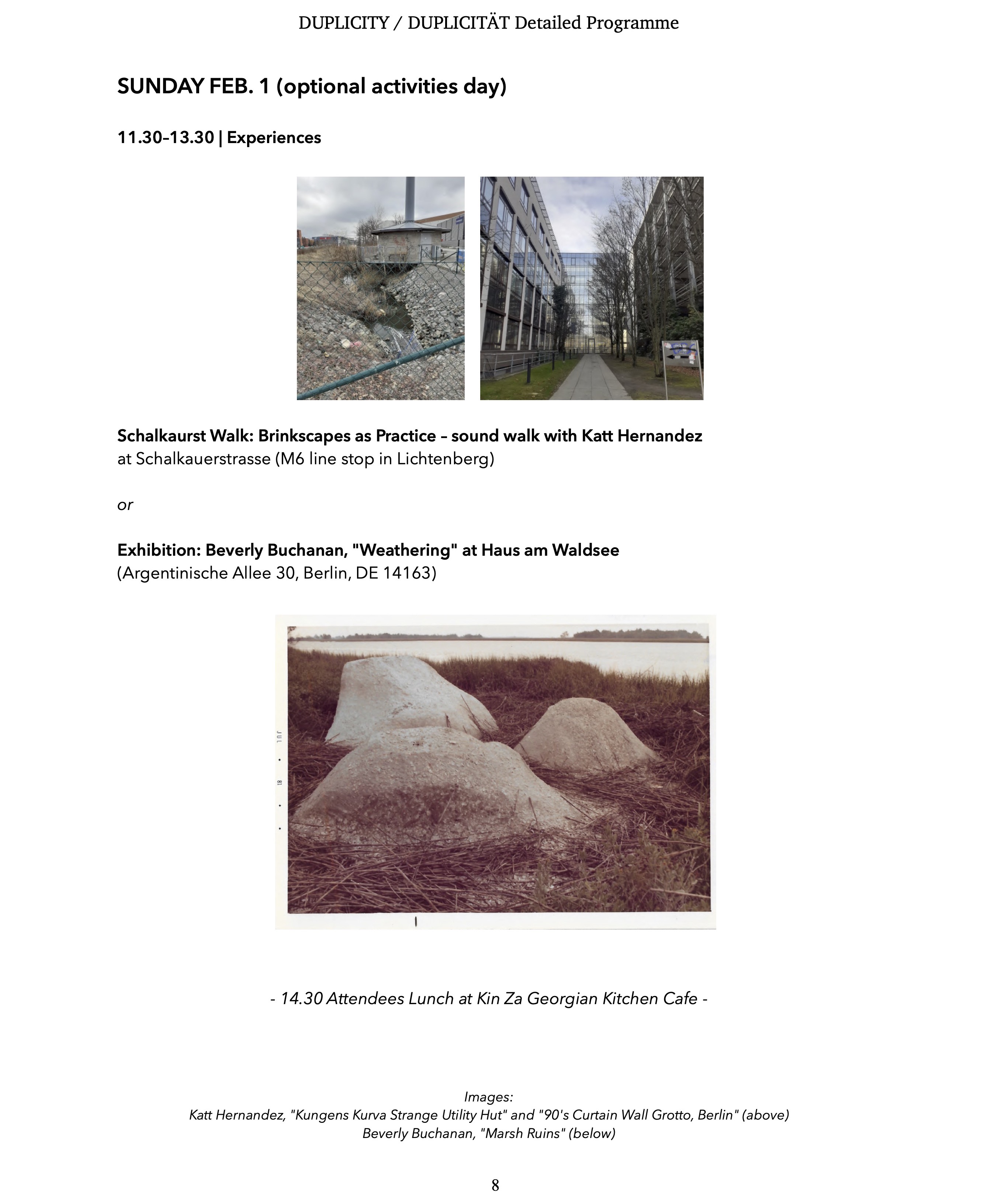
On this wintery Sunday morning, some participants decided to rest and digest, while others were homeward bound – to Trondheim, Porto or Los Angeles… The rest of us made a choice between the Weathering exhibition at Haus am Waldsee, or a sound walk / dérive in the former East Berlin district of Lichtenberg.
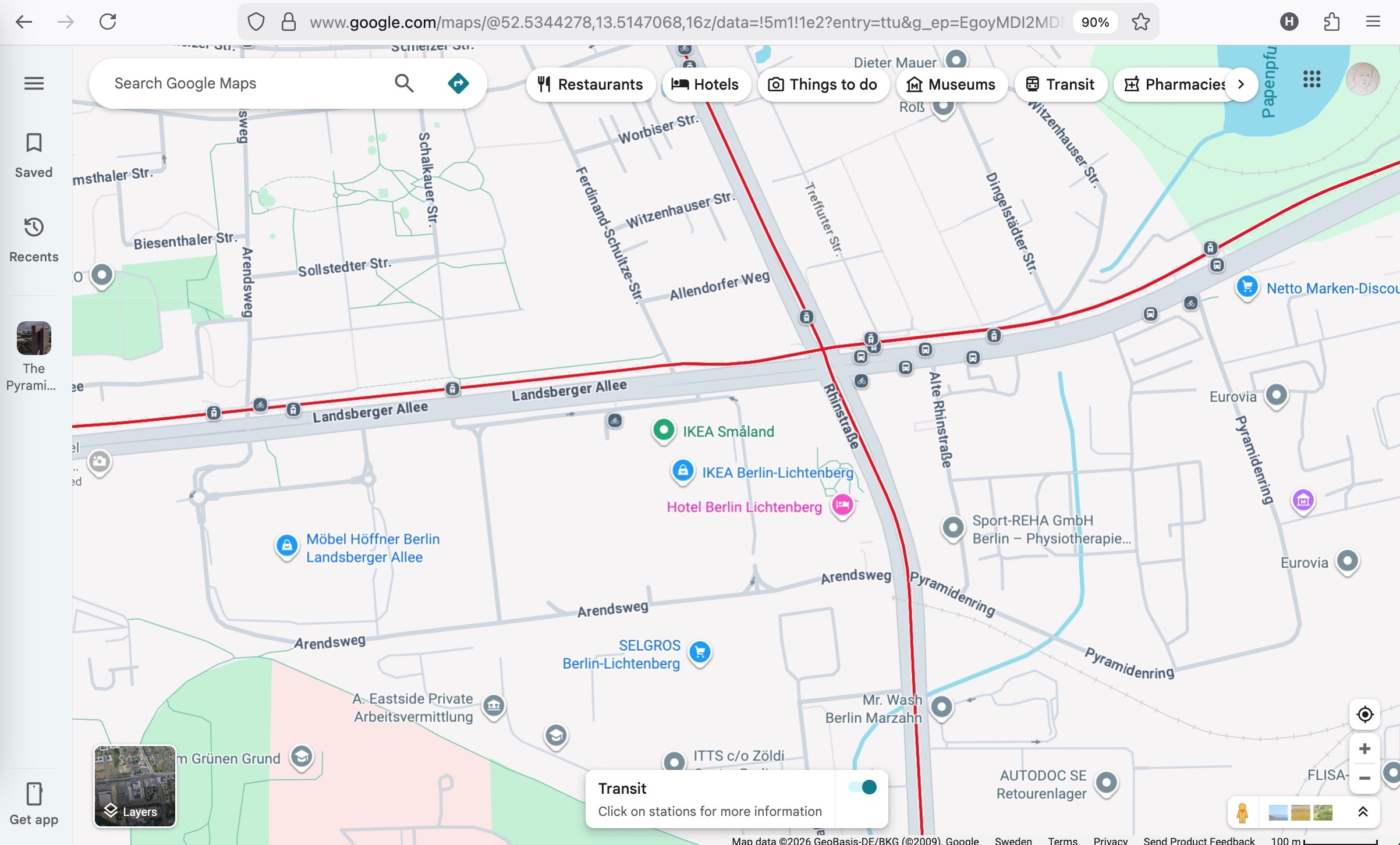
Screenshot
Landsberger Allée – Arendsweg – Pyramidenring – Alte Rhinstrasse
(Google Maps screenshot)
I head for the sound walk, taking the M6 tram to the stop at Schalkauer strasse where Katt is waiting. Soon enough, Eli and Paul join us. Incessant through traffic rumbles along the Landsberger Allée, and a biting wind rattles the flaglines in front of IKEA as we cross the huge parking lot. South of the walkway, the windowless metal façade of a giant wholesale warehouse closes the view. Above Rhinstrasse, a towering high-rise: Die Pyramide – a prestigious 145 million € project completed a few years after the German Wiedervereinigung, soon a cause of financial disputes, later sold to a real estate developer… now a post-modern monument well past its prime.
From Pyramidenring, we turn left to proceed along the back side of this glass-and-granite complex, where it turns into a long stretch of lower building blocks alternating with narrow yards where trees stripped of leaves comb the wind. From Eli, we learn that Alte Rhinstrasse marks the border to a no man’s land, of sorts; or rather, a “some men’s land”, since violent right-wing groups claim the space beyond this old road – now a backstreet – making it a no-go place for those in focus of their aggressivity. A little further up the street, a rusty boom barrier and a sentry box with flaking paint still monitor a former industrial area, disused since decades.
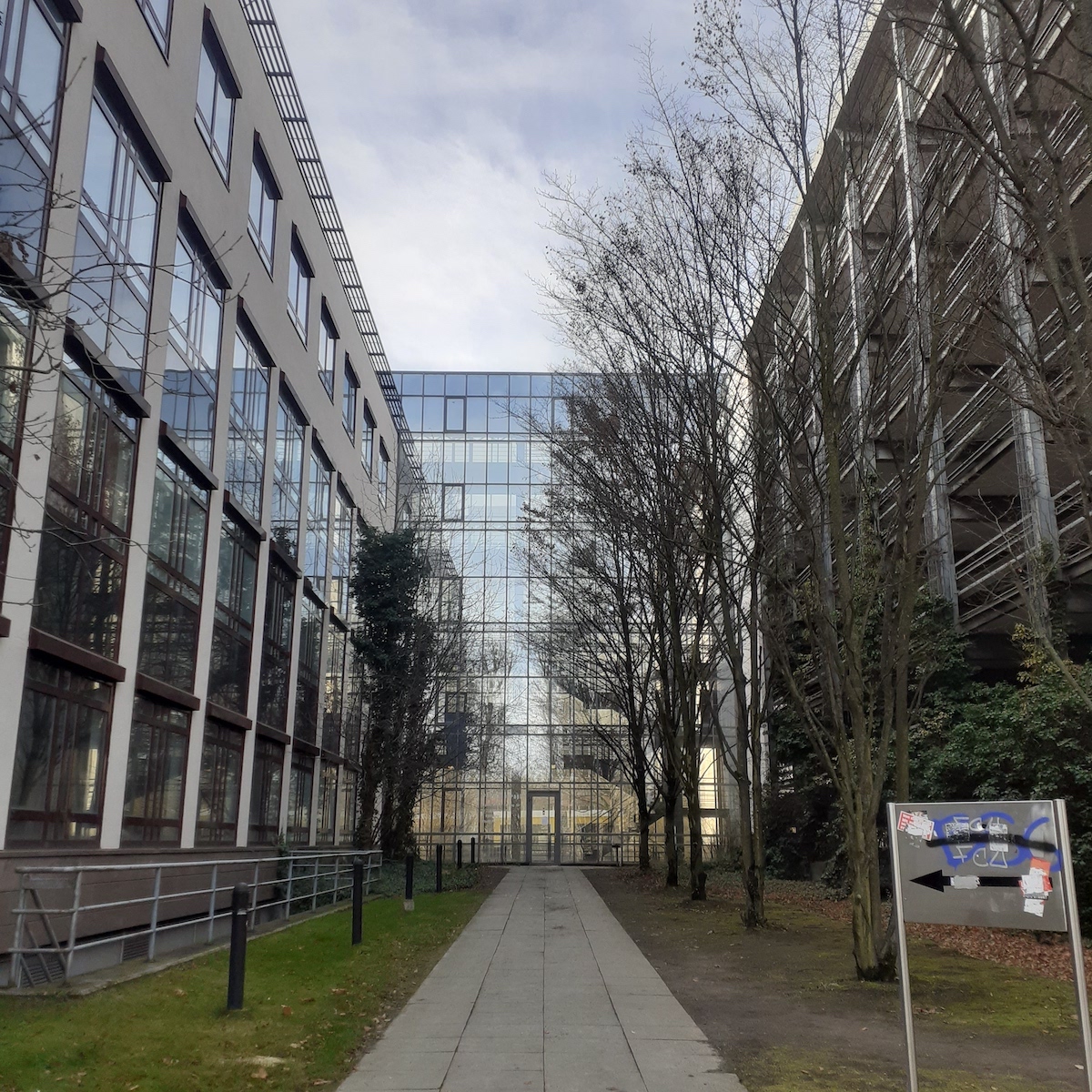
“90’s Curtain Wall Grotto, Berlin”; photo by Katt Hernandez
A man exiting from a gym in the Pyramide’s side block allows us to slip inside to hide from the cold a few minutes. As we gaze at empty windows, empty stairwells, empty name plates on metallic information boards, Katt evokes images of families walking by on their way to the shopping malls on a sunny autumn’s day… A phone signal rings; it’s Lu, looking for us and asking us to send her a live position on Whatsapp. We hurry out to meet her in the street, and suddenly find ourselves back at the Landsberger Allée just outside the main entrance of the Pyramide. To our surprise, the doors are unlocked and we can walk inside.
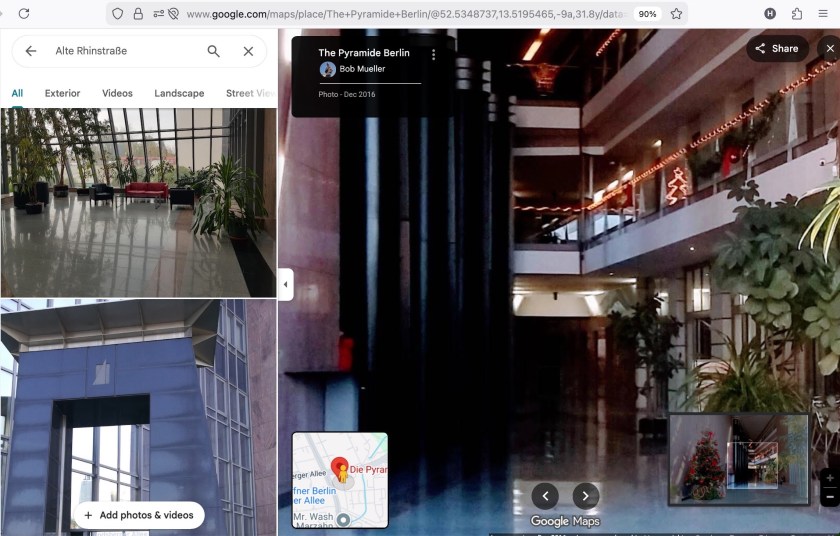
Screenshot
“Die Pyramide” main entrance (Google Maps screenshot)
Vast, blank surfaces. No sounds of human presence, except for our own footsteps; we fall silent, too; unsure about how to behave. Cautiously, we sneak towards the high row of black pillars… behind which a security guard is relaxing by the reception desk. He offers us various folders and prospects from the enterprises housed in this office hotel. We thank him politely and return to the street, where the M6 line takes us back to the city center. We finally join with the remaining group for a warm Georgian lunch at Kin Za restaurant, before breaking up.
However, this sound walk / dérive stays with me. In little more than an hour, a stroll of perhaps 2 kilometers in seemingly dull surroundings caught an incredibly complex image of recent German history, architecture-as-ideology, financial manipulations, flows of communication and commodities, varying conditions for people’s everyday lives, and the continuous cycle of quiet growth and decay within the city’s ecosystem of flora and fauna. I hope to hear Katt’s violin tell more about this brinkscape practice… and I’ll bring the experience into the continued work of Studies in Remoteness.
 Helena Hildur W.