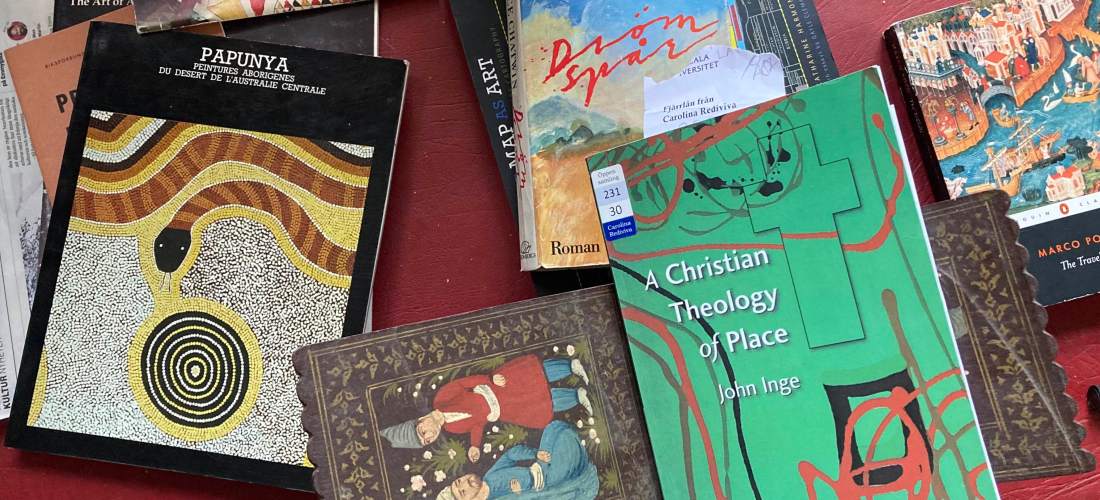
Since the Sigtuna working retreat in November, mapping procedures are on my mind… and all over the place; in books, notes and various materials. Reading and making. Seeking ways, following paths.
One accessible course would be to track the development of map projections, meant to change certain aspects of representation; to advance geodetics, to aestheticize or challenge general understanding – or combinations thereof, such as the “butterfly projection” invented by Bernard Cahill (1909) and improved by Gene Keyes (1975), the Dymaxion map by Buckminster Fuller (1943) and the reconsidered butterfly map by Steve Waterman (1996).
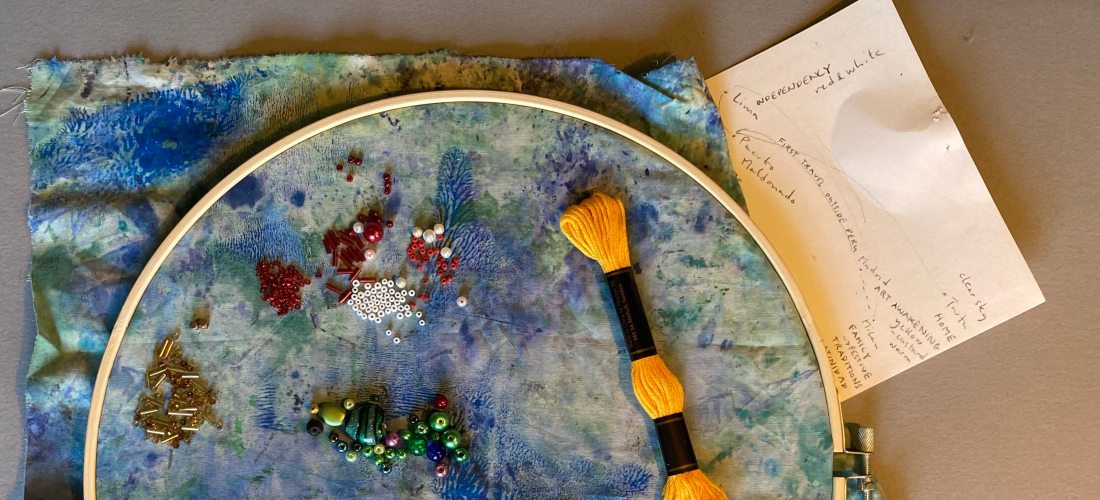
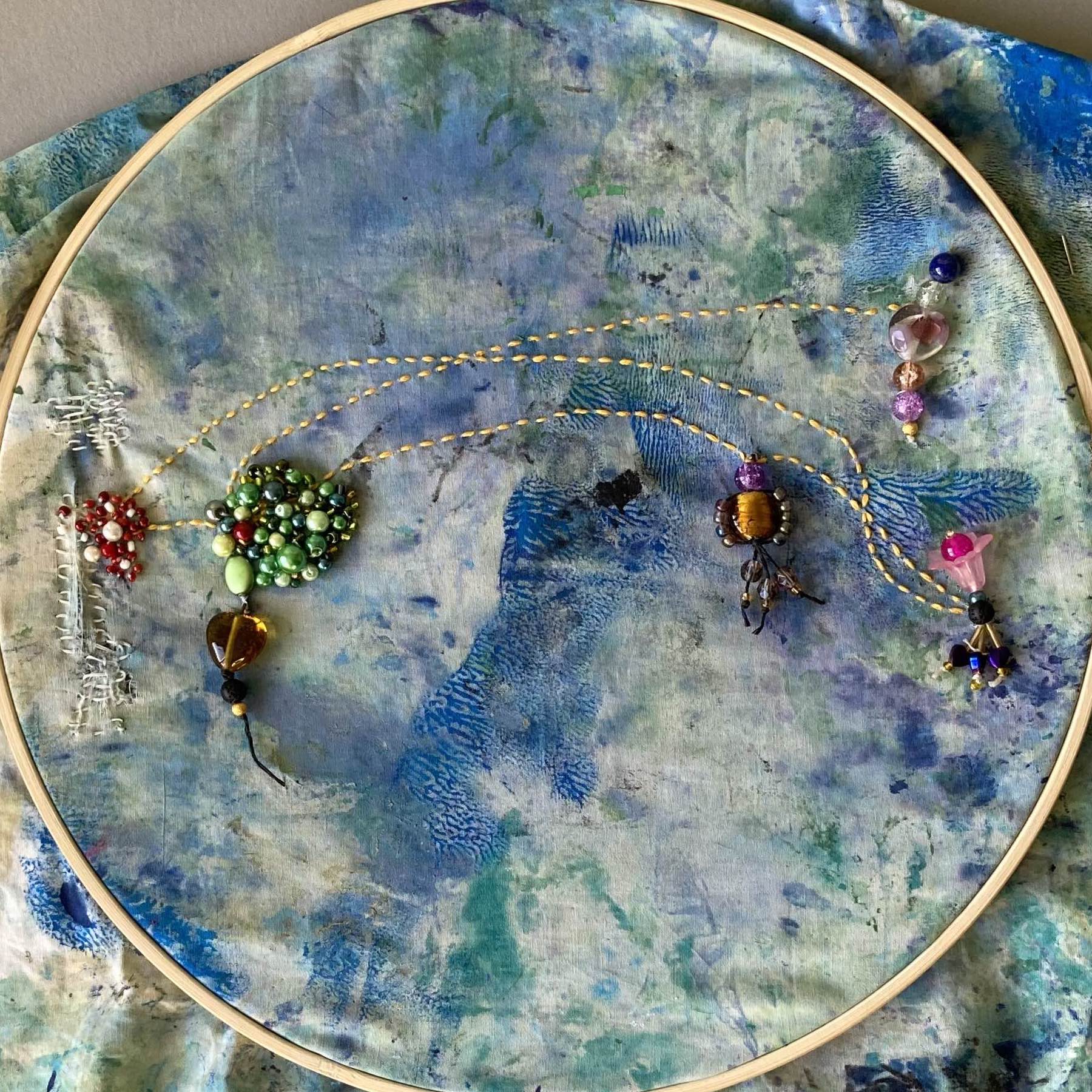
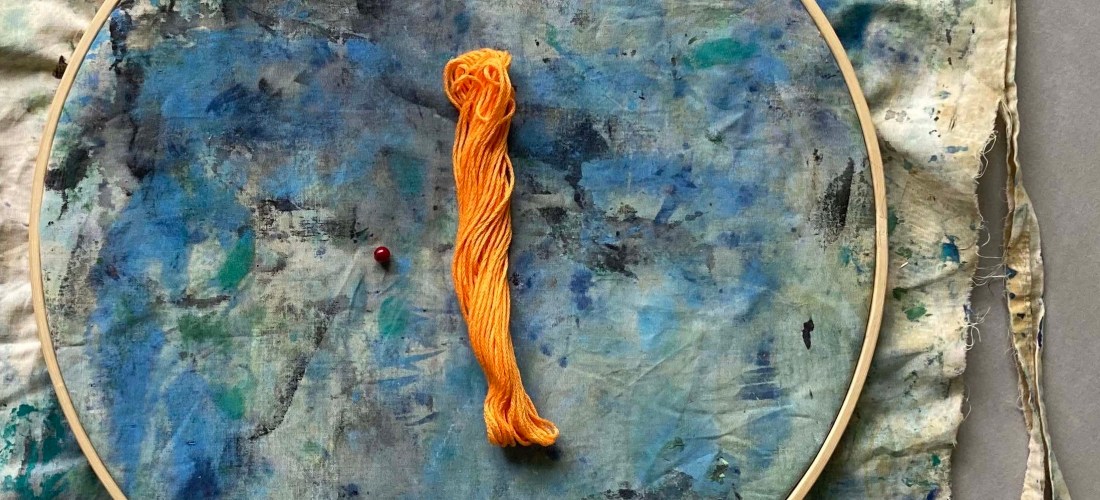
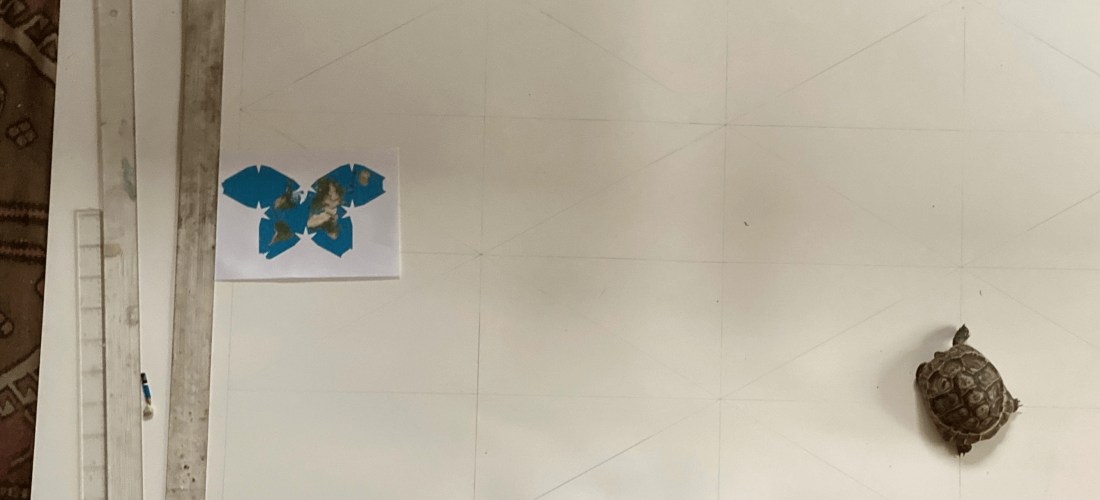
The butterfly map concept provides a starting point. As the Praxis group (and Nordic Summer University) gatherings generally take place in the Nordic-Baltic countries, I have chosen Waterman’s Europe-centered version (1996), reproducing it in varying sizes; A3, 1 x 2 metres and 2 x 2 metres. At the Sigtuna retreat, all participants were invited to mark their own places of special significance on the 1 x 2 metres map. Some persons pinned only one place, others many. Connecting the individual pins with embroidery yarn (remainders from the 2018 Star Roads project) casts a somewhat arbitrary net over the so far colourless cardboard…
Praxis “significant places’ map”; graphite drawing on cardboard, coloured map pins and mercerised cotton threads; 100 x 200 cms; (collaborative work in progress)
Connective threads and pinned places: silver grey: Purmo–Hosaina–Fiji; dark green: Puerto Maldonado (Amazonas)–Madrid–Tartu; greyish brown: København–Reykjavik–Vancouver–Lisboa–Stockholm–Post-Anthropocenic Speculative Diaspora; green: New York City; bright blue: Mariehamn–Lisboa–Åbo–Cottonwood–Kökar–Atupeva/Atupera?; brownish yellow: Herental / de Wimp; dark grey: Nakkila–Åbo–Haifa–North Namibia / Ovamboland; dark red: Alta; warm yellow: Seattle–Taos (New Mexico)–New York–Berlin; light yellow: Tejgadh–Frostviken–Melbourne–Stockholm; light violet: Örebro-Kåvi–Stockholm–Linnés Hammarby–Bern–Kailash–Helgum–Umeå–Lycksele–Visby–Dalhem (Småland).
Before the map, there were the tales of travellers. Before the concept of abstract space, there were a thousand and one places.
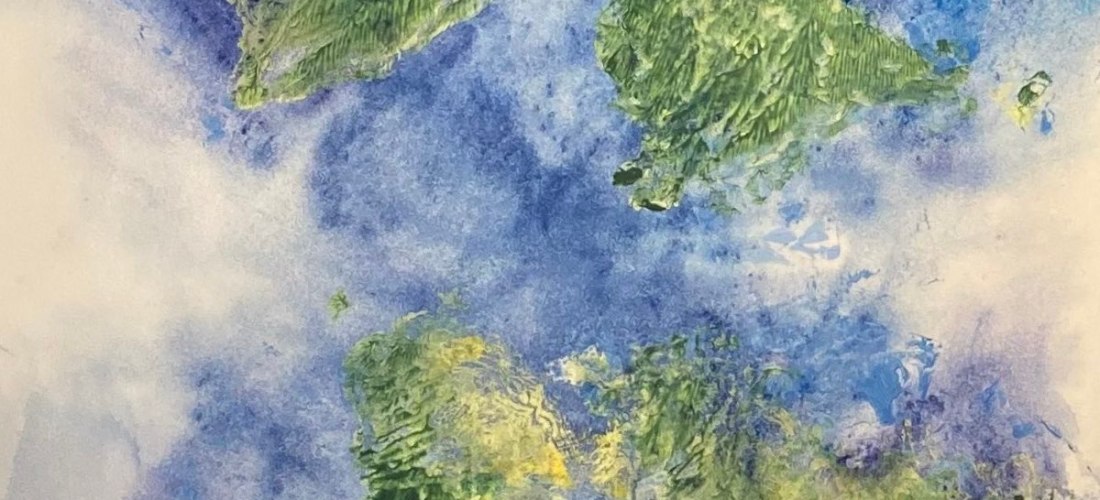
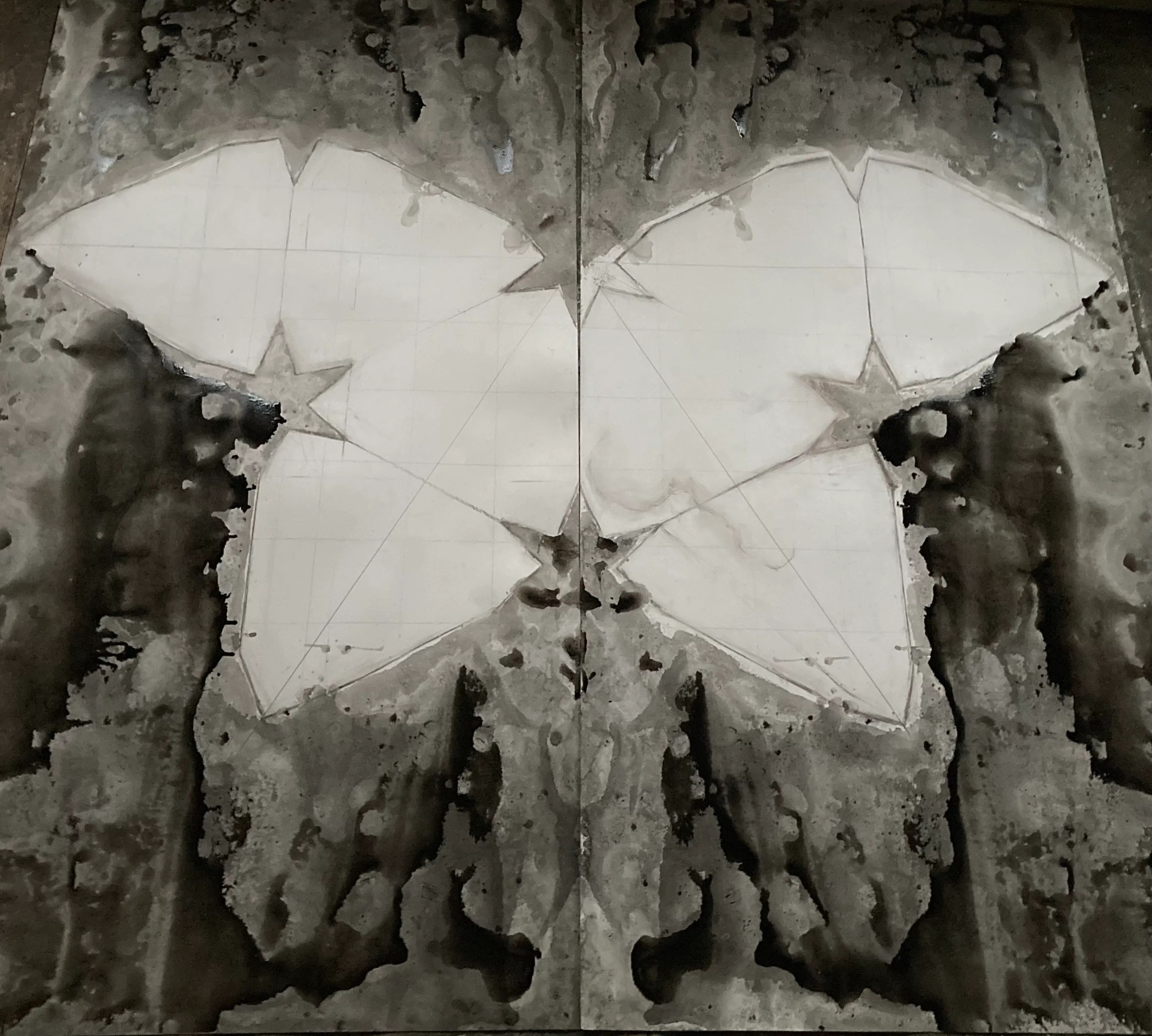
Helena Hildur W: two A3 size butterfly maps; left: graphite pencil on paper; right: monoprint with graphite shading on paper
The Praxis of Social Imaginaries – an intriguing title* and an inspiring project, launched by Dr. Lindsey Drury and Dr. Laura Hellsten in 2022; still in its first year out of three, the initiative has managed to attract researchers, scholars and artists from six (!) continents, to gather around readings of mediaeval travellers’ tales. Like distant mirrors,** the written accounts of monks and merchants reflect shifting interests, gradually forming a worldview that impacts our lives deeply even today… And we ourselves, as a working group, are a diverse set of mirrors, framed in so many cultural contexts; from the Amazon forest to Berlin and New York City; from Kampala, Singapore and Adelaide to Sápmi… hopefully opening up for developing new modes of understanding; for social imaginaries more appropriate to our own world.
Views from Sigtunastiftelsen: dining room, garden and library
Our contributions to the Praxis project are partly realized within our respective professional settings – but, since the aim is to nurture genuinely transdisciplinary collaborations, ad hoc gatherings will be held over time as sub-projects emerge. So here we are, in the small mediaeval city of Sigtuna some 45 kms from Stockholm, to spend a weekend together in late November… The venue itself provides unique values; we’re hosted by the Sigtuna Foundation – a meeting ground dedicated to dialogue and openness ever since 1917. Nobel Peace Prize laureate Nathan Söderblom, UN general secretary Dag Hammarskjöld and poet Gunnar Ekelöf are some of the notable Swedes historically connected to this place, which still offers a lively spot for cultural, scientific and interreligious exchange. Anders the librarian gives us a guided tour in his sanctuary of books; some of the items are of venerable age, others come fresh off the presses to spark debate or enhance knowledge in current topics. (Due to GDPR issues, you will neither see Anders in action, nor the amazement in our faces here.) Later, we also got the opportunity to attend an opening at artist-run space Slipvillan, where our fellow project contributor Emma Göransson was part of a group show.
Walking and talking in Sigtuna; Sigtuna Foundation and the ruin of S:t Per’s church
Was there any time for actual work during this working session, then? I think it’s fair to say that shared time, shared experiences and shared meals are meaningful elements in work processes like this one. Equally important, of course, are the moments of structured reflection – both individual and common… and yes, there was time for that, too. Even sleep may bring unforeseen revelations…
…to be continued…
This slideshow requires JavaScript.
* “The imaginary (or social imaginary) is the set of values, institutions, laws, and symbols through which people imagine their social whole.” – Wikipedia: Imaginary (sociology)
**A distant mirror is the title of a renowned book by historian Barbara Tuchman. That specific work isn’t part of the Praxis project reading list; however, the title is too good not to be re-used – with due credit!
End of July, and a group of scholars and artists meet up to continue the journey that begun in March: studying the Praxis of Social Imaginaries. Observing our own times through the lens of mediaeval travel accounts, this transdisciplinary research project is now turning to William of Rubruck and Marco Polo – both speaking to us from the 13th century.
“The journey of William of Rubruck to the eastern parts of the world”
Marco Polo, “The Travels”
Summer session readings: the travels of friar William of Rubruck (photo credit Laura Hellsten) and Marco Polo’s Book of the Marvels of the World
A diverse bunch of people we are, actually representing all continents except Oceania; diverse also in age and cultural background, not to mention other kinds of situatedness… Reading under the pine trees in Palanga Botanical Garden brings out knowledge and memories from Sápmi and the Amazonas. Listening to voices from the 13th century brings out concern for the silence(d) in history. The ‘brave space’ of genuine dialogue brings out deep emotions of grief, joy and care… as well as the interchange of intellectual perspectives.
The Praxis project will continue for another two years – partly within the alternating Winter and Summer sessions of the Nordic Summer University, and partly in parallel side projects; next gathering planned in November, at Sigtunastiftelsen north of Stockholm. I’ll have some mapping work to do before that… For now, I wish to cherish the creative flow that emerged from sitting beside Ilona Blumgrund, and our thinking together swiftly and wordlessly.
With great gratitude to Ilona, Adriana, Jackie, Louie, Emilia, Roberto, Tinka, Eduardo, Dorcus – and, of course, co-facilitators Lindsey Drury and Laura Hellsten – à la prochaine!
Mapping on the beach; how to realize common values in colonizing the future
About the Nordic Summer University This particular study circle is but one out of a dozen, which together constitute the Nordic Summer University. From July 27th to August 3rd, the NSU Summer session 2023 was held in Palanga, Lithuania. Keynote speakers Ekaterina Kouznetsova, Amanda Valentin and Epp Annus all focused on different aspects of democracy in our time; academic freedom in an authoritarian society, election monitoring, and Russia’s colonial engagements and imaginaries of supremacy. In daytime, study circles worked independently (and sometimes joined). In the evenings, cultural programs were offered – such as music, workshops and multilingual readings (a practice introduced by Lara Hoffman last summer)… Together with Alina Kalachova, I conducted a mapping event which made us think, as well as cry and smile. A valuable experience.
Keynote speaker Epp Annus presenting a poem by late writer Victoria Amelina (killed in Russian strike on Kramatorsk, July 1st); and a joint reading of short stories on the beach
About Palanga and Hotel Vysuris The venue and the city itself deserve some attention, too. Hotel Vysuris, built under the Soviet regime, stays almost unaltered since the 1970’s; history alive in many aspects, also in the struggle of the kitchen staff to navigate between different instances of need and want. The long applause they got at the final gala dinner was well earned.
(above) Vysuris restaurant and the last evening’s gala dinner (below) Some features of the labyrinthic, circular building
And finally, some touristic views from walking in Palanga – and a treasured gift (thank you so much, Dorcus!):
Last month’s notes from the conference in Åbo/Turku briefly mentioned a new research project launched by Laura Hellsten. Here’s a little more on that…
Laura’s scientific approach is shaped by her dual competence as a dancer and a Doctor in Systematic Theology. While she holds a position at Åbo Akademi University, part of her current research will be conducted within the framework of the Nordic Summer University (aka the NSU). Actually, this project has already begun; in early March 2023, the first gathering of NSU Circle 3 Praxis of Social Imaginaries; Cosmologies, Othering and Liminality took place in Oslo. Lindsey Drury – post-doc and co-facilitator of this study circle – is an early modernist historian, and an educated dancer as well. Their common work evolves around mediaeval accounts from travels into ‘unknown lands’; aiming at transdisciplinarity, the methodology incorporates reading aloud, various modalities of movement, academic lectures and discussions, and…
The Hereford Mappa Mundi – a mediaeval world map, conceived in the very place where Gerald of Wales spent the last part of his life (although nearly a century later) – presented in a keynote lecture by historian Line Cecilie Engh; picture made available by Wikimedia Commons
…and more? Future will tell.
In this first Praxis session, a number of scholars and artists from different fields and places processed the tales of Gerald of Wales: a monk travelling uncivilized Ireland by the end of the 12th century – reporting back to his learned colleagues and to the English king; picturing Éire and the Irish through a lens of curiosity, religious zeal and practical political thinking.
Here’s my own recap from our five of days walking, talking, listening, disputing and dancing in wintery Oslo:
Domus Theologica (University of Oslo) hosted the event
Streets of Oslo – a signpost pointing the way to a bomb shelter; Saint Olav guarding sewages and waters underground; icy footway; a cool cat by night
Saint Olaf, king of Norway, accompanies us, as we walk the streets – occasionally trodding along his old pilgrimage path, leading all the way from here to Olaf’s grave in Nidaros (Trondhjem). In his youth, Olaf sailed the Baltic and the North Sea as a fierce warrior, before being baptized and returning to Norway as a Christian king. His image, cast in iron, can be seen on every lid covering the descents to the city’s system of underground sewage pipes. The waters that have cleaned our bodies – or passed through them – is kept from sight and smell in those sewers. Meanwhile, Aker river running through the city, once heavily polluted, is now restored to be the ‘green lung’ of the urban area…
How can one atone for the wrongdoings of history? As we walk and talk, I think this may be the beginning of a pilgrimage.
Limestone wall of Old Aker Church – the oldest existing building in Oslo, erected by the mediaeval pilgrim route
For the closing summary, I did an ad hoc mapping on a classroom blackboard – picturing our experiences as a group: reading Gerald’s tales, listening to Viveca Servatius’ lecture on Hildegard of Bingen, seeing lovers in a churchyard, meeting dogs friendly and angry, slipping and sliding in a park, dancing between graves… Other participants helped me fill in the empty spots.
Slipping along an icy slope
Proceed with care!
Reading aloud in groups in Old Aker churchyard
Noted by participant: many fathers walk their kids in Oslo
Noted by participant: many people walk their dogs in Oslo
Noted by participant: I got locked in inside seminar building for some time
Dancing in a graveyard, and lecture on Hildegard of Bingen’s musicology
Oslo architecture, and seminar group seated around a table
Loving couple under a tree in churchyard
Next gathering will take place in Palanga, Lithuania, when July turns August. See you there!
Leaving Stockholm on Sunday evening, May 14th, sleeping across the Baltic sea and waking up early Monday morning to sunrise over Åbo/Turku… In 2010 and 2011 I made this trip quite a few times, when engaged in the Nomadic University project at Åbo Akademi. Now I’m back to take part in a conference hosted by the Donner Institute and the University of Helsinki: Religion and Spirituality as Sites of Learning.
Nice to trod the streets of Åbo once more…
..and nice to be back in the facilities of Åbo Akademi University. Niklas the caretaker helps me to arrange a poster exhibition that I’ve brought for the occasion. Soon, conference guests begin to arrive and register. Then: coffee time, and next the welcome introduction by Ruth Illman, research director of the Donner Institute, and professor Terhi Utriainen from the University of Helsinki – followed by a keynote speech on Unlearning by professor Kim Knott of Lancaster University; a productive opening to three days dedicated to learning.
Entrance hall at Arken, Åbo Akademi University
Ruth Illman and Terhu Utriainen opening the conference
The conference proceeds with three parallel sets of lectures throughout the day. Among the presentations I manage to attend is Jaana Kouri‘s research on Learning in contemporary shamanism (carried out congruently with her own shamanist practice); among the ones I’m sorry to miss out on are Miriam Feldmann Kaye‘s Learning as Idea: ‘Hospitality’ from a Philosophical Perspective and Emine Neval’s Where are the Women?.. This first day is wrapped up with a reassembly and panel discussion on Eastern Spirituality in Arts. Panelists Nina Kokkinen, Måns Broo, Linda Annunen and Ville Husgafvel open for a highly interesting and well-grounded discussion along the themes of Inspiration, Appropriation, Conversation… upon which follows a get-together reception and the awarding of Donner Institute Research Prize 2022 to Maija Butters for her book Death and Dying Mediated by Medicine, Rituals, and Aesthetics.
Leaving the gusto of seventy researchers gathering ‘in real life’ for the first time since covid 19, to enter the calm atmosphere within the Bridgettine sisters’ guesthouse… where a modest room is waiting for me, and the singing of psalms accompany Tuesday’s breakfast.
Morning choir at the Bridgettine Convert’s guesthouse
The second day of conference begins with researchers from the University of Helsinki sharing conclusions from their project Learning From New Religion and Spirituality. In addition to informal talks and tasty lunch (the menu is all vegetarian), I enjoy and learn from Lena Roos and Laura Wickström lecturing on, respectively, The Green Sabbath Project and Learning about the Environment Within Islamic Tradition – just to mention two out of many appealing themes.
Researchers from the LeNeRe project
Laura Wickström on environment in Islamic tradition
Lena Roos presenting her research on the Green Sabbath project
The third and final day starts directly with the sets of parallel sessions; in Auditorium Källan – the Well – we delight in multi-skilled university lecturer Mikko Autere reciting Sufi poetry in Urdu (or was it Hindi?) and introducing us to South Asian practices of aesthetic and mystical cognition; his talk followed by doctoral student Olivia Cejvan, reporting about secrecy as a didactic tool in a Swedish esoteric society. I feel very favoured to be the third one to present in this sequence – even more so, being the one non-academic person to attend the conference. My talk takes place by the entrance, in front of the poster exhibition; retelling the story of Interfaith Dialogue in Images (a workshop in two parts, which I conducted in the autumn of 2019), presenting the concept of Pictorial Reasoning and inviting feedback from a researcher’s perspective. Again, I’m privileged to get insightful comments and questions from such an extremely qualified audience. Two of them to appear on stage a little later…
Nataliia Pavlyk captured me talking
‘translating’; professor Mulki al-Sharmani
‘In search of…’; professor Mulki al-Sharmani
After the coffee break, with continued discussions, it’s time for professor Mulki al-Sharmani to hold her keynote speech on Women Living with, Learning from, and Reasoning with the Qur’an – sharing experiences from long-time engagement with a number of Muslim women. Some of her informants belong to the islamic minority in Finland, others to the majority in Egypt; some are fairly well-off, others underprivileged; each one of them possessing deep resources of judgement and agency.
Next out, in the closing set of parallel sessions, is Laura Hellsten, dancer and doctor in systematic theology. The subject of her lecture is Dance as a Spiritual Formation Practice… partly treated in connection to her project The Praxis of Social Imaginaries; Cosmologies, Othering and Liminality, which has recently been launched in collaboration with Lindsey Drury (PhD at Freie Universität Berlin/ University of Kent). I’ve already had the pleasure to take part of Laura’s and Lindsey’s work within the framework of the Nordic Summer University. More to follow there…
‘…through our whole body…’; Laura Hellsten
Laura Hellsten (2)
Laura Hellsten (3)
‘… Letting desire lead to deeper levels…’; Laura Hellsten
And so: time for some closing words, and one more cup of coffee before we leave. The walk along the Aura river, on my way to the ferry , brings me close to the Wäinö Aaltonen Museum of Art, where a rich retrospective of Jan Kenneth Weckman’s painting is on view. I cannot just pass by, of course; after three days of intense listening, I need to wash my eyes in colour to see again. Need to pay respect to Jan Kenneth’s corpus; to art as materialized thinking.
Jan Kenneth Weckman at WAM (1)
Jan Kenneth Weckman at WAM (2)
Jan Kenneth Weckman: still from video interview
Jan Kenneth Weckman: Mother of God (2016); oil on canvas
What, then, have I gathered from these sites of learning in Åbo/Turku?
…from Jan Kenneth: to focus on painting, not on the picture.
…from the sisters’ guesthouse, a kaleidoscope of fragmental memories: a digital key handed over at night hour; clean surfaces, plain clothing, sparse colours; morning oats, singing voices converging in the unison. Austerity and care. Time stripped bare of signs of change.
…from the conference: the Q’s and A’s. Observations of the living world, transformed to words aligned according to the rules of logic. A poem in urdu (or was it hindi?) ungraspable by logic. Delight in meeting, delight in sharing. A beautiful sign on the restroom doors.
A painting long forgotten. Until, one day, it caught somebody’s attention; a customer, as it turned out.
A painting long forgotten, then remembered. Re-membered, integrated: additional lapis lazuli pigment to deepen the colour blue – “light coming into being“. More of the all absorbing, finely ground charcoal for the black circle. The floating tadpole figure outlined anew in charcoal, and graced with gold leaf within. Overall proportions trimmed before mounting between acrylic glass sheets, cut to shape. Then carefully packed for transport…
…and delivered to a private home, situated on an island in the archipelago of Stockholm. Here, a number of smaller artworks were reshuffled along the walls to make space for this one. Good neighbours they will be, for sure… Two windows are providing daylight – one facing east, the other south. Outside, the sky is clear and trees are leafing. Indoors, sunlit rooms still echo from a grand piano long time gone. And so, the painting finally has found its place.
Thank you, B and A, for your hospitality!
This I Know (final version); tempera, charcoal and gold leaf on paper, 200 x 120 cms
“Art and Spirit – like a twelve-tone scale, the works of eleven artists sound in the Musical Quarter. The exhibition takes place on all floors within the building – in the doorway, the entrance hall and stairwells, in the foyers and the concert spaces.”
A one-day-only exhibition at Stockholm’s Musical Quarter, curated by Tobias Sjöberg – up and running from noon at Saturday, March 11th, into the wee hours of the night when the last guests are leaving the party.
Friday, March 10th: gathering together to hang the artworks. A colourful curtain – made for the occasion by Amanda Cardell – will greet every guest at the main entrance. In the Clara Schumann hall, works by Viktor Kopp and myself have found their place, waiting quietly for tomorrow’s artsy sounds, klezmer swing and late night disco. Manager Andil Dahl always seems to be in the right place to make everything run smoothly. (below)
Amanda Cardell: “Entering” (behind the entrance doors); a drapery of ribbons
Viktor Kopp: “Door and line”; oil on canvas 160 x 170cms
Andil and Johan discussing lighting matters
HHW: three diary paintings; oil on wood panel
HHW: four monthly pictures; blood, ashes and chinese ink on silk
(above) Hanging completed in the Clara Schumann hall; on display from my part are three diary paintings (oil on wood panel) and four monthly pictures (blood, ashes and chinese ink on silk).
In the first floor foyer, painted wood sculptures by Tiago Altink are put on display. At the second floor, Jakob Sjöstedt’s sculptural sounding objects interplay with scenic elements of the locale. Missing on photo are Margrethe Sjöberg’s embroidered birds of fantasy, and Jouko Mario’s enigmatic paintings opening up to views of strange streets and buildings. (below)
Installing sculptures by Tiago Altink
Tiago Altink: painted wood sculpture
Jakob Sjöstedt: “Signal”/”Untitled”; loudspeaker elements, sand, sound / reeds, deer skull, copper plate, parts of a torn-down kitchen
In the stairwells, Mats Adelman builds exquisite cabinets where the night fly finds rest and the barn owl can be seen flying… The old and the new meet in the third floor foyer, where Beata Fransson’s playful photographic sculpture echoes the brick wall of a building across the street.
Halfway down another staircase, Stefan’s self portrait is a world in itself; I’m humbled and grateful to have my cloud drawing placed next to it.
Missing here are Tobias Sjöberg’s Octave – watercolour paintings covering two huge windows, creating a quiet virtual space opening to pure colour; turning the room into a floating vessel, carrying living people and pale plaster muses along outside of time … (below)
Mats Adelman: “Subforest”; installation with sculpture and drawings
view from the third floor foyer
Beata Fransson: “Corner”; black and white print on woodprin
HHW: cloud drawing; graphite on paper
Stefan: untitled; watercolour and pencil on paper
Saturday, March 11th: giving the installations a last finish; then removing tools and ladders, doing a bit of cleaning up; and, the Art and Spirit exhibition is up by noon. At four o’clock, the Swedish Wind Ensemble gathers for a sounding parade around the neighbourhood. When they return, guests are already queuing to get inside. Scendödsfestival sets off – let the party begin!
Time to move on – from the digital dirtroad experience to an exquisite 19th century building by the waterfront of central Stockholm: the very first concert hall built in Sweden, patroned by the Royal Swedish Academy of Music. Today, the Musical Quarter is multi-functional venue hosting a variety of genres: from folk & world music (permanently housed in the old backyard horse stable) to early music, opera, jazz, philharmonic and purely experimental… in creative process, as well as in public performances and festivals.
Right now, the prospect of having rents increased by more than 55% threatens the whole initiative. The managing team then decided to mobilize all friends and good powers in Scendödsfestival – a full night’s total music and art experience, with free access for the public – happening on Saturday, March 11th.
I’m very happy to be counted among those friends; last week, I joined a group of visual artists – invited by our much esteemed colleague Tobias Sjöberg – to check out the site. What a marvelous place…
…and what a kind, professional and receptive bunch of people to work with. Many of us had never met before – I’m eager to see what we’ll come up with together!
More to follow…
Bronze horse close to the Musical Quarter, casted from a copy of the famous Byzantine horse sculptures in Venice; an installation by Swedish sculptor Sivert Lindblom (1989)