
(photos 1 – 3)
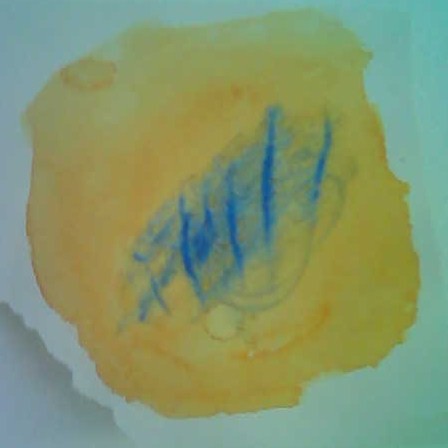
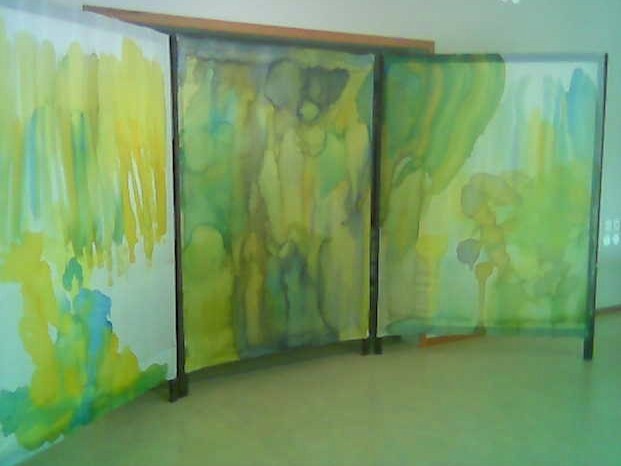
Did I say there were no images from Mir this summer? I was wrong; here are some. All photos are by me, all paintings by the participants. Crayons and watercolour on paper (1, 2) or silk painting (3 – 8).



(photos 4 – 8 )
(photos 1 – 3)
Did I say there were no images from Mir this summer? I was wrong; here are some. All photos are by me, all paintings by the participants. Crayons and watercolour on paper (1, 2) or silk painting (3 – 8).
(photos 4 – 8 )
All these photos are by Reino Koivula. Thanks a lot, Reiska!
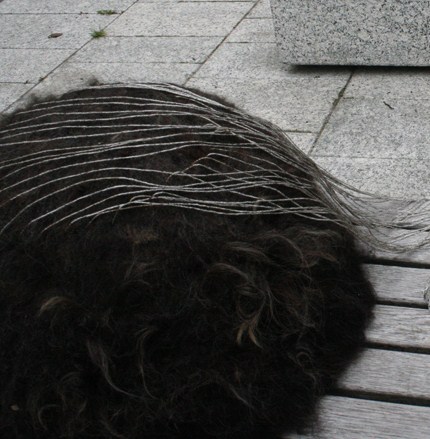
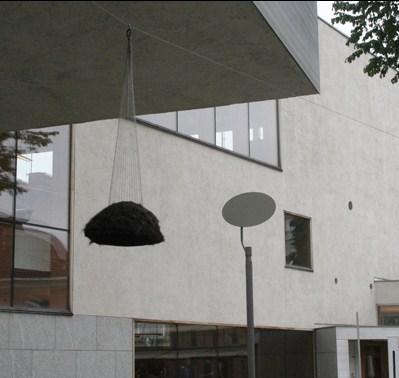
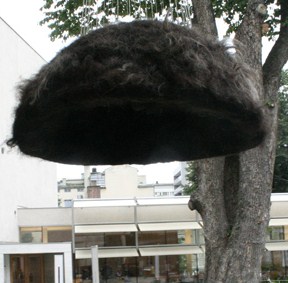
Growing darkness in the yard of Åbo/Turku municipal library; “Pimeyden kodat” (“Cots of darkness”) exhibition can be seen during the library’s opening hours until August 31st.
On returning from Finland, I spent two weeks in the Land of Mir (temporarily located outside the exotic city of Södertälje) together with old and new friends. No photos, but for documentation from last year, see Archives/July 2008.
And right now, I’m writing up the course in aesthetic-based qualitative research.
Daylight is shortening by minutes, a larger bell of darkness awaiting.


Today’s my last day at Titanik. The Darkness workshop will go on for another week, though, with Reiska, Timo, Simo Helenius and others. Finally it will end up with an exhibition in the yard of the public library, just across Aura river.
Thunder and rain reached Åbo/Turku yesterday – just after my last writing. I will not accomplish the felting of the large bell here and now, since it needs to be done outdoors and preferably in warm weather.
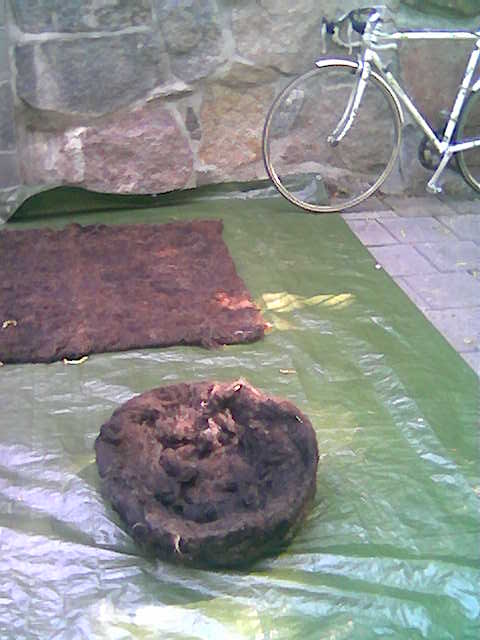
However, the smaller, experimental piece turned out quite well.
I start the day by giving it a nice shave, using a shepherd’s scissors.
Then I set to finish my things here, packing the car for going to the ferry.


If I leave something behind, it means I’ll be back some day.


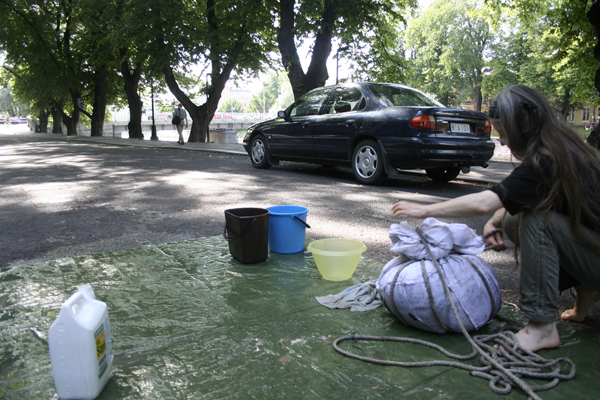
Darkness workshop at Titanik; three photos by Reino Koivula
In Åbo/Turku, the Darkness workshop continues, and, returning from Venice, Reiska and I join in again.
One three-dimensional piece of felt is produced by using a smaller part of the bell-shaped textile form; the technique works out well, but the gutefår wool seems too coarse to make good felt. From now on, I will use only the wool from the värmlandsfår breed.
 Today is warm and sunny, so I move outside to work. People stop to look, and some share their experiences of wool, sheep and feltmaking. I hear stories about felt soles being made out in the Finnish archipelago and sold in the town’s fishmarket; about coalmining in Australia and its fatal consequences for sheep; I hear memories from travelling in Kyrgyzstan as well as arguments for vegan activism. Somebody remembers his childhood, when clothes weren’t bought but made by the mother from hand-spun and handwoven wool – that was northern Finland in the 1940’s.
All these stories go through me, down into the whirl of dark hair I’m working.
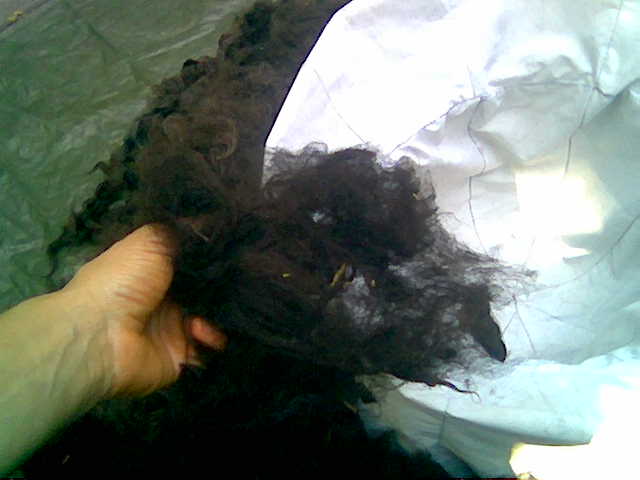
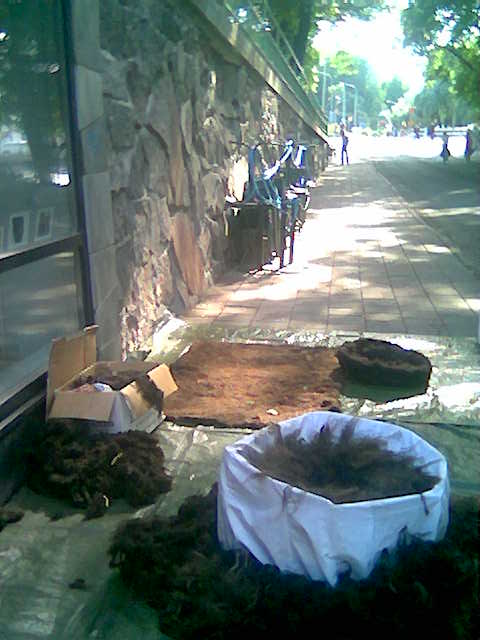
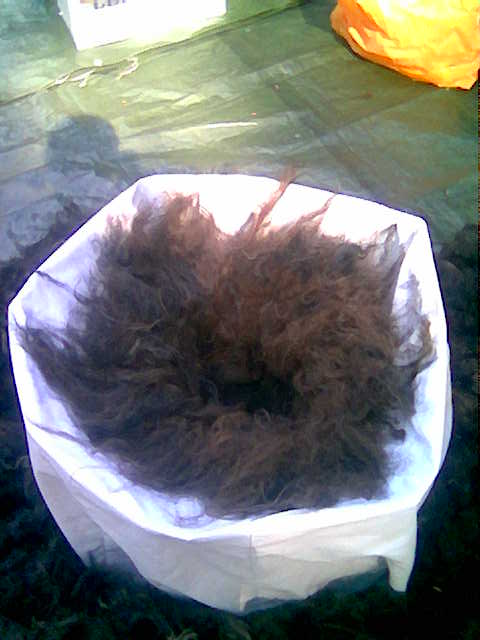

On Friday, June 19th, Midsummer’s Eve – Juhanni – is celebrated in Finland. The day is cold and rain is in the air, city’s almost deserted. I keep working darkness. Because of the low temperature, I decide not to do the actual felting, just prepare for the making of the bell. Wood sculptor Timo Nenonen helps me in trying out the equipment.

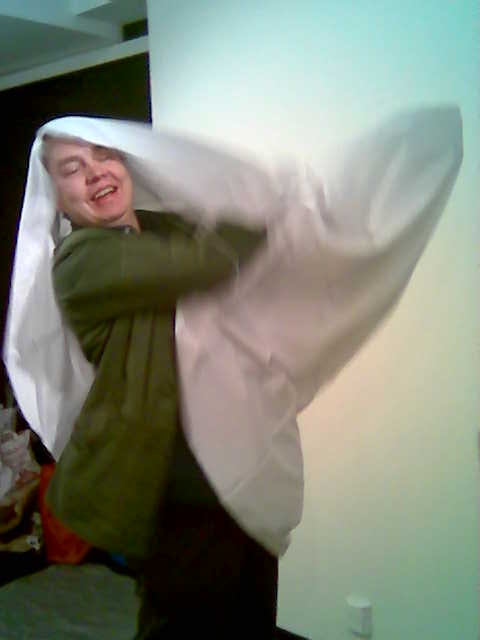
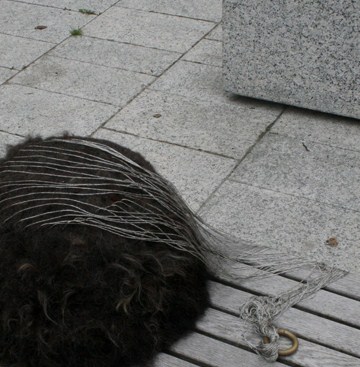
Reino keeps company, while I build the shape by filling wool from the bottom (which will eventually turn out top), spiralling out outwards and upwards and making sure that fibres are criss-crossing so as to keep together well when felted. Finally, I insert the inner bag filled with saw-dust (kindly provided by Timo) which is meant to keep the material fixed in shape while felting. But for the time being, I leave it there.
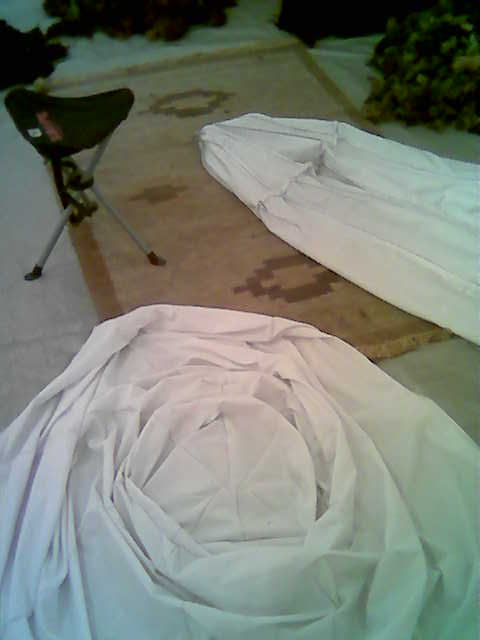
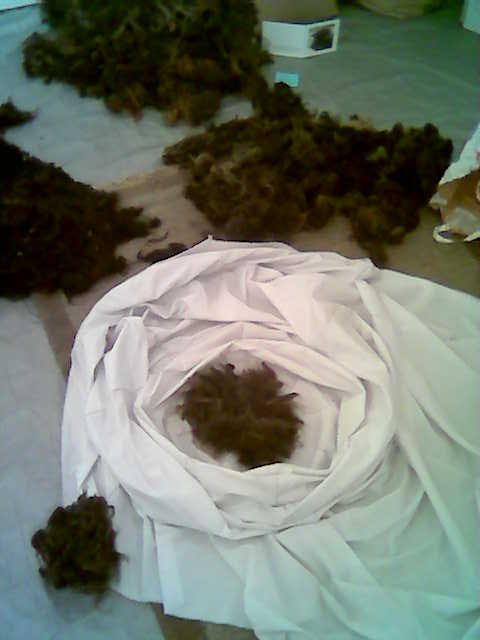
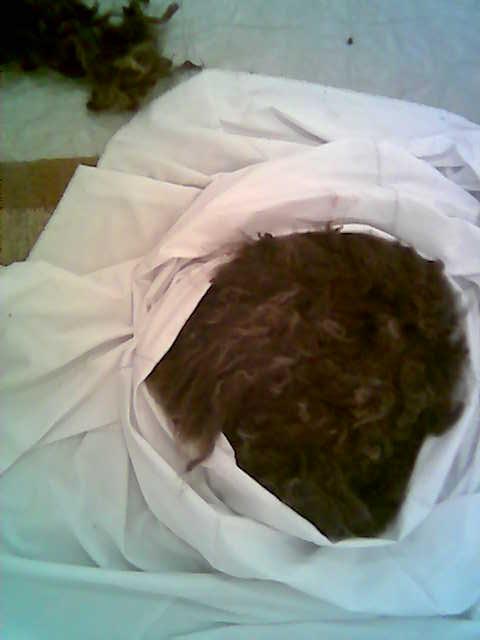
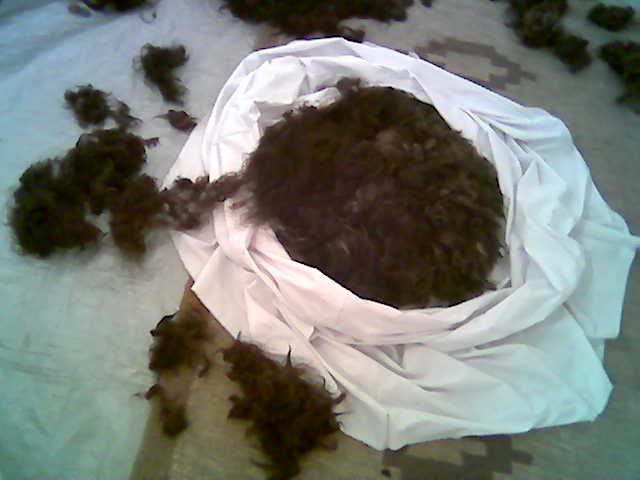

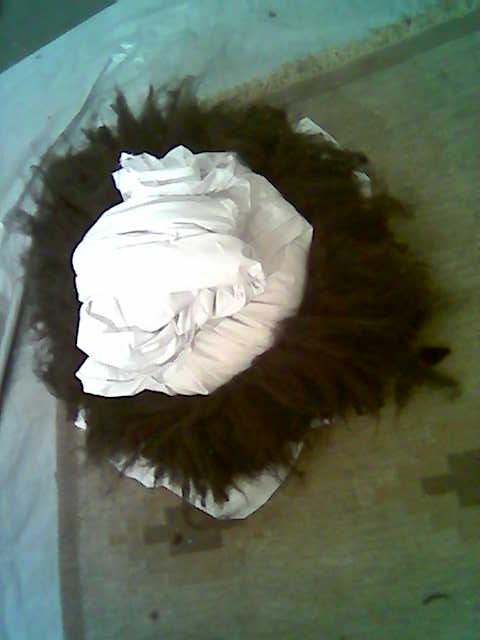
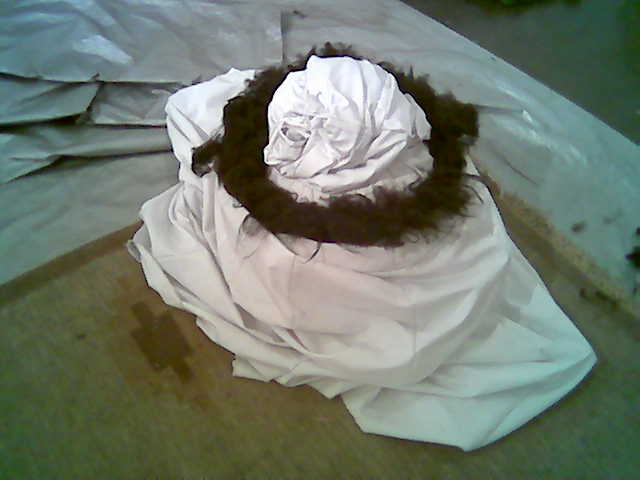
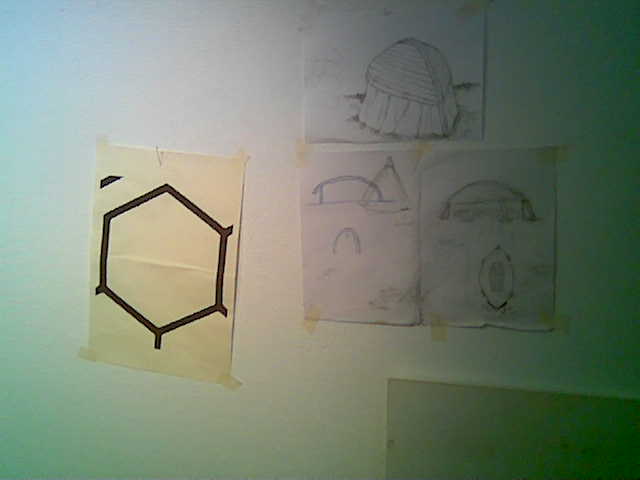
‘Darkness’ workshop is going on at gallery Titanik, in the heart of a Northern midsummer’s abundance of light; right now it’s almost 10 pm and still daylight outdoors. Reino Koivula, my appreciated colleague, non-organizes the event which develops graciously.
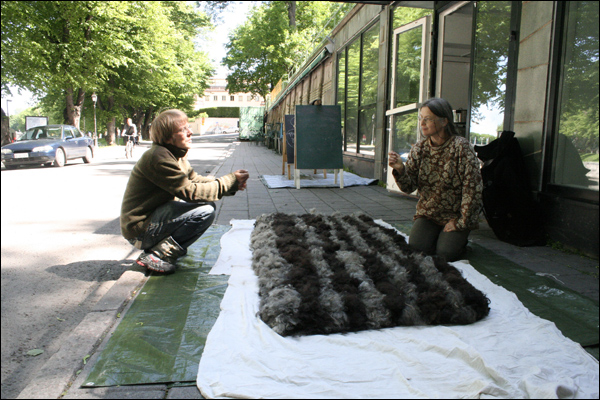
Darkness workshop at gallery Titanik; photo by Reino Koivula
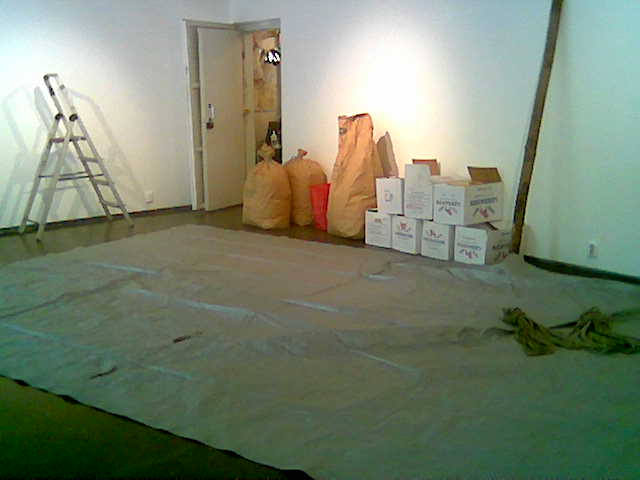
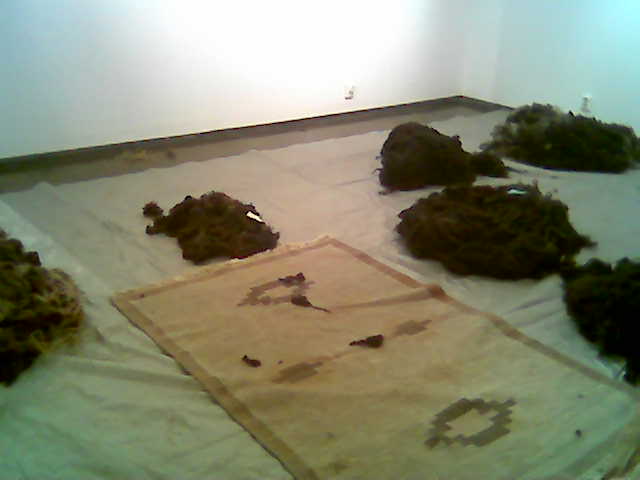
I’m the last to leave the gallery, having figured out a possible technique to make three-dimensional bell-shaped pieces of felt and now making the equipment for it. Today’s accomplishment was another carpet, striped in lighter and darker gray and measuring 1,0 x 2,4 metres, later to be cut and shaped by Reino.

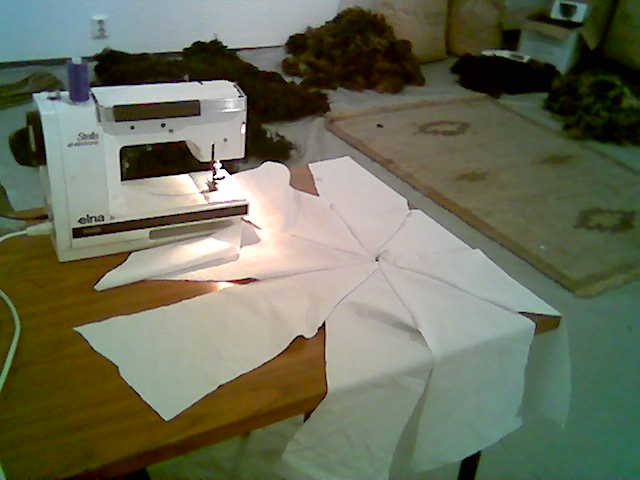

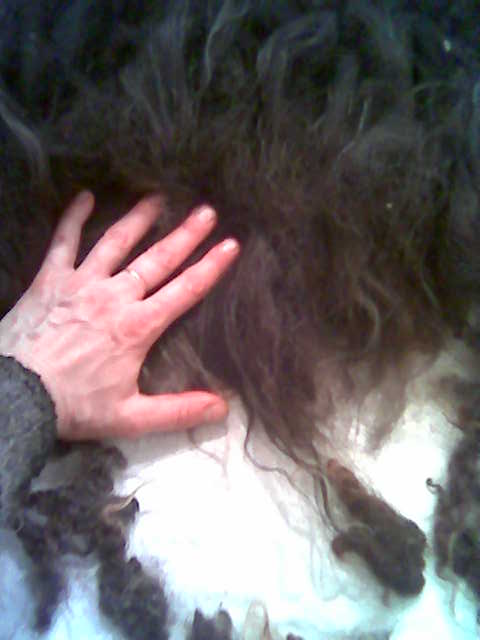


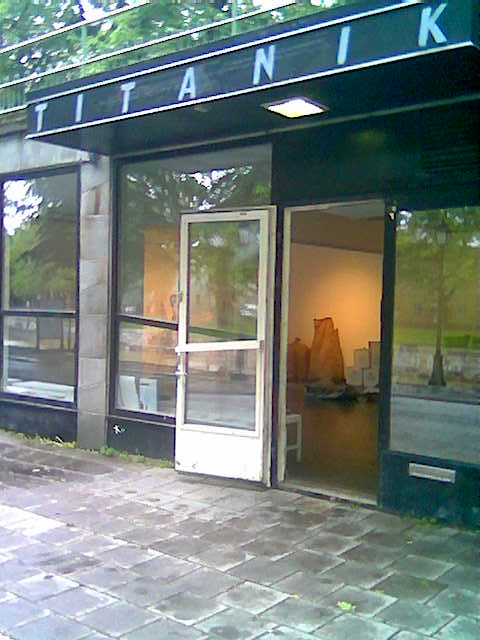

Today, the first felting was done at gallery Titanik by the bank of Aura river in Åbo/Turku. Wool from värmlandsfår and gutefår, two old Swedish sheep-breeds, was used. Two ewes of värmlandsfår, Stina and Brita, had provided us beautiful dark brown/black fells which were successfully turned into one flat, thick piece of felt measuring 1,1 x 1,5 metres. Moreover, we did some experimenting on three-dimensional felting with gray-black gutefår wool.

Last week, the Nomadic University held its eighth oasis called ‘Crisis? What Crisis?’ – once more in Åbo/Turku. There were lectures by Roger Säljö, Bruce Johnson, Karl-Erik Norrman and others … the opening of Hanna Varis’ exhibition in Åbo Castle… and some good working which will hopefully turn out fruitful.
For full programme, see the NUrope webpage:
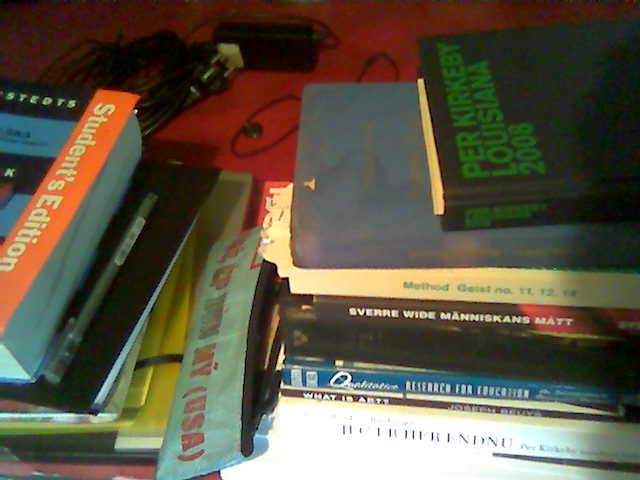
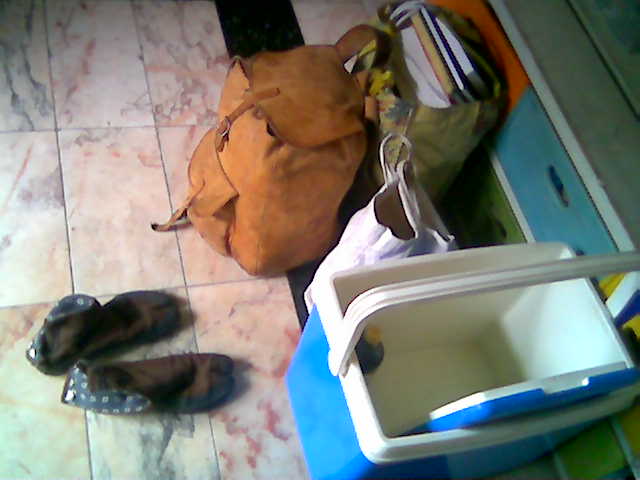
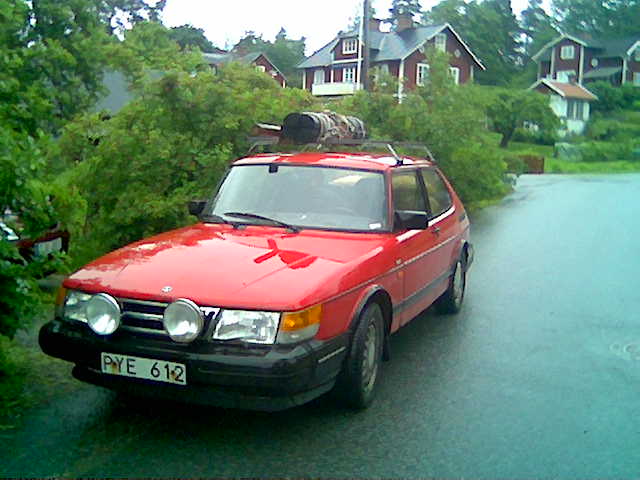
Now, after a short visit home, I pack my car for returning: one bag of course literature, a cool bag for milk and honey, some personal things – clothes and toothbrush, mainly; a huge big cauldron, ten litres of liquid soap, a carpet, a tarpaulin, a bed-sheet and a young tree-trunk plus eight sacks of first-class quality wool in different shades of darkness. Let’s see what will happen next.

“Is there a method to die?”
How could this question make sense? For all we know, death will happen to everybody alive; it’s the one condition we all share. There’s no method not to die.
This makes clear that the essential word here isn’t ‘death’ – it’s ‘method’. The common-sense understanding of this word might be something like: ‘a set-up of presumptions and techniques used systematically to arrive at a certain result’. Now, if the result – in this case, physical death – is certain, no matter what, the question may still seem absurd. But stay with it a while…
The Greek origin of the word ‘method’ means ‘way’. Without doubt, the way one takes could be related primarily to a determined goal – that is, result-oriented – which doesn’t necessarily affect one’s existence very much. When going to the airport, one may choose between the highway or the railway; both offer the prospect of a fast and safe arrival (though we all know that things do not always happen the way we plan).
On the other hand: when going into something unknown, one will need to enhance awareness when moving along the chosen direction. Finding one’s way then becomes process-oriented; in each moment, the way outside exists only to the extent that it exists in one’s mind. This is how the concept of method is often adressed in contemporary art and research.
I remember the way I travelled by the side of my mother. I remember the parting of ways.
And the question makes perfect sense.
Second course seminar with professor Liora Bresler from the University of Illinois, USA, together with Swedish hosts Lars Lindström and Eva Österlind (Stockholm University) and some twenty master and doctoral students. Akira Kurosawa’s movie Rashomon from 1949 provides a common ground for discussions about truth on different levels.
Most people agree there exists such a thing as objective reality; in Rashomon, it is represented by a man found dead in the forest. The characters involved are struggling to understand the course of events. Their tales are told and retold in multiple layers: by Kurosawa’s choice of sounds and images in making the film; within the story by the actors acting them over and over, each time from another point of view; and when the movie ends, by our thinking and talking over it. On each level, interpretations are constructed, negotiated and created anew; if there is a true story about what happened, it remains an enigma. Still, the memory stays with us, the gesture of seeking truth and meaning.
So, where is the difference, really, between the researcher’s mode of understanding reality and the artist’s? Is it only a matter of context, of different communities and traditions? Here’s one attempt at an answer, from John Dewey in 1934:
“The rhythm of loss of integration with environment and recovery of union not only persists in man but becomes conscious with him; its conditions are material out of which he forms purposes.
[…]
Since the artist cares in a peculiar way for the phase of experience in which union is achieved, he does not shun moments of resistance and tension. He rather cultivates them, not for their own sake but because of their potentialities, bringing to living consciousness an experience that is unified and total. In contrast with the person whose purpose is esthetic, the scientific man is interested in problems, in situations wherein tension between the matter of observation and of thought is marked.
[…]
The difference between the esthetic and the intellectual is thus one of the place where emphasis falls in the constant rhytm that marks the interaction of the live creature with his surroundings.”John Dewey, Art as Experience (1934)
 Helena Hildur W.

