
Mars, the God of War, is pictured as a potent bringer of violence and destruction. Many among us have also experienced the actual pains and traumas of migration, displacement and escape from unbearable circumstances…
Still, there will always be futures beyond warfare.
How do we understand our true needs – and how can they be fulfilled in times of turmoil?
Which values are worth building a future upon?
How could new paths be found, when old ways are lost?
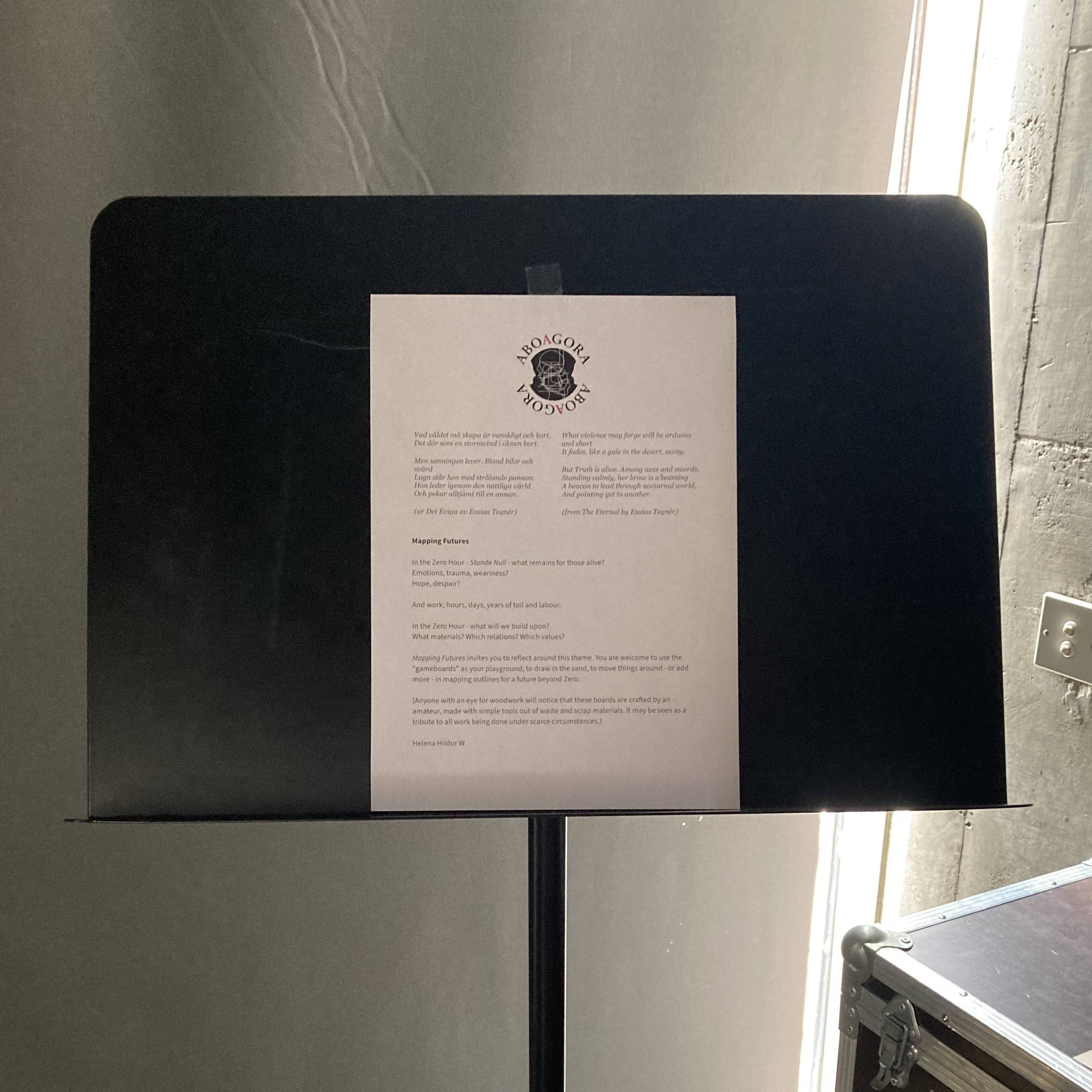
Mapping Futures invites participants to reflect, to share experiences, and to co-create around this theme. We’ll use map-making as a working format, along with movement and listening. And – since play is a very serious business – the workshop will stay open for playfulness, too.
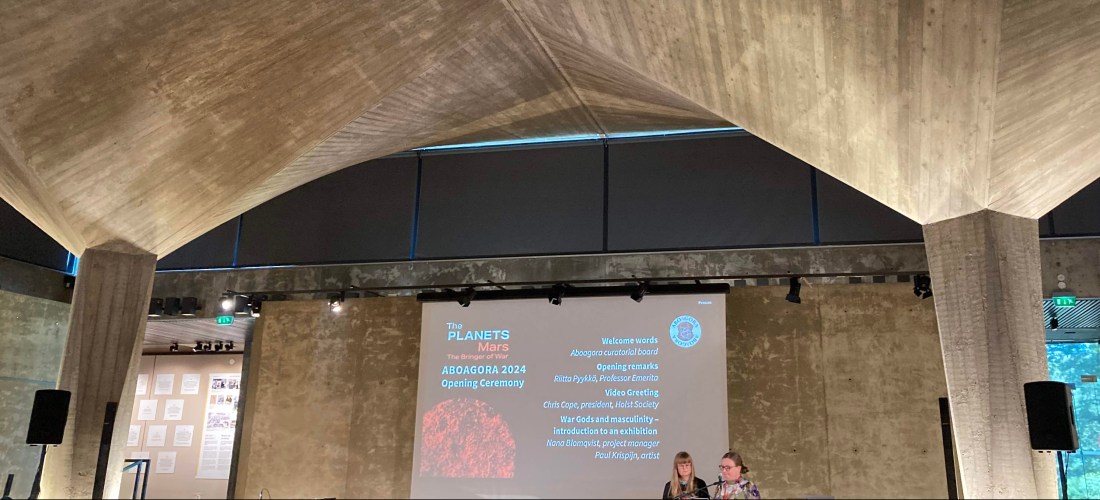
Such was the presentation of Mapping Futures, as it appeared in the programme of AboAgora 2024. I learned that sixteen participants had signed up in advance – a full group. The actual workshop was scheduled on the third and last day – Friday, August 30th – and the plan was to have it outdoors, in the museum’s garden, to connect with nature as well as with the surrounding cityscape… Unfortunately, according to the weather forecast, the floating fluffy morning skies were likely to turn into heavy winds, thunder and rainfall by noon. Project coordinator Petra and I had to take a decision about the locale, and quickly agreed to move all the material inside. An hour later, 40 kilograms of sand was carried indoors along with the hexagon boards, and the “beach” was prepared – complete with pebbles and seashells, bottle caps and plastic rubble, bird feathers and other tiny items (all brought from Sweden in my suitcase).
By 10am, a few light clouds occasionally dimmed the warm sunlight. The group of participants gathered in the shadow of the huge oak tree, once planted by Linnaean adept Pehr Kalm – a tree that has survived fire and ice, war and unrest for more than 250 years… After two full days of artistic and scientific perspectives on martial machineries, this seemed to be a good point of departure for a workshop focusing on resilience.


left and right: Pehr Kalm’s oak;
middle: the group assembling, photo credit: Pekko Vasantola
Before leaving, each one of us took a moment to visualize a Stunde Null, such as it might appear in some place familiar: in our home or workplace, in the streets or paths we use to walk… A Ground Zero not only for humans, but for all structures and living organisms. Bearing this image in mind, we set out for a silent walk to the cobbled square by the cathedral.


Silent moments, photo credit: Pekko Vasantola
Ten minutes went by there, as we quietly stayed with our personal thoughts and feelings; then we gathered again to return to the museum.
In the Zero Hour, what remains for the ones alive – emotions, trauma, weariness? Hope, despair?
And hard work; hours, days, years of toil and labour.
What, then, would remain to build upon? What structures and materials? Which relations? Which values?
On walking back, the participants were invited to share with each other, and also to keep an outlook for objects that could serve as tokens and symbols in the map-making. The sky was already darkening as we entered the museum. The smaller groups, which began to form during the short walk, now clustered around the boards. This was a crucial moment to me; how would these highly qualified individuals feel about playing together, using pebbles and pinecones like little kids in days long gone? and moreover, around such a challenging theme?


above and below: hands-on work and extended connections;
photo credit: Pekko Vasantola
It turned out that there was no need for worries. The groups immediately began projecting their ideas: honouring the dead and caring for the living, constructing shelters and community facilities, preparing the soil for sowing… Plastic waste created problems in some places, while forests, domestic animals, music and insects were generally cherished. In one of the maps, plastic caps were opened up and distributed to represent receptivity, tolerance, and understanding; in another, a grey feather, planted upright, proudly signalled the rejection of black-and-white thinking.


Heart-shaped artwork by Jan Erik Andersson in Pehr Kalm’s garden outside the museum,
and mapped futures by workshop participants inside
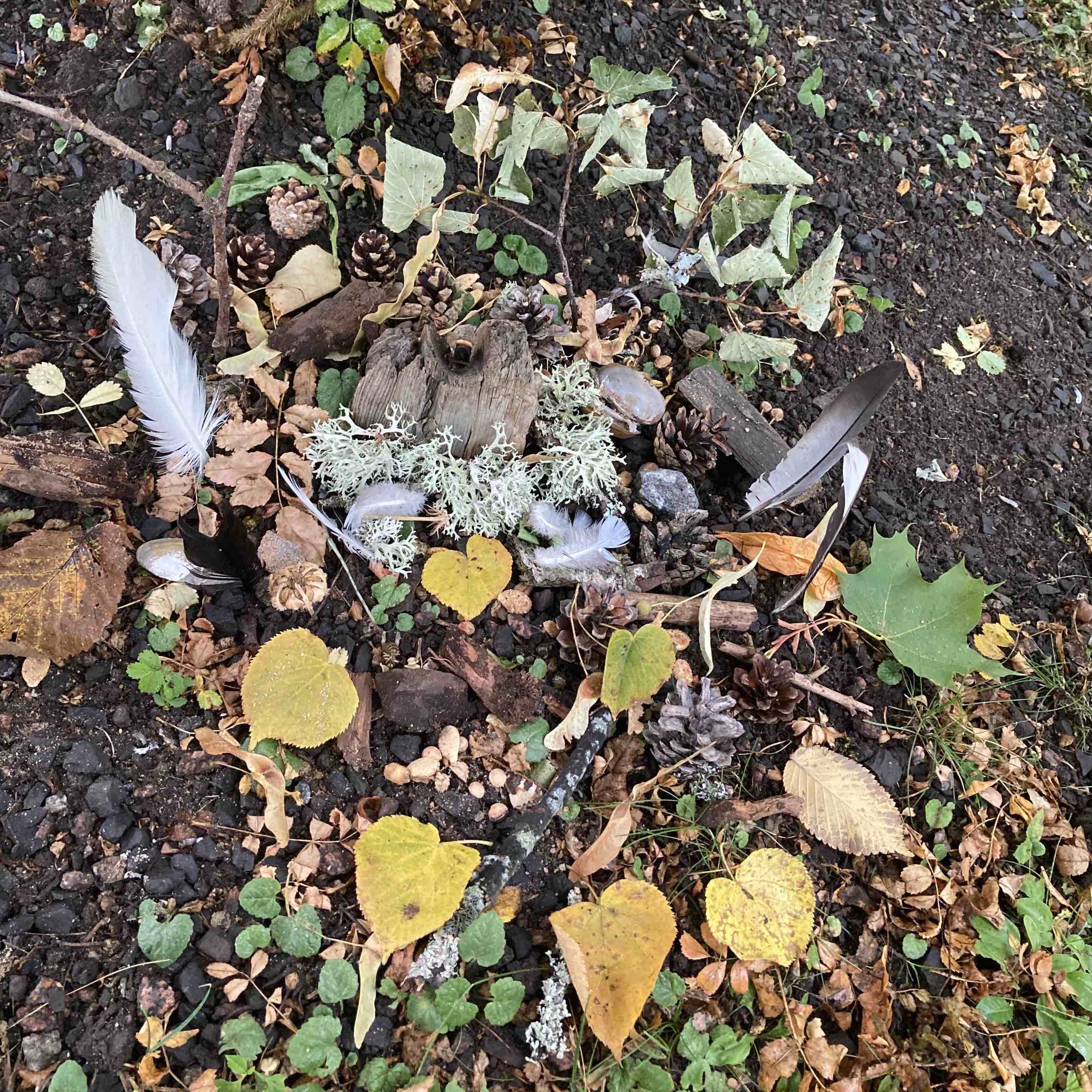
One hour and a half passed quickly, but there was still time to share some concluding reflections while the wind slowly dropped and the sky grew clearer. Later in the afternoon, the crafted futures were collected and brought back to where they belonged: non-organic waste to the recycling systems, and the leaves, lichen, feathers, and butterfly wings to the rain wet ground under a rose bush.
I wish to thank all participants, who played along so wholeheartedly, and the staff members of AboAgora 2024 and the Sibelius museum, who welcomed and supported Mapping Futures; and thanks also to all who took part in Mapping on the Beach in 2023, and Alina Kalachova, with whom I developed the original concept.


 Helena Hildur W.