Duplicity / Duplicität Symposium (Day 00)

art, upcoming

Tuesday morning begins with breakfast at Lindsey’s, then a slippery walk on pavements all covered with black ice. Yesterday, S-bahn trains were cancelled due to ice on the tracks; today, luckily, they’re back in traffic. The trip from Wedding to Steglitz takes approximately 40 minutes, then another walk from Rathaus Steglitz to the Institut für Theaterwissenschaft at Freie Universität Berlin. Here, the sidewalks are carefully sanded since our path coincides with the direction to a meeting point and facility for the community of blind Berliners. Gratefully, we trod along following a gentleman finding his way by help of the white stick.

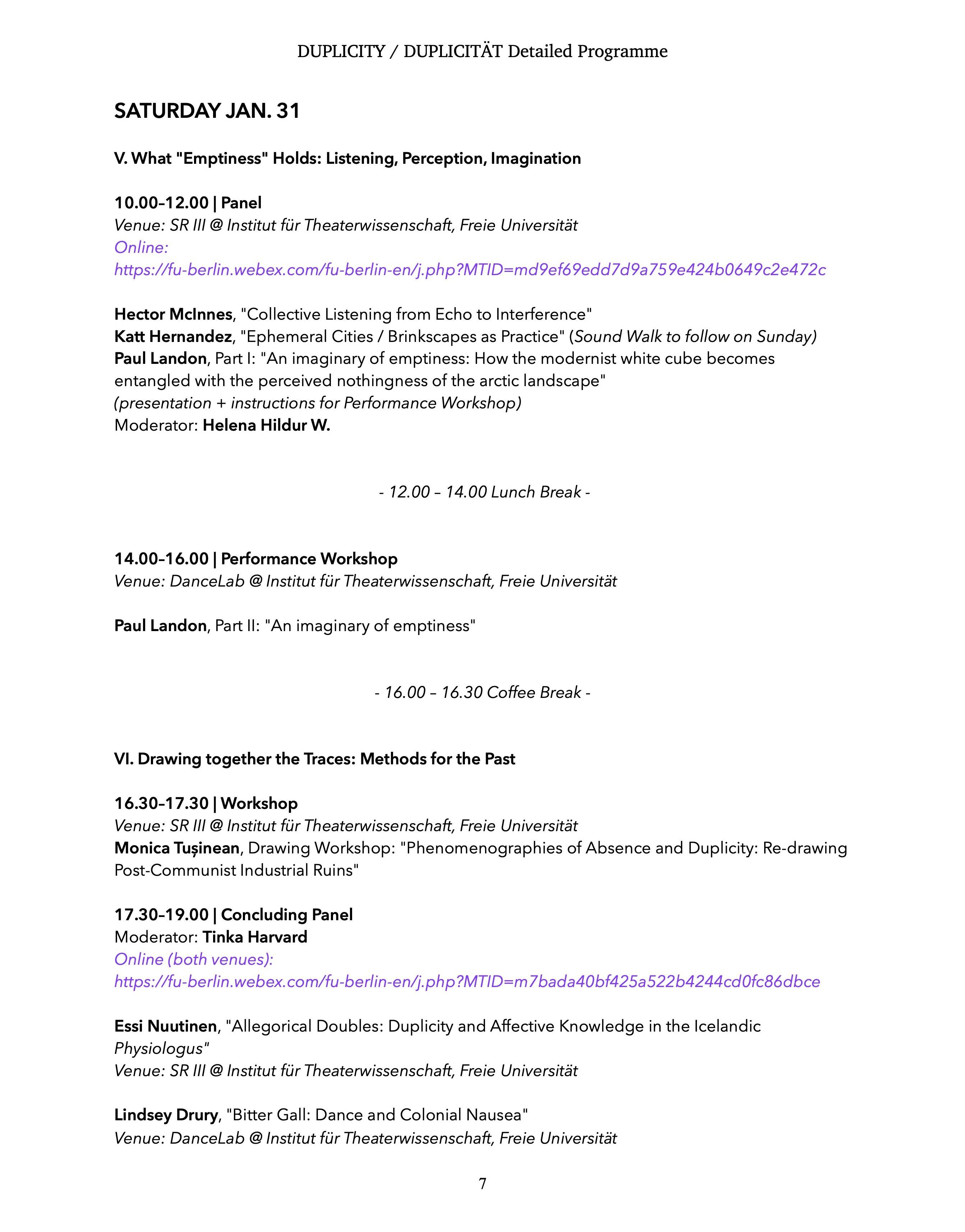
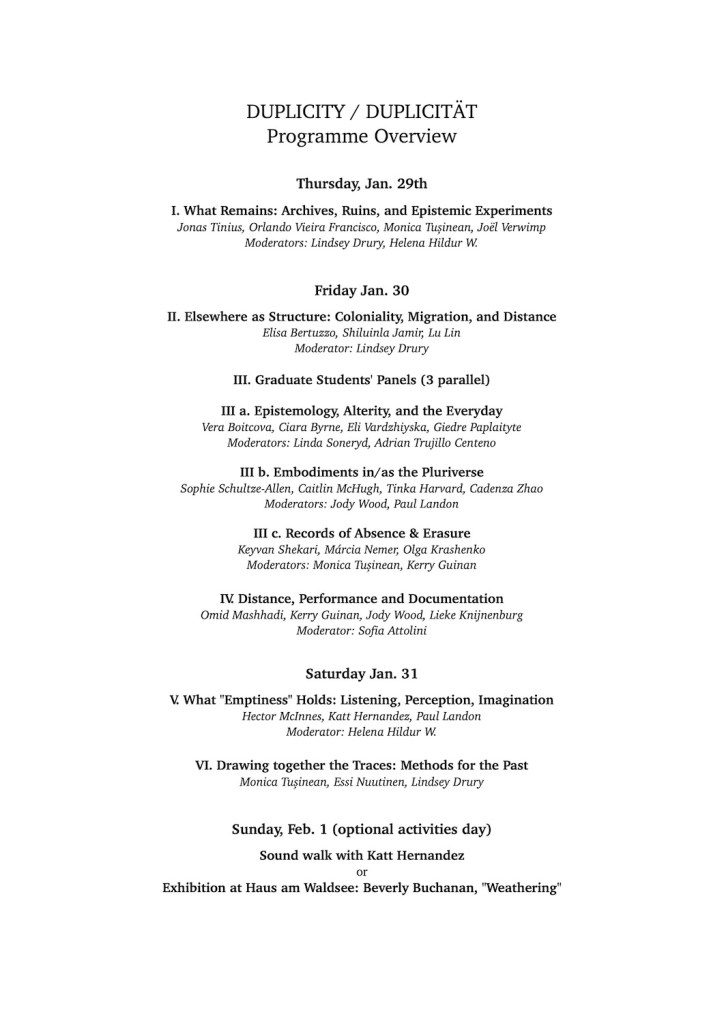
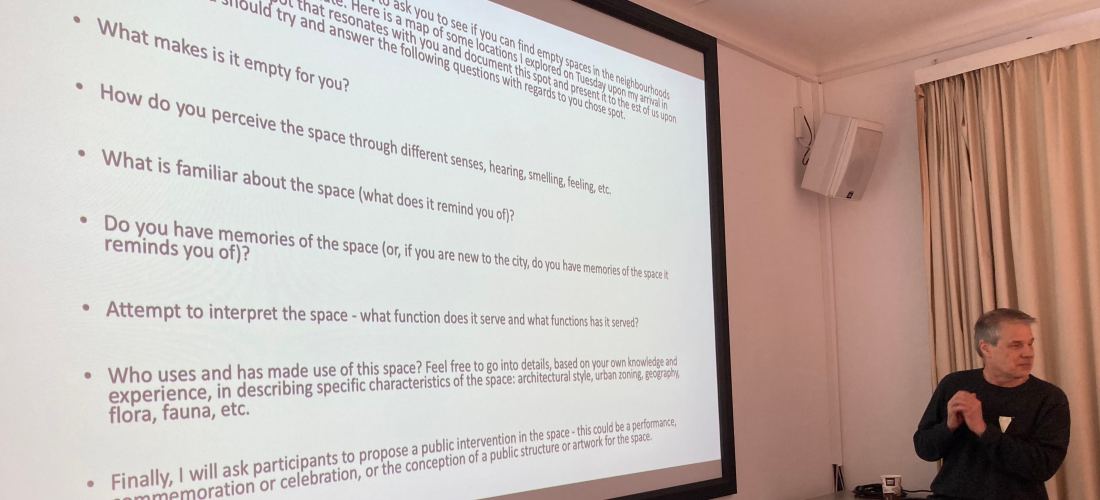
This is my first visit to the Freie Uni. (and, in fact, to Berlin). I try to make myself familiar with the venues booked for the symposium, as Lindsey prints the first copies of the event programme. It’s difficult to imagine that all these things are actually going to take place here; that all these people will soon show up in person… Still two days to go.

For the afternoon, I decide to visit Haus am Waldsee further out in the Southwest part of the city, to see the exhibition we’ve added as an option for Sunday’s programme: Weathering by Beverly Buchanan.

Leaving the Freie Uni, I see a man writing something in the snow covering the windshield of a yellow car, then continuing to the next one to leave another message, before he strolls on along the road… Arriving at the Rathausplatz, I realize today is January 27th – the International Holocaust Remembrance Day. 

The Haus am Waldsee turns out to be a museum of modest proportions, a patrician villa within a large English garden, dedicated mainly to contemporary art since 1946. The ongoing exhibition – works by Black American Artist & Diva Beverly Buchanan (1940-2015) and London/Amsterdam-based artist Ima-Abasi Okon touches me deeply. Buchanan’s equally headstrong and compassionate way of moving forward as an artist, bringing forth the dignity of vernacular architecture in rural US Georgia (and thus, of its builders and dwellers) and carrying out toilsome projects rooted in experiential understanding of power structures and history; paired with the walls painted by Okon with bee pollen soaked in water, in a colour floating between dirt and gold, and conveying a heavenly scent through the light-filled spaces.

This slideshow requires JavaScript.

In the evening, Remoteness team member Tinka arrives from New York City and we move into the hostel apartment that Lindsey has provided for us. Tomorrow will be a busy day…

Duplicity / Duplicität Symposium (Day 000)

art, recent work, upcoming

Still a couple of days to go before the opening on Thursday. Preparations…

This slideshow requires JavaScript.

Ice on the tracks delayed train traffic throughout Denmark and Germany yesterday, and offered plenty of time to make name tags from scrap paper and safety pins.

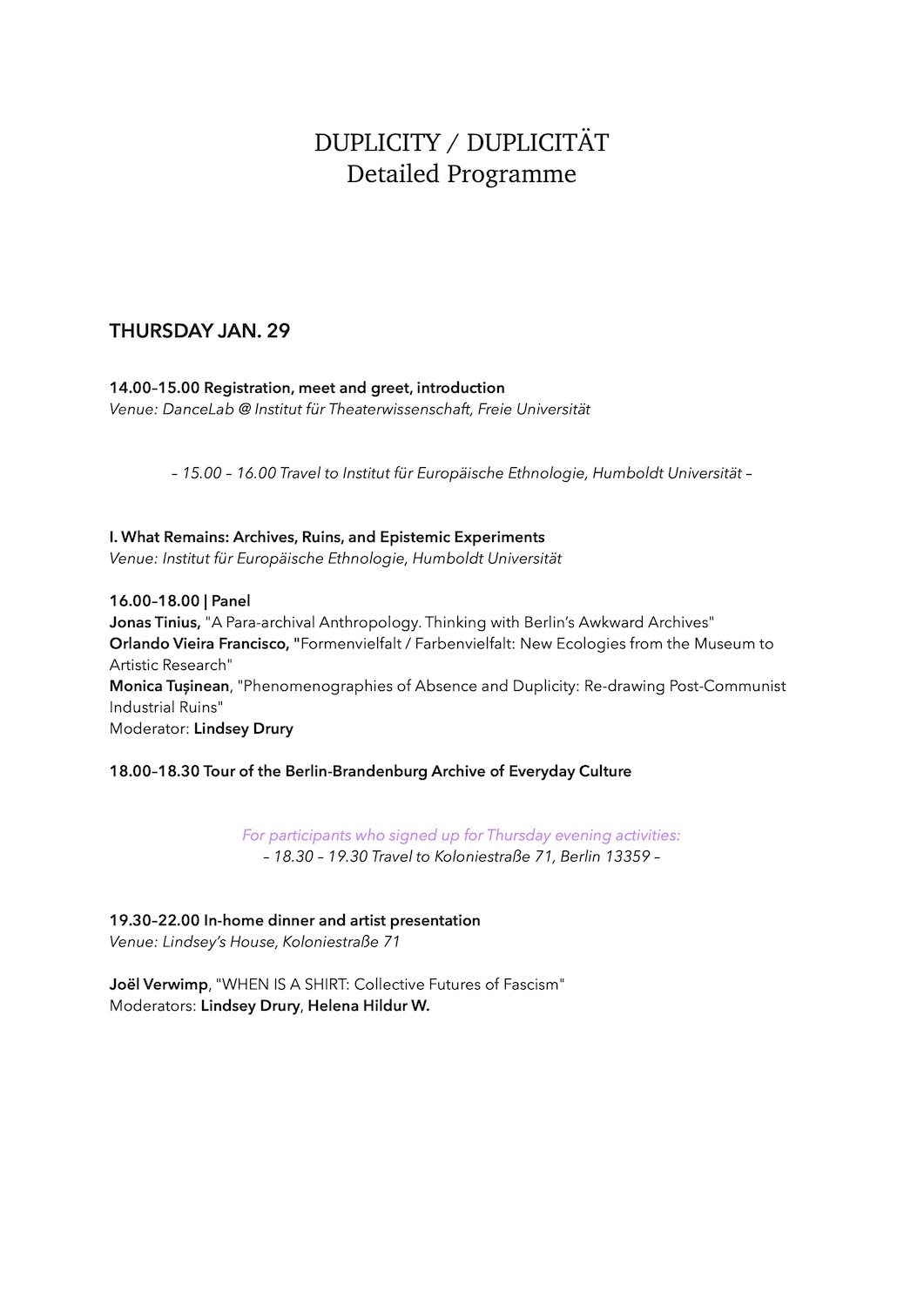
Finally, a warm welcome and a tasty meal in Berlin, followed by the final proofreading of the symposium programme.

Download the full programme here:
Duplicity/Duplicität Winter Symposium Programme

Looking forward: 2026

uncategorized

Looking forward, I see hope.

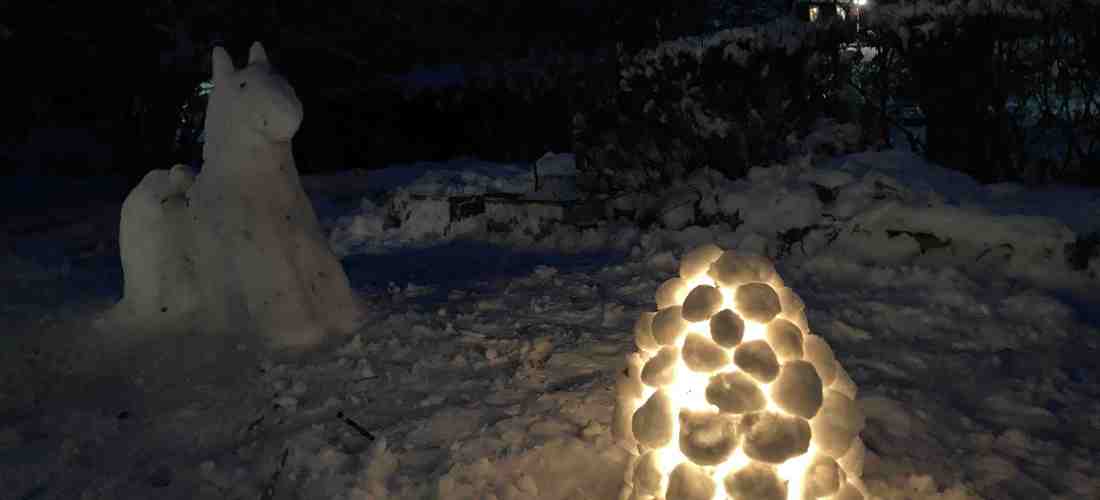
No matter how chaotic, violent and confusing the present, the Earth still travels with the Universe. Snow still falls in the North – sometimes. Birds come to the feeder.

I am connected to people living under conditions of war, of oppression and of poverty; they resist. As long as they do, I cannot give up.

I see acts of care and kindness. I have the freedom to support others; to contribute to my neighbours, to the human and the more-than-human.

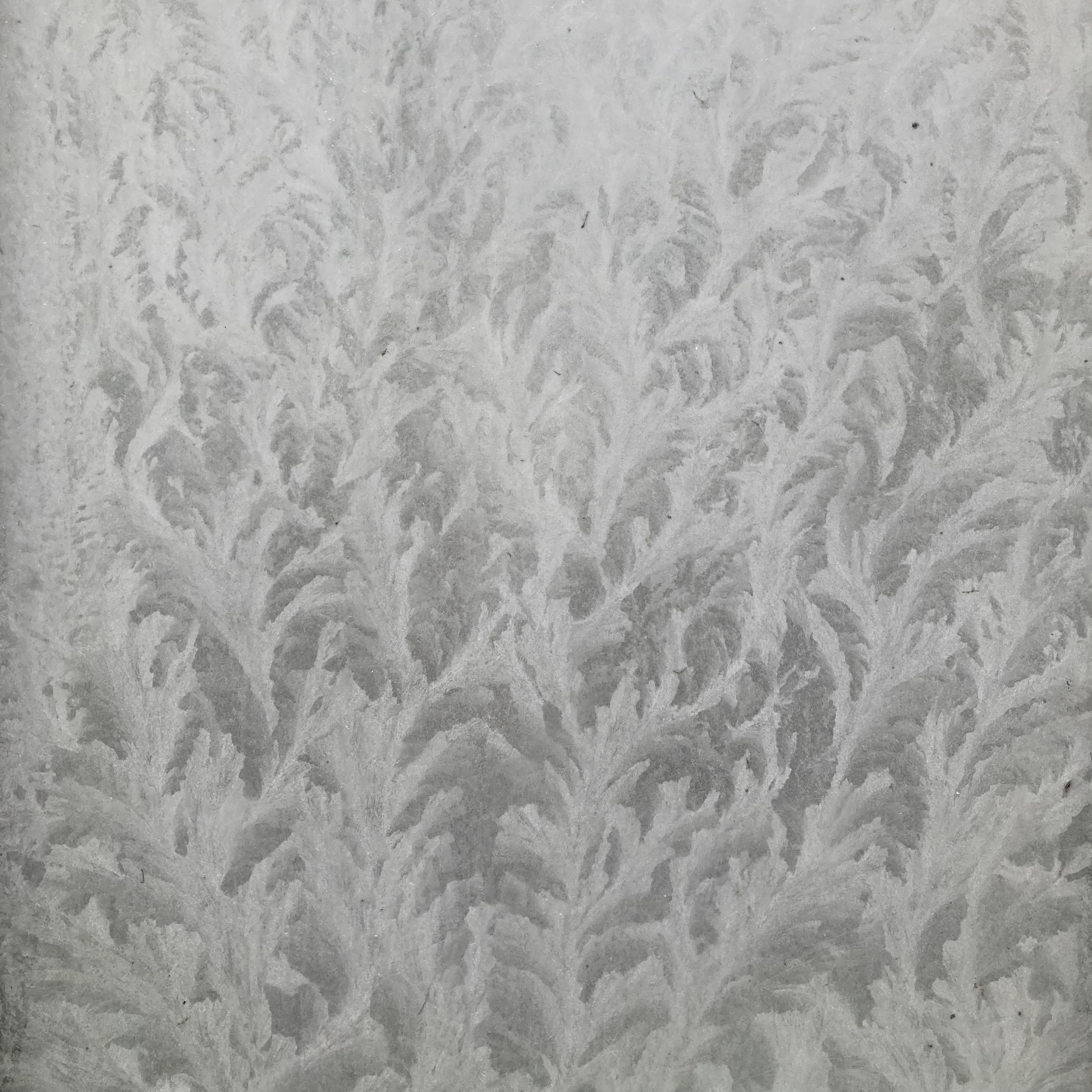
I see hope, like the full moon shining in the winter night; like snow lightening the darkness; crystallizing swiftly like ice fractals.

Mapping Praxis Working Remotenesses I

art, recent work

While the Praxis of Social Imaginaries study circle was coming to an end in 2025, its continuation took form during the recent NSU Summer Session – this year gathering not far from the city of Jyväskylä in the Lake District of central  Finland. Leaving Stockholm on Sunday evening, July 20th…

Stockholm – Åbo/Turku – Jyväskylä – Korpilahti

…I reached the Alkio-Opisto folk high school in Korpilahti after 20 hours of travel. The staff people were welcoming and helpful, it was good to meet friends and colleagues old and new, and delightful to have a swim in the nearby lake – immersing oneself in its summer-warm, velvety body of water. 

Tuesday morning began with scheduled work in the nine established study circles of the Nordic Summer University; the tenth group being our working team. On Tuesday afternoon, we presented our draft for a coming three-year cycle of Studies in Remoteness for community review. The proposal got substantial feedback, which we continued working on during the following days. A few of us were attending on-site in Korpilahti, others could join in digitally when needed. Those of us present also had time to visit some of the other study circles – among them Circle 1, Places of Heritage and Circle 7, Meta-Perspectives on Climate Change Knowledge; later also the circles on Critical Theory, Queer Materialism and Feminist Theory. In each circle, urgent topics were presented and processed in various productive ways; these visits were thought-provoking, not least in trying to understand how our future study circle could add constructive perspectives and relevant methodologies to the Nordic Summer University as a whole.

The Remoteness team was assigned a workplace located at a corridor’s end, beyond the pool table and the soda machine. Having passed a row of portraits of stern-looking men, we opened the door to a neat classroom, containing pot-flowers as well as an exercise bike, a row of large windows, an interesting document hanging in a frame on the back wall…

Entering the ‘Studies in Remoteness’ workplace.
A translation of the text above the tiny photos in the framed picture would be
“First Parliament of the Finnish people, 1907 Disbanded on April 6th 1908”;
an impressive number of women were present (I can spot at least five in the close-up).

… and lo! a world map. After spending the past two-and-a-half years with mappings of various kinds, I cannot un-see the colonial implications of a North-above, Europe-centered map. Having improvised a large table in the middle of the room, I could lay down the map horizontally – still Europe-centered, but at least accessible from all sides. This position invited a more playful approach… A handful of tiny pebbles did the rest.

This slideshow requires JavaScript.

Playing with pebbles on a world map – shifting perspectives, from Nagaland (India) via Berlin, Oslo and Stockholm (Europe) to New York (USA); these are places where the ‘Remoteness’ team members are currently based.

Mapping Praxis IX: In Process

art, recent work

Since March, I’m working in parallel with two or three different mappings. Here some sketchwork pictures:


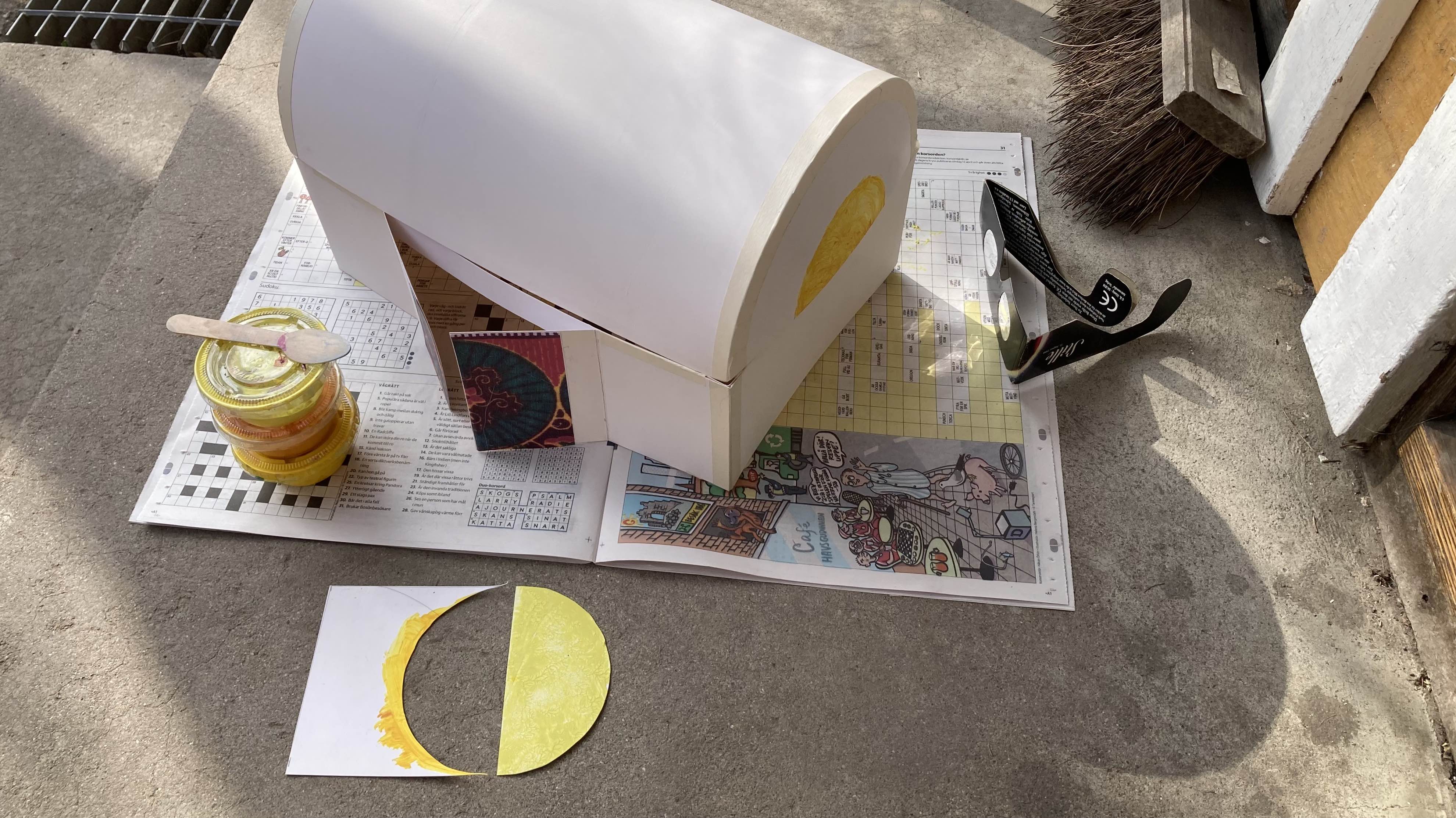
March 29th; sitting outdoors during a partial solar eclipse, manufacturing a cardboard maquette for a three-dimensional map. Half a yellow sun then found its way to one of the sidepieces.

This slideshow requires JavaScript.

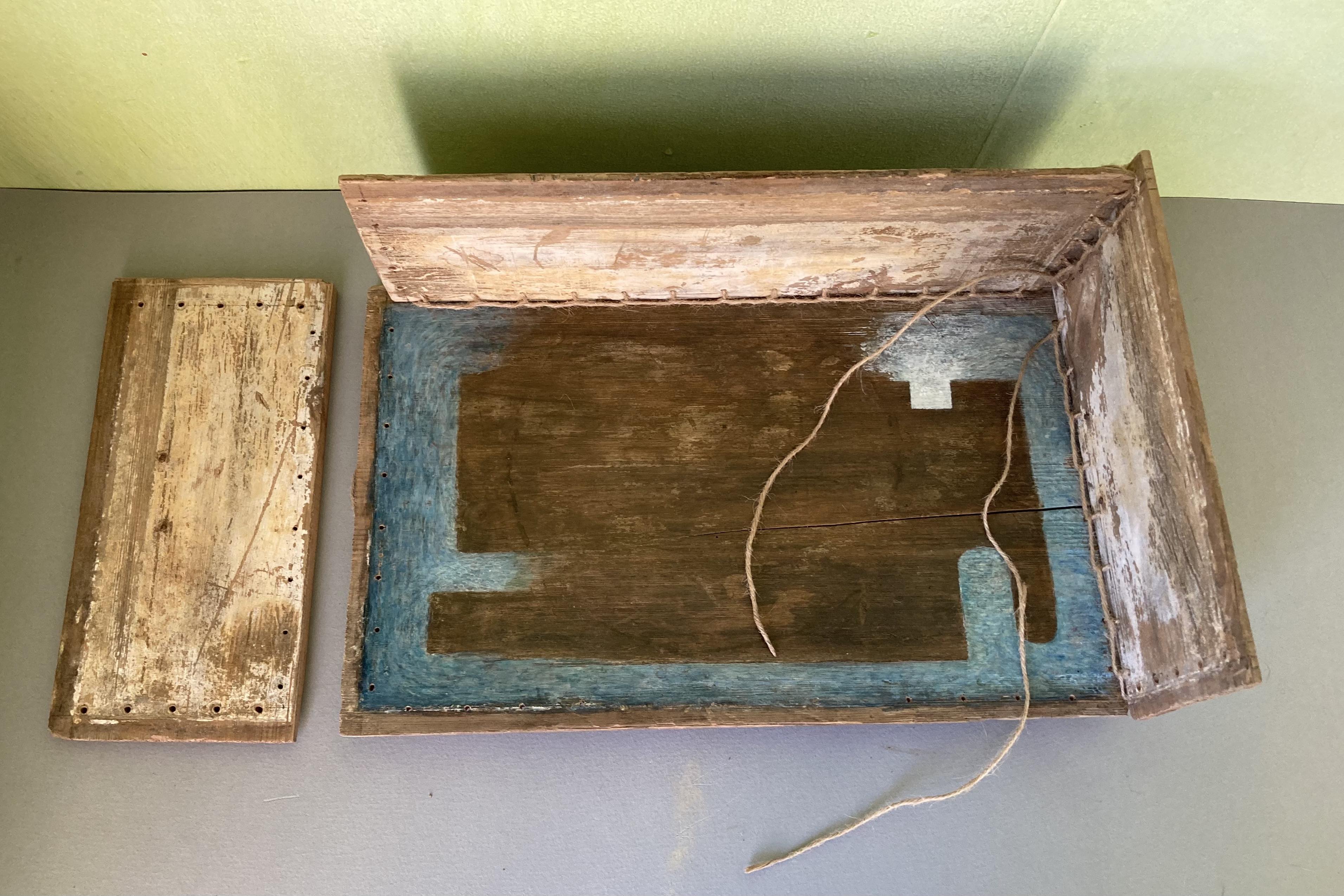
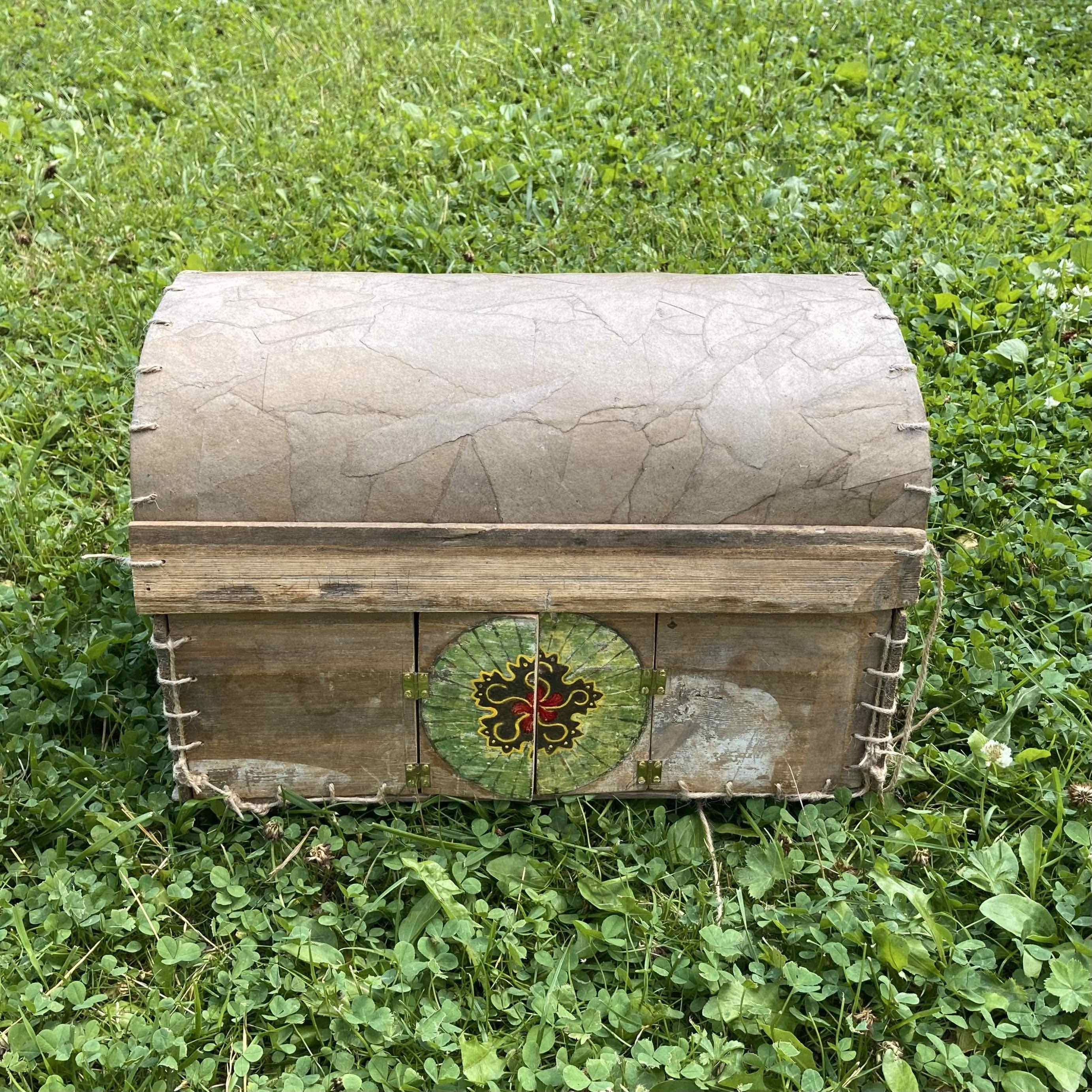
April: following the maquette study, the real construction began. Parts of an old door with flaking paint provided the material. A mountain with a house on top was fitted into the chest, and a vaulted papier maché lid added.

Then, painting. There should be a flower pattern on the doors – a hibiscus would make sense. I tried copying a design from a printed textile by Wax Mama.


Also, the ocean surrounding all continents had to be visualized inside the chest.
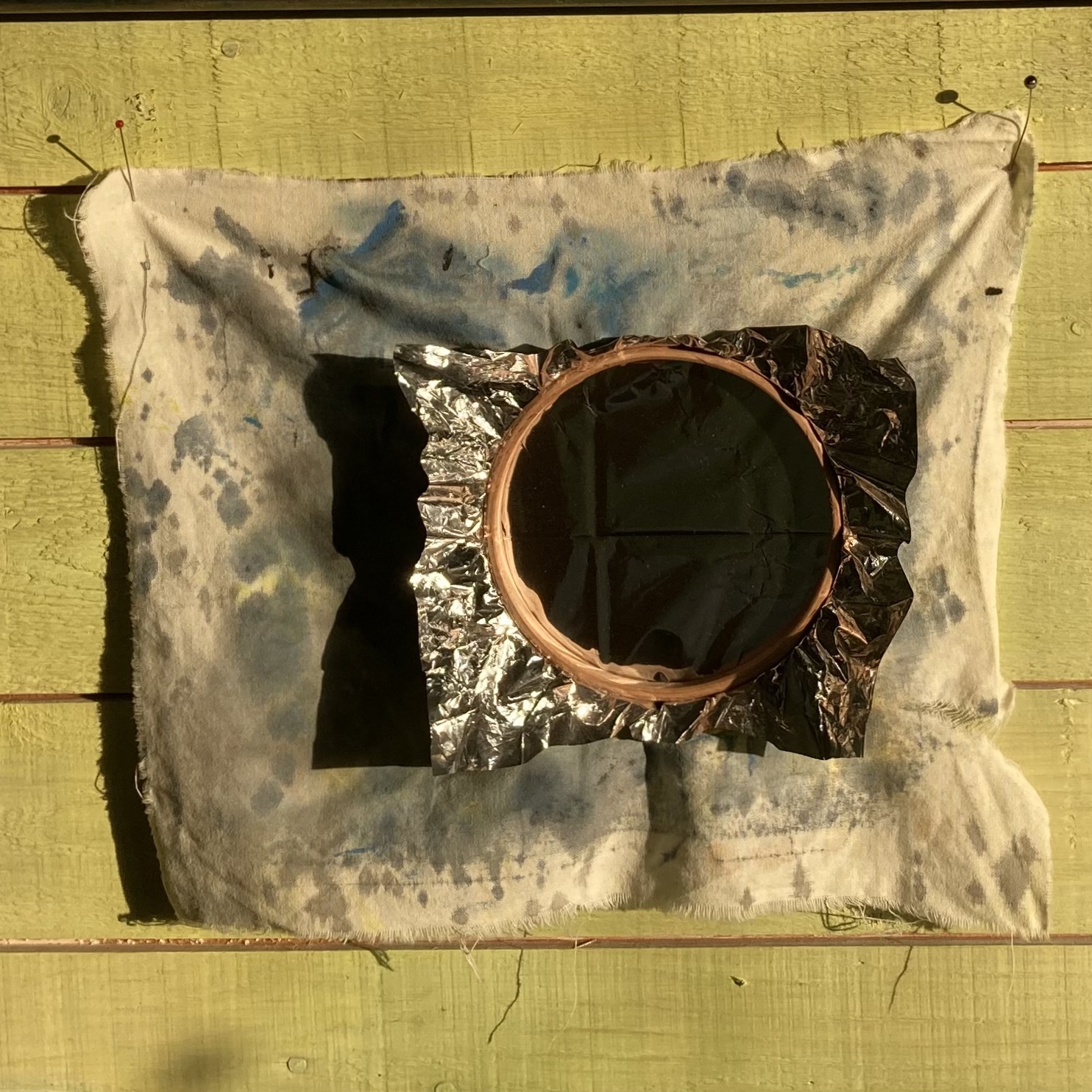
May came and went. Inbetween the construction steps of the chest, I tried to figure out how to best turn an emergency blanket into a mirror – for the making of another, embroidered map…

…before returning to the world inside the chest. Now  summer is in full bloom, and this one is nearing completion… More to come.
Obinna’s Itinerary

Praxis of Social Imaginaries, Winter Session 2025

art, recent work, time-out

On March 5th to 9th, the Praxis circle gathered for another Winter Session – the last one within this three year cycle. Once more, we were hosted by the Sigtuna Foundation; a center for culture, research and education, with roots in the Christian ecumenical movement of the early 20th century. The Foundation resides in a cluster of monastery-like buildings, situated among pine trees on a hillside in the mediaeval city of Sigtuna (Sweden)… a venue quite congruent with the texts we were reading. And the book was A Description of the Northern Peoples, written by Olaus Magnus – the last Catholic archbishop of Sweden – during his exile in Rome, and published in 1555. 

Woodcut from Olaus Magnus’ ‘A Description…’ showing a party of Scricfinnias hunting on ski;
artist unknown, image source Wikimedia Commons

The book consists of a very large number of short chapters, covering topics such as The Five Languages of the Northern Kingdoms, On Preventing Filthy Ditties and Of the Sea-Magicians.  The text was approached from various perspectives (as usual within the Praxis study circle) and further processed through workshops in writing, drawing and listening.  A chapter on sword and fire dances generated an improvised solo dance by Dr. Laura Hellsten; and the mediaeval Festivals of Greenery were discussed and enacted while enjoying the first sunny day of spring. In present time, Ramadan had begun and a handful of the participants were observing the lent during daylight. Luckily, dinners were served after sunset, and we could all share plentiful, tasty meals in the dining hall… as the new moon was quietly waxing.


Woodcut from Olaus Magnus’ ‘A Description…’ showing a ship running aground after being misled by a fire on the shore, 
and men of the Finnmark attacking the supposed pirates onboard with stones in their hands.;
artist unknown, image source Wikimedia Commons

Olaus Magnus’ original text was accompanied by woodcuts, made under supervision of the author himself especially for this first edition; an unusual feature that most probably contributed to make the book a success. As can be seen, the scenes were abundant with vivid detail… About one hundred of these pictures actually originate from an earlier publication of Olaus Magnus: the Carta Marina. Printed in Venice in 1539 – after twelve years of work – it is in itself a rich description of places, creatures and people; an almost overwhelming compilation of material provided from memory by the banished archbishop. This map provided the starting point of a session on Magic, facilitated by Dr. Lindsey Drury, where we connected events described in the book with the actual places on the map – and, again, with our own experiences of traditions and histories handed down over generations…

Olaus Magnus’ Carta Marina, printed in Venice (1539) and later hand-coloured;
artist unknown, image source Wikimedia Commons

My own contribution followed shortly after this session, and included a listening exercise borrowed from Pauline Oliveros’ Deep Listening scores; a silent walk along the hillside groves; and providing handmade booklets for making personal notes while finding one’s way back to the Foundation. The idea was to turn from an analytical mode, into attention in the present – shifting from the realm of the scholar (Olaus Magnus) in order to approach the mindset of a person closer to weather, shifts of light and temperature, and other-than-human life…

(In fact, I believe that the indigenous “magic” perceived by foreigners may – more often than not? – be the result of close attention paired with traditional knowledge.)

Spirit Land performed by Nina Nordvall Vahlberg, Emma Göransson, Olli Liljeström, Carolina Bjon, Minna Hokka, Marianne Maans, Kari Mäkiranta and Frank Berger

In the next-to-final day of the Winter Session, the Praxis circle was invited to take part of Vuoiŋŋalaš Eanadat / Spirit Land, an artistic collaboration between two of our co-participants: textile artist / artistic researcher Emma Göransson and composer / musician Frank Berger. The performance also included a number of musicians from Finland and Sàpmi, and was open to the public as a part of Sigtuna Foundation’s cultural program.

The auditorium was crowded, and the afternoon sun gently spread its light through the textiles as music and jojk began to fill the air. For two years, Emma and Frank have been working towards this performance – and now was the moment! Colours, textures and sound intertwined, invoking the visible and invisible landscapes of the North. In Emma’s own words: “The three cosmological spheres in traditional Sami mythology – Jabbmeájjmo/Underworld, Eana/Earth, and Albmi/Heaven – are represented by monumental weavings, here set to music. The voices of the landscapes are heard anew, restored and brought to life, but changed.”

Afterwards, Dr. Hellsten moderated a talk between Frank, Emma, and Dr. Shiluinla Jamir – another valued member of the Praxis circle, who graciously added the perspective of a person from the indigenous Naga people of Northeast India. Listening to Frank’s music, and the jojks of Emma and Nina Nordvall Vahlberg; watching the delicate weavings floating in light; and following the exchange of indigenous experiences… were some of the memorable moments of hope and beauty that will stay with me.

Mapping Praxis VIII: Talk, Text and Textiles

art, recent work

The embroidered Mapping Praxis itineraries are products of face-to-face chats, and of handicraft rendering talk into tactile textile maps. In parallel, and thanks to the efforts of Laura Hellsten, participants of the Praxis of Social Imaginaries study circle have been invited to contribute to a special issue of a scientific journal. Since September, the mapping project has therefore extended into academic writing.

Halfway into the first month of 2025, three embroidered maps were completed (sometimes after several revisions) and a first draft for an article was submitted. The work continues, now by realizing the next three mappings… 

Art’s Birthday Rebirth: Soundtower Growing Roots

art, recent work, upcoming

Being part of the Ljudtornet (Soundtower) sound/art platform has been inspiring, joyful and rewarding in so many ways… From the beginning in 2018, we have realized six ANTENN festivals in the old Watertower of Gnesta (engaging almost a hundred Swedish and international sound artists, musicians, filmmakers, and other exhibitors/performers); we have made web radio broadcasts reaching listeners globally; and since 2020, we have celebrated Art’s Birthday on the 17th of January by making original sound/art installations.

From the Watertower into the forest; photo HHW.

When the local municipality decided to lock the watertower permanently in 2023, the Soundtower staged a mourning march and farewell ceremony. We lost a homeplace, but the spirit stayed with us; we kept on collaborating, in various constellations, and kept in touch. In November 2024, some of us took part in a manifestation for Ulvaskogen/Wolves’ Wood – a local forest, threatened by brutal logging. From this event, a seminal thought began to grow… and on Art’s Birthday 2025, the seedling reached the light.

The Soundtower is growing new roots… 

This slideshow requires JavaScript.

“The Light in Wolves’ Wood” event, Nov. 17th, 2024;
contributions by Soundtower artists Julia Adzuki, Patrick Dallard, Tomas Björkdal, Rolf Schuurmans, Helena Hildur W, the Ministry for Environmental Grief;
photos by Eliot Freed

Mapping Futures @ AboAgora II

art, recent work

Mars, the God of War, is pictured as a potent bringer of violence and destruction. Many among us have also experienced the actual pains and traumas of migration, displacement and escape from unbearable circumstances…

Still, there will always be futures beyond warfare.

How do we understand our true needs – and how can they be fulfilled in times of turmoil?
Which values are worth building a future upon?

How could new paths be found, when old ways are lost?

Mapping Futures invites participants to reflect, to share experiences, and to co-create around this theme. We’ll use map-making as a working format, along with movement and listening. And – since play is a very serious business – the workshop will stay open for playfulness, too.

Such was the presentation of Mapping Futures, as it appeared in the programme of AboAgora 2024. I learned that sixteen participants had signed up in advance – a full group. The actual workshop was scheduled on the third and last day – Friday, August 30th – and the plan was to have it outdoors, in the museum’s garden, to connect with nature as well as with the surrounding cityscape… Unfortunately, according to the weather forecast, the floating fluffy morning skies were likely to turn into heavy winds, thunder and rainfall by noon. Project coordinator Petra and I had to take a decision about the locale, and quickly agreed to move all the material inside. An hour later, 40 kilograms of sand was carried indoors along with the hexagon boards, and the “beach” was prepared – complete with pebbles and seashells, bottle caps and plastic rubble, bird feathers and other tiny items (all brought from Sweden in my suitcase).

By 10am, a few light clouds occasionally dimmed the warm sunlight. The group of participants gathered in the shadow of the huge oak tree, once planted by Linnaean adept Pehr Kalm – a tree that has survived fire and ice, war and unrest for more than 250 years… After two full days of artistic and scientific perspectives on martial machineries, this seemed to be a good point of departure for a workshop focusing on resilience.

left and right: Pehr Kalm’s oak;
middle: the group assembling, photo credit: Pekko Vasantola

Before leaving, each one of us took a moment to visualize a Stunde Null, such as it might appear in some place familiar: in our home or workplace, in the streets or paths we use to walk…  A Ground Zero not only for humans, but for all structures and living organisms. Bearing this image in mind, we set out for a silent walk to the cobbled square by the cathedral.

Silent moments, photo credit: Pekko Vasantola

Ten minutes went by there, as we quietly stayed with our personal thoughts and feelings; then we gathered again to return to the museum.

In the Zero Hour, what remains for the ones alive – emotions, trauma, weariness? Hope, despair?
And hard work; hours, days, years of toil and labour.

What, then, would remain to build upon? What structures and materials? Which relations? Which values?

On walking back, the participants were invited to share with each other, and also to keep an outlook for objects that could serve as tokens and symbols in the map-making. The sky was already darkening as we entered the museum. The smaller groups, which began to form during the short walk, now clustered around the boards. This was a crucial moment to me; how would these highly qualified individuals feel about playing together, using pebbles and pinecones like little kids in days long gone? and moreover, around such a challenging theme?

above and below: hands-on work and extended connections;
photo credit: Pekko Vasantola

This slideshow requires JavaScript.

It turned out that there was no need for worries. The groups immediately began projecting their ideas: honouring the dead and caring for the living, constructing shelters and community facilities, preparing the soil for sowing… Plastic waste created problems in some places, while forests, domestic animals, music and insects were generally cherished. In one of the maps, plastic caps were opened up and distributed to represent receptivity, tolerance, and understanding; in another, a grey feather, planted upright, proudly signalled the rejection of black-and-white thinking.

Heart-shaped artwork by Jan Erik Andersson in Pehr Kalm’s garden outside the museum,
and mapped futures by workshop participants inside

One hour and a half passed quickly, but there was still time to share some concluding reflections while the wind slowly dropped and the sky grew clearer. Later in the afternoon, the crafted futures were collected and brought back to where they belonged: non-organic waste to the recycling systems, and the leaves, lichen, feathers, and butterfly wings to the rain wet ground under a rose bush.

I wish to thank all participants, who played along so wholeheartedly, and the staff members of AboAgora 2024 and the Sibelius museum, who welcomed and supported Mapping Futures; and thanks also to all who took part in Mapping on the Beach in 2023, and Alina Kalachova, with whom I developed the original concept.