Duplicity / Duplicität Symposium (day three of three)

art, recent work, time-out

… and how could the spirit of the second day be carried forward now – bursting with intellectual and emotional energy as it was?

The answer turned out to come almost by itself, with a change of pace: from yesterday’s parallel strings of concise case studies swiftly followed by verbal exchanges of Q’s and A’s, to extended presentations creating space for a deeper listening; for resonance, outwardly and inwardly…
 

The first feature of Saturday’s programme, sound artist Hector MacInnesCollective Listening from Echo to Interference, carried us from Berlin to the the Isle of Skye, inviting us to roam and rest within a delicately composed soundscape of voices: repeated calls for contact, interlaced with distinct impressions and reflections on records, intimacy, and distance – evoking feelings of loss and sadness, imbued with a sense of care. A tentative call for solidarity?

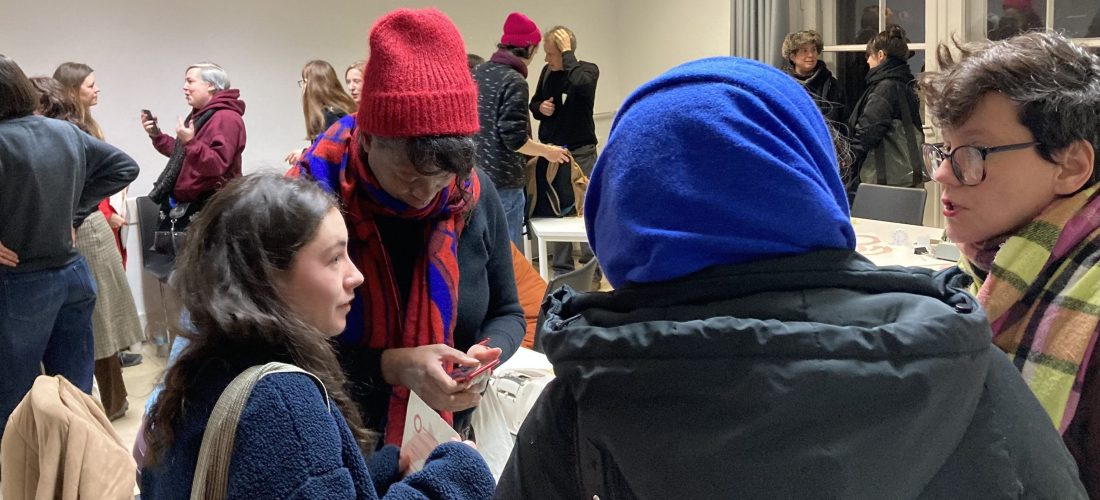
Above: Hector MacInnes in dialogue with the group, after the Collective Listening experience
Below: Katt Hernandez waiting to present Brinkscapes as Practice (left);
“Kungens Kurva strange utility hut”, photo credit Katt Hernandez (right)


Next, musician and composer Katt Hernandez performed a dérive in urban peripheries, cutting through notions about desolate wastelands by addressing the warehouses, shopping malls, and vast parking lots as comforting sites of everyday human presence and protective anonymity, fondly naming them brinkscapes. The rhythmical sequence of pictures, speech, and silences unfolded as if tuned to inaudible music – eventually set free to sound by the fiery and tender voice of Katt’s violin.

The journey continued as media artist, professor Paul Landon took us to Arctic landscapes in the Cold War era, where military demands employed the “perceived nothingness” of supposedly uniform expanses of dazzling snow, as the DEW (Distant Early Warning) system was erected across Alaska and Canada; a massive effort turning self-sustaining ecosystems into a backdrop for the demonstration of power and cutting-edge technology.

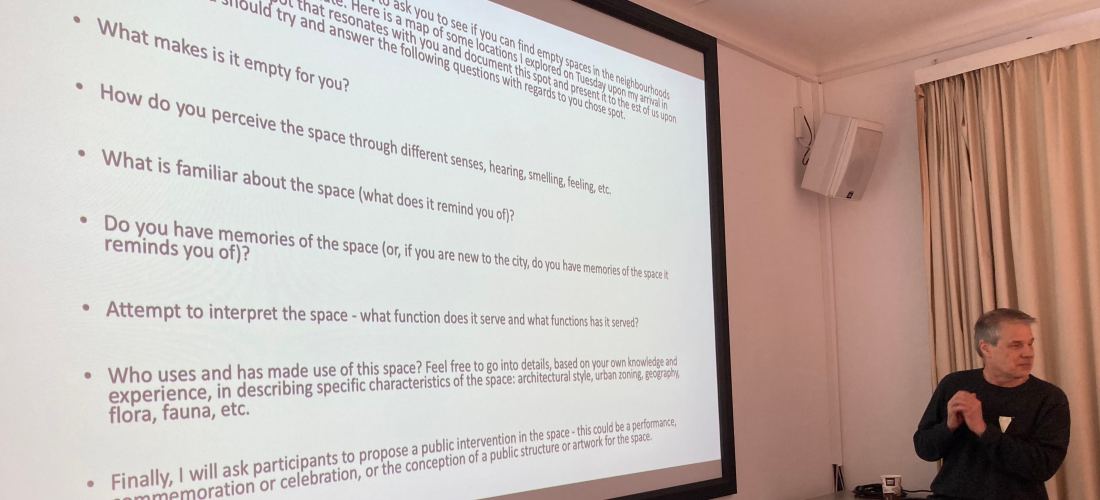
For the extended lunch break, Paul sent us on a mission:

– Go for a walk in the neighbourhood and look for an empty space that resonates with you; document what you find, so that you can present it to the group; stay with your chosen spot for a while, trying to perceive, understand and interpret it; from this experience, think of a public intervention to amplify, alter, celebrate or comment on its particular emptiness.

And so we did.

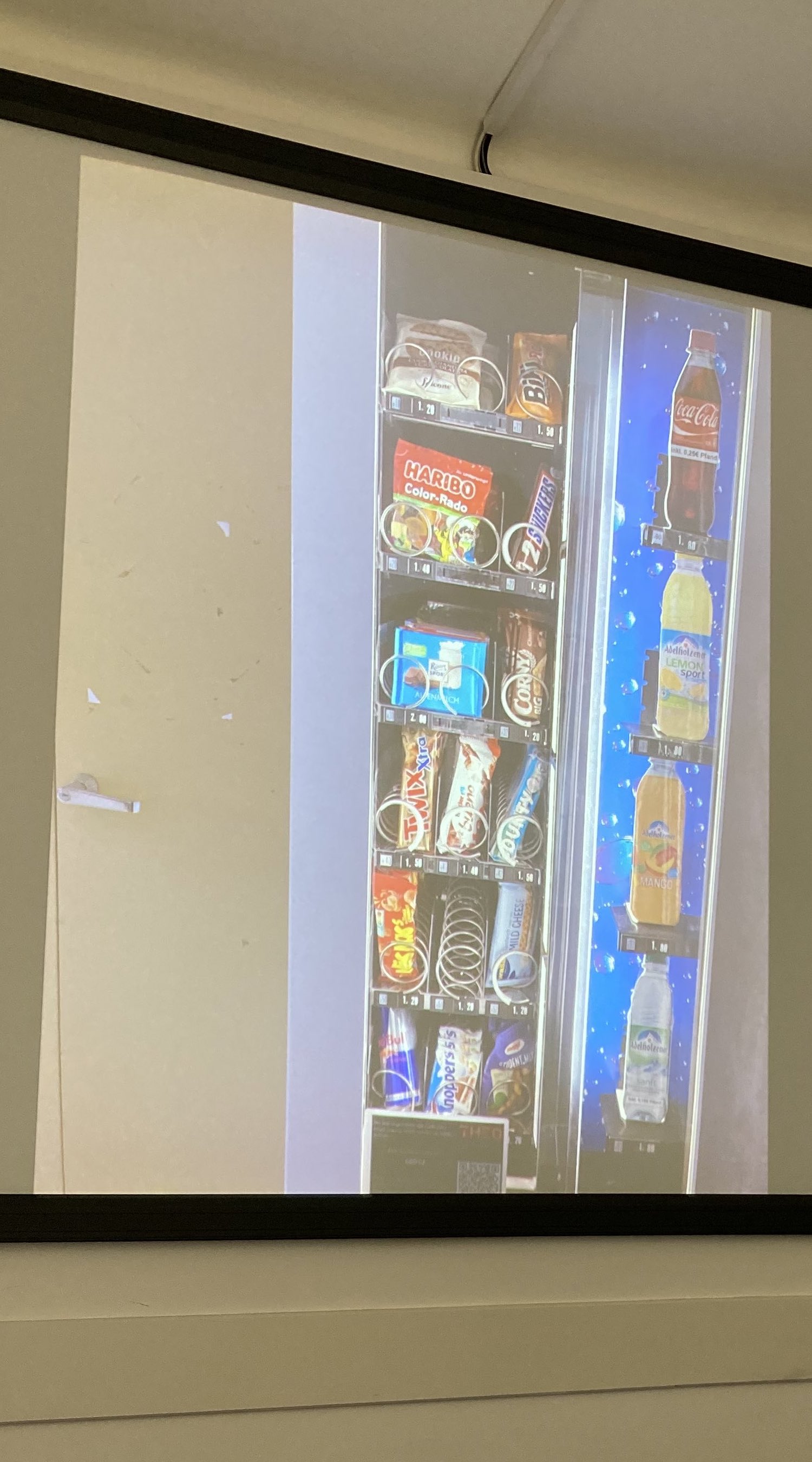
Two hours later, the group reassembled to share the documented emptinesses: an inaccessible yard; a snow-covered balcony; a construction pit; a beanie hat lying in the street, lost from the head it used to protect; a gap in the flow of consumer goods in a vendor machine…

Above: Prof. Paul Landon sharing pictures from his personal collection of emptinesses
Below: an emptiness captured by Caitlin McHugh
We shared photos, and more: we shared, unguardedly, our sustained attention, our awareness towards qualities and emotions, our personal renderings – stirring interest, reflections, compassion, and friendly laughter – in a flow already present yesterday, now broadening and deepening like a river.

For my own part, this workshop remains a highlight; first, spending time on my own in the midst of these intense days, and then returning, respirited, to co-create with to peers, now become friends.

Duplicity “emptiness” excursion along Grünewaldstrasse – Paulsenstrasse – Rückertstrasse – Brentanostrasse
(photos by HHW.)

A coffee break, then another workshop: Phenomenographies of Absence and Duplicity. Re-drawing Post-Communist Industrial Ruins by architect Monica Tușinean. Drawing and tracing paper rolled out all along the table, graphite pens and thick black markers distributed, instructions given…

Above: re-imagining Romanian industrial heritage sites by drawing “phenomenographic vignettes”,
workshop by Monica Tușinean
Below: Essi Nuutinen gives us monsters

The playful excitement of the drawing workshop was gently redirected into focused common attention by Tinka Harvard, serving as moderator for the programme’s last section. As eyes turned back to the projection screen and the room fell silent, Essi Nuutinen introduced us to the Icelandic finngálkn, or onocentaur; a hybrid human-animal being, signifier of inherent duplicity and vehicle for imaginative moral thinking; a creature of folklore and Christian allegories appearing in the mediaeval book known as the Physiologus. The Icelandic manuscript in itself carries a story of transformation, as it went from being a valued keeper of knowledge, to having its pages torn apart and perforated by hundreds of tiny holes – surviving the centuries repurposed to separate coarse meal from finer… a sieve. A membrane. 

After moving upstairs to another venue – the DanceLab – the intertwined themes of ethos, body, and mediaeval history were continued by Lindsey Drury, in her performance lecture Bitter Gall: Dance and Colonial Nausea. History inherited as the “past-in-body-present”; the body, a receptacle torn by conflicting forces; ethos, the values and practices that sifts out the self. 

This slideshow requires JavaScript.

From Lindsey Drury’s performance lecture Bitter Gall: Dance and Colonial Nausea

I cannot reduce this performance lecture into words; I will not even make an attempt. But it stays in my sieve, like the coarse and nutritious elements of stone-ground wholemeal – not to be disposed of, not to throw up, but to be digested over time. I will carry it with me, as a part of who I am, for times to come. 

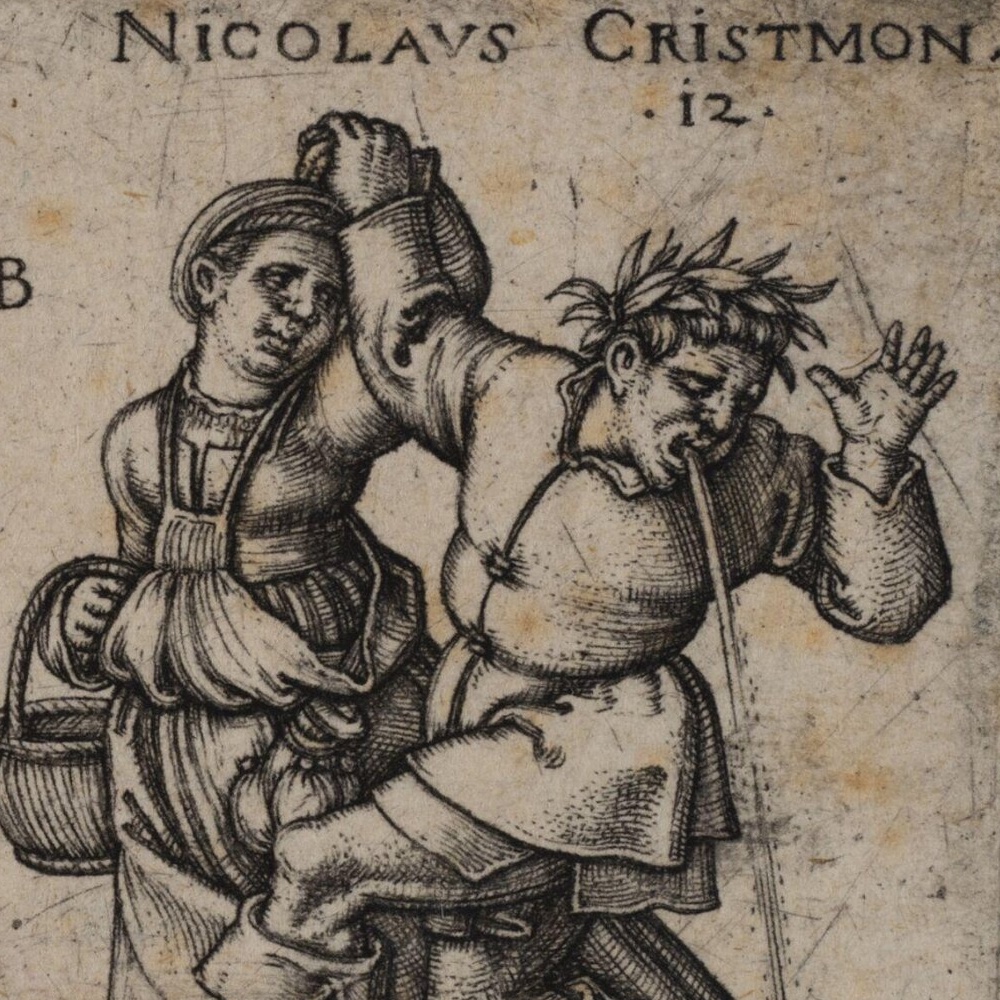
For a final vignette, I return to an engraving visible in one of the photos above: Sebald Beham’s The Peasants’ Feast (month of December). I see the woman. I see her steady gaze beholding her witless, spewing partner, while leading him forward in dance; her expression does not tell of any judgment.
Duplicity / Duplicität Symposium (day two of three)

art, recent work, time-out

Come the second day of this adventure… beginning at 10am sharp with Elsewhere as structure: a panel on coloniality, migration and distance, with two of the speakers present online from Southeast Asia. Urban ethnographer Dr. Elisa Bertuzzo opened the panel with another flip of perspectives, recounting how colonizers of the past proudly filled Europe’s novel, prestigious botanical gardens with “exotic” plants – while today’s immigrants are accused of spreading “invasive” species when growing kitchen vegetables from their home places in South European backyards. PhD student, architect, and designer Lu Lin shared her work on dual belongings and cross-cultural design proposals, carried out between China’s Wenzhou region and Italy, together with immigrants and returnees. Concludingly, Dr. Theol. Shiluinla Jamir reflected on Lifestyle as Resistance (an intriguing essay by Prof. Veena Talwar Oldenburg in 1990), raising questions on how moral life is performed in a socio-spatial sphere of “remoteness”, and what it could be to lead a good life.

From the “Elsewhere as Structure” panel: hybrid meeting preparations;
two slides and a close-up from Elisa Bertuzzo’s presentation;
a mapping exercise shared by Lu Lin (all photos by HHW.)


After lunch, the programme divided into three parallel tracks in the Graduate Students’ Panels. I sadly missed out on the Epistemologies and the Erasures panels, as I followed four presentations on Embodiments – by Sophie Schultze-Allen, Caitlin McHugh, Tinka Harvard and Cadenza Zhao – insightfully moderated by Prof. Paul Landon and artist Jody Wood, with beautiful exchanges also between the panelists.

Sophie Schultze-Allen on “Decolonial Ecologies in Dance”, and feedback snapshots from Cadenza Zhao’s presentation on “Embodiment of Duplicity” (all photos by HHW.)

After a coffee break – offering some time to share reflections more informally – we all gathered to listen to presentations on Distance, Performance and Documentation by PhD student and theatre director Omid Mashhadi (Dokumentartheater Berlin), and visual artist Dr. Kerry Guinan (Centre for Art and the Political Imaginary, Gothenburg-Stockholm); again, generating many thoughts as well as lively exchanges.

This slideshow requires JavaScript.

Slide from Mashhadi’s rehearsal work with Ukrainian refugees at the Dokumentartheater Berlin;
participants taking notes;
a slide with content creators from Nepal, Egypt and Ukraine on live video stream, from Guinan’s work “Portraits”;
snapshots from discussion between Mashhadi and Guinan (all photos by HHW.)

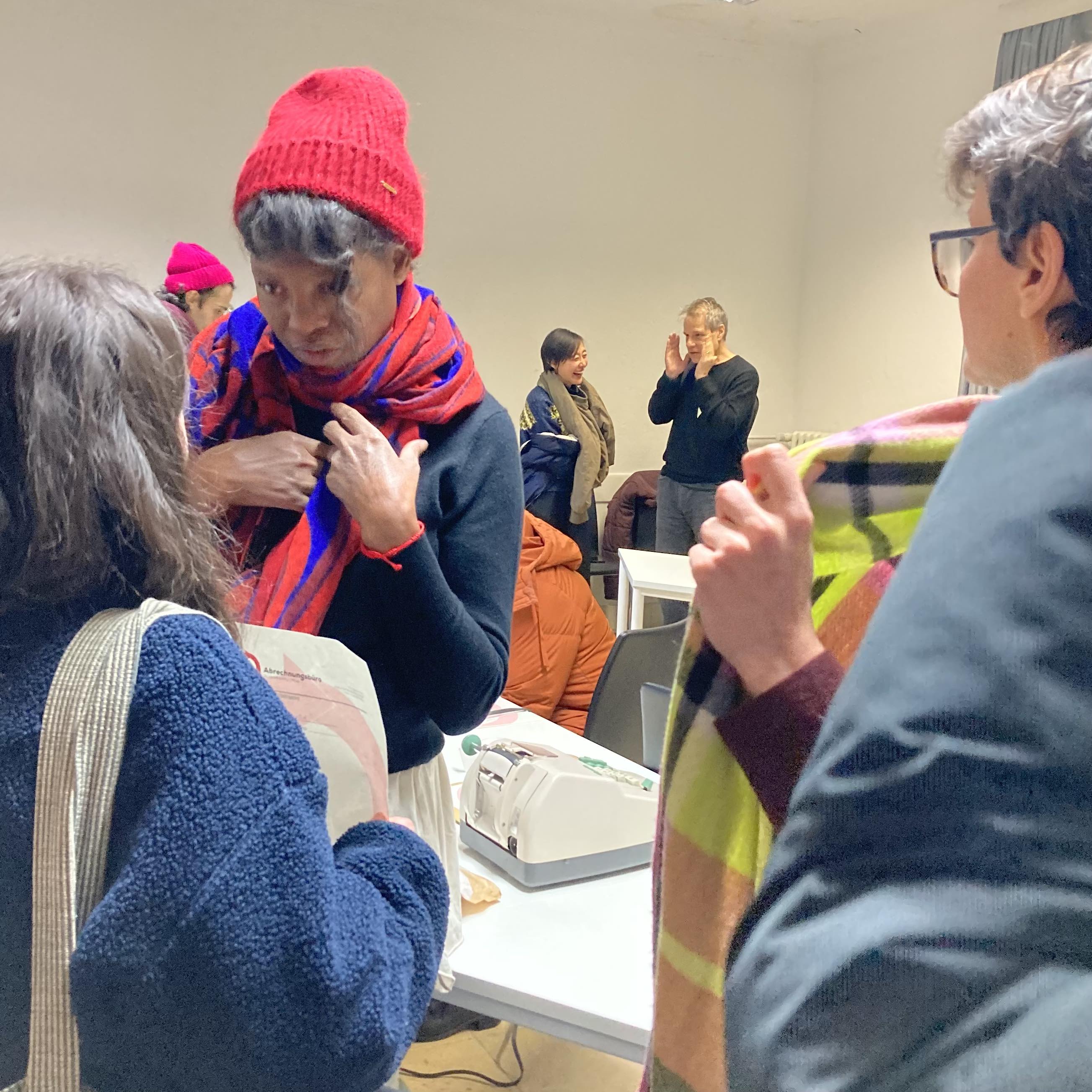
To complete this abundance of experiences and perspectives, we were finally invited by artist Jody Wood to calculate our Virtual Credits and Residual Guilt Reserve in her workshop Abrechnungsbüro – an engaging, thought-provoking and fun exercise, followed up by a conversation between the artist and philosopher-writer Lieke Knijnenburg. Aptly moderated by PhD student Sofia Attolini, it also involved participants, and continued well into the Berlin evening, during dinner at a nearby Chinese family restaurant…

Above: “Abrechnungsbüro” snapshots
Below: social practice artist Jody Wood and composer Olga Krashenko in following discussion
(all photos by HHW.)

…and we still have a full day ahead in this symposium. More to follow…

Duplicity / Duplicität Symposium (day one of three)

art, recent work, time-out

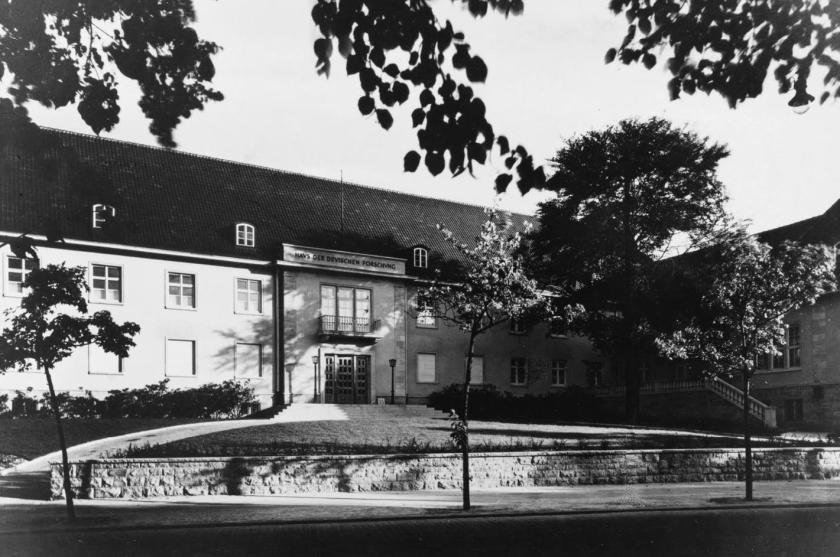
Time is almost 2 pm, and we’re at the Institut für Theaterwissenschaft of the Freie Uni. Berlin: a building once known as the Haus der Deutschen Forschung –  in the years of WWII containing a lecture hall and a library, a ballroom, a casino, fifty offices and an air raid shelter; and, according to journalist Ernst Klee, housing a “cover-up community”, where an enormous ‘degree of agreement between politics and science'” took place. 
Zur Geschichte des Instituts für Theaterwissenschaft

Today, on January 29th, 2026,
the coffee table is set outside the DanceLab, and name tags are waiting to be written and attached. People arrive, crossing the imposing foyer to find their way, continuing upwards via the symmetrical double staircases, heading for our more modest localities on the top floor. The footsteps and voices, the greetings and questions and answers tell of uncertainties as well as excitement.

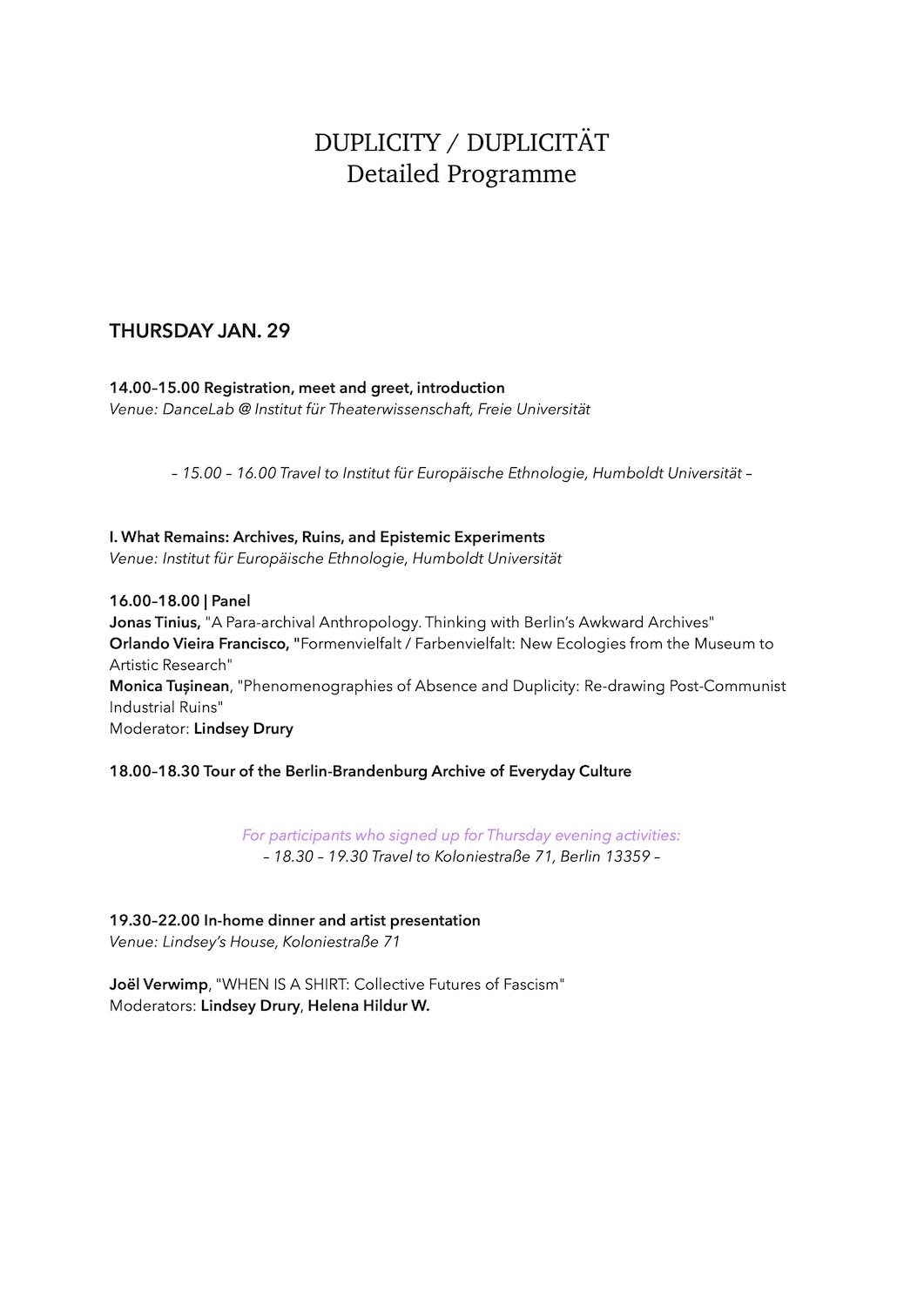
Within an hour, we have welcomed most of our participants. It’s time to move; we’re going to the Berlin-Brandenburg Office for Everyday Culture, where the recently installed director Jonas Tinius will host the first session of the Duplicity symposium…

Due to EU General Data Protection Regulations, I’ll share only a few photos from the actual session here; Dr. Orlando Vieira Francisco (i2ADS Research Institute in Art, Design and Society, University of Oporto) presenting on Formenvielfalt-Farbenvielfalt: New Ecologies from the Museum to Artistic Research – an artistic line of thought, which (to my understanding) touched in a very personal way on the polarity between form and colour / drawing and painting / discerning and integrating… followed by Dr. Monica Tușinean (architect and researcher at the University of Stuttgart), sharing her work on post-communist industrial ruins in Romania – from which I borrow a slide (below). 

Slide with hare borrowed from Monica Tușinean’s presentation “Phenomenographies of Absence and Duplicity”


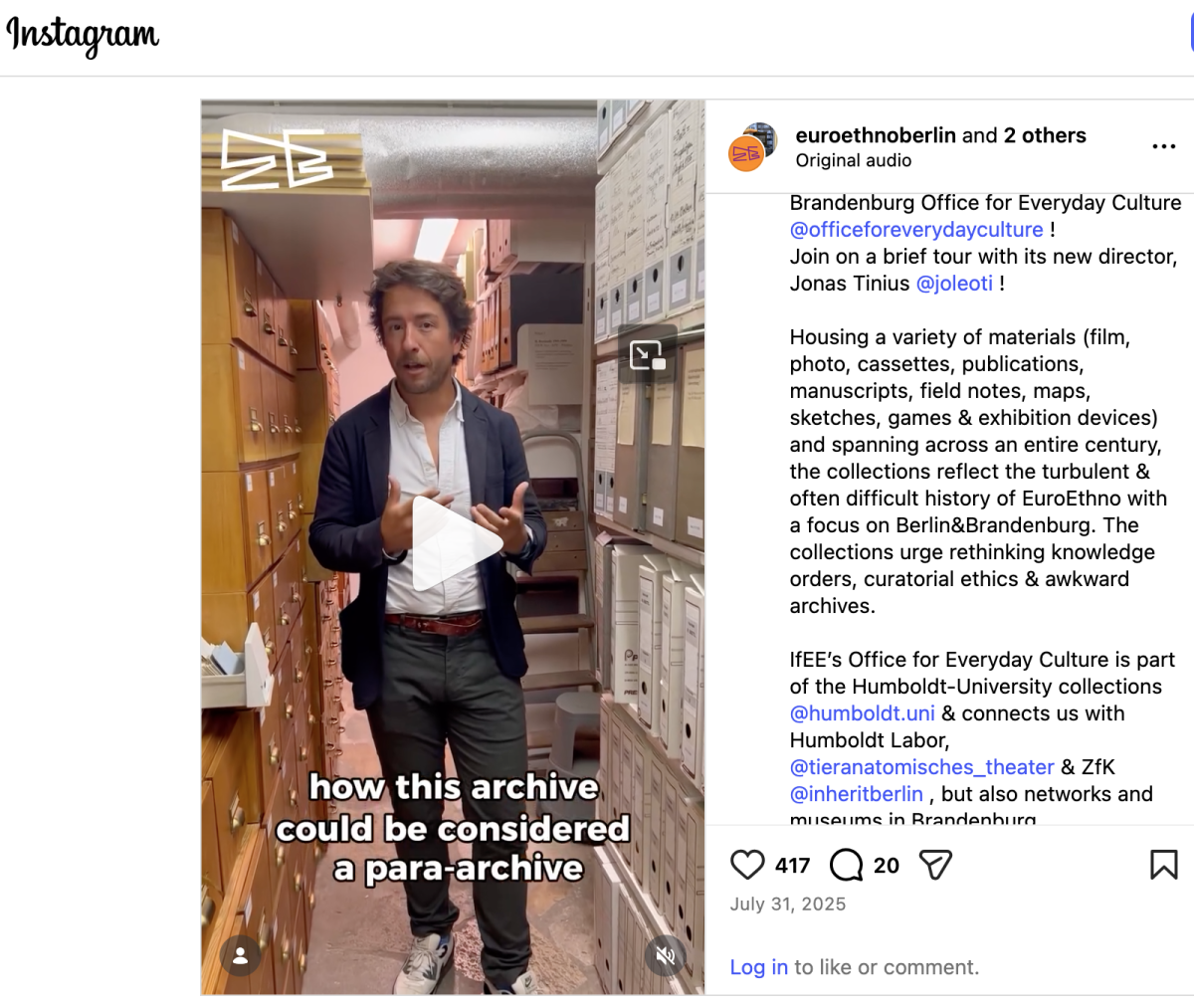
Dr. Jonas Tinius both opened and closed the panel, first by presenting the (Para-)Archive as a site for investigations into how archives come into being; and, eventually, by taking the whole audience on a guided tour in the Archive’s enchanting basement.

Click the link, and follow Jonas Tinius along on an earlier tour in the Archive’s basement:
euroethnoberlin Landesstelle Re-Opening! 

For those of us foreseeing (and lucky) enough to have reserved a space, the evening continued in a Wedding apartment with performance artist and cook Joël Verwimp’s In-home dinner and artist presentation WHEN IS A SHIRT? Collective Futures of Fascism.

This slideshow requires JavaScript.
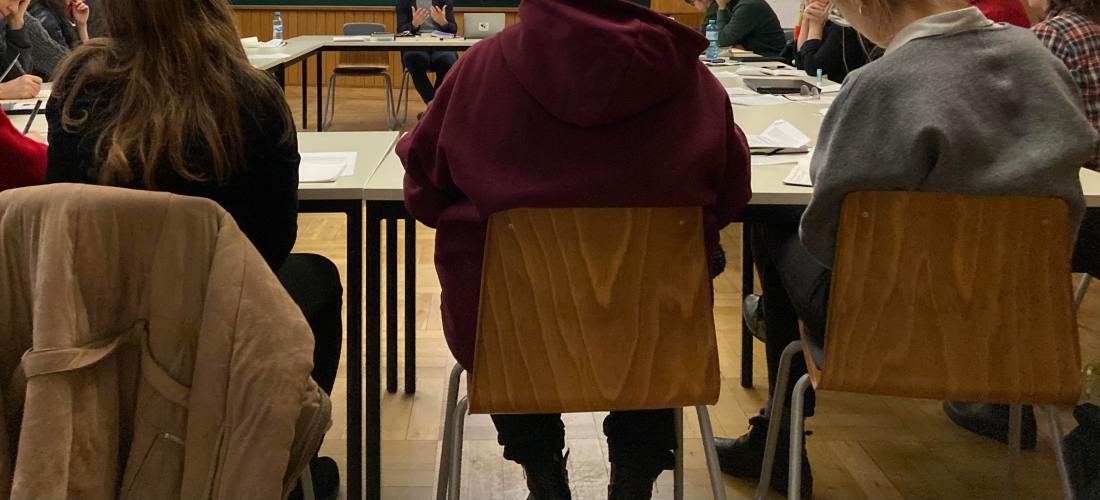
Joël Verwimp, “WHEN S A SHIRT? Collective Futures of Fascism” performance
Photo credits: Essi Nuutinen