2025: Looking back

art, painting

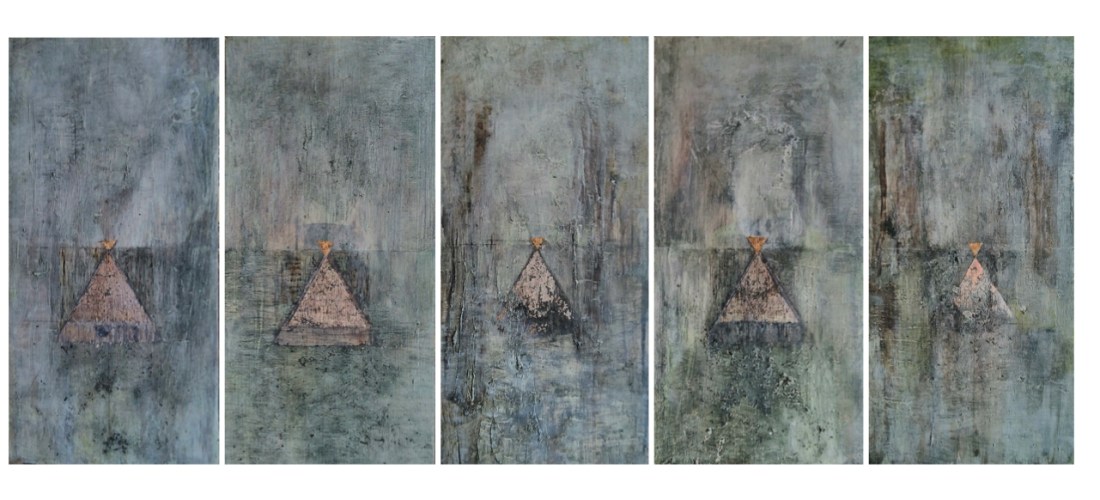
Looking back, I see the flow of time. I light a candle in the stillness of the winter night. Countless starry points shine back at it from inside my heart, connecting me with somebody just across the road, as well as with other, more faraway places… with Stockholm, Fulltofta and Toulouse; with Kyiv, Järna, and Ermetzhof; with Bengaluru, Berlin, and New York; with Tyresö, Tokyo and Turku…

A constellation of love, friendship, creativity and care.


January: the past year began with the maps of Robertho and Frank finally completed. I was invited to write an article on the Mapping Praxis project, for a “special issue” of an art journal, and took it as an incitement to collect my thoughts on maps and mapping.

*
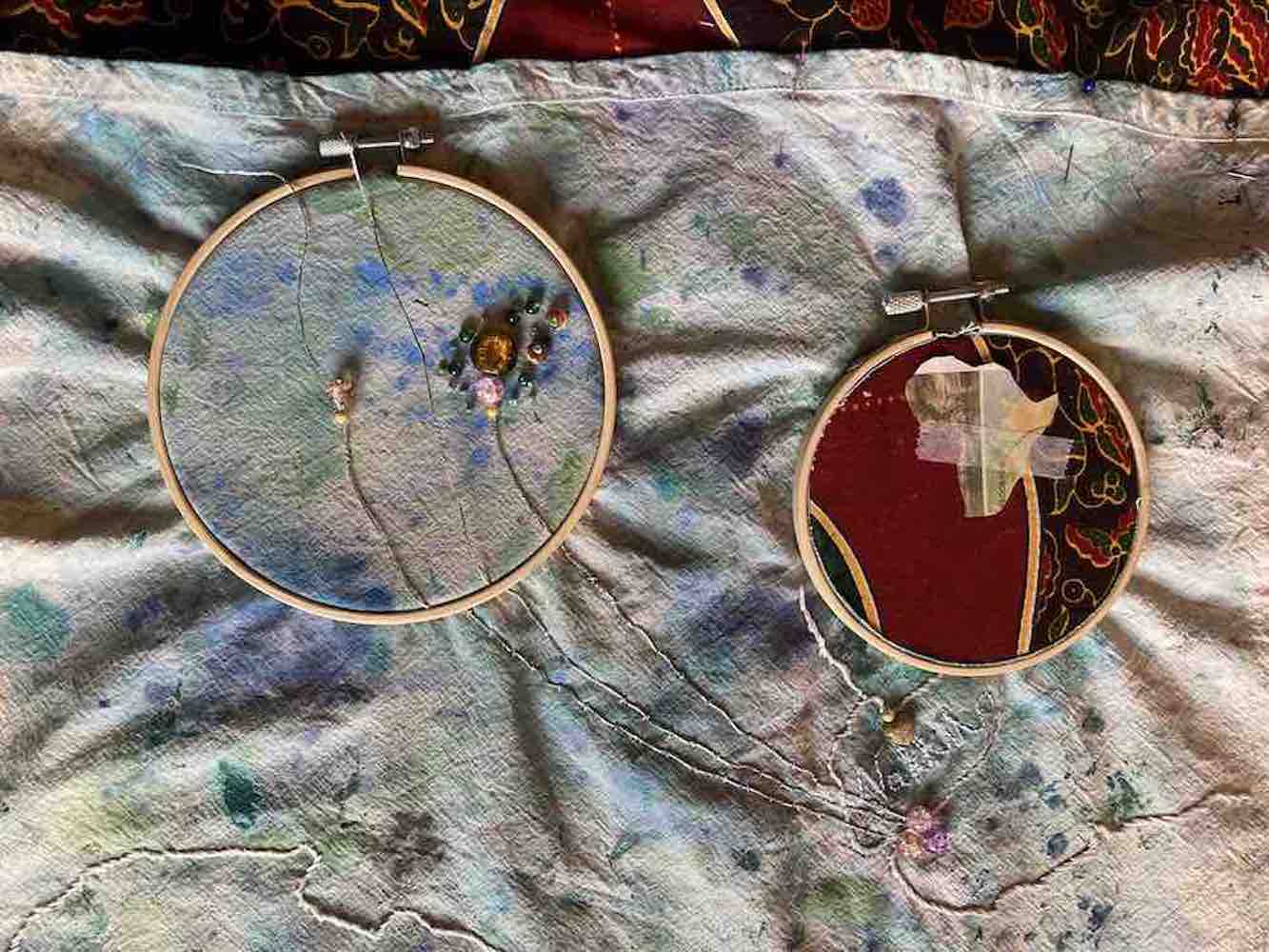
February: with the mapping text more or less finished, I realized that the journal that issued the invitation might not be quite the high-standard scientific publication that it claimed to be. In the end, I decided to withdraw the article, to instead take up the more rewarding work of making another map… This one, again, presented me with new challenges. The story of “I” – my partner in dialogue – was layered in ways that the preceding ones weren’t; I chose to add an underlying lining, visible only in certain places; and to insert “zoom-in” spots, using the sketchwork that “I” had provided me with during our first conversation. It took quite a few tries, and some emailing, to make the map resonate with the emotions and conceptualizations of my conversation partner.
And on February 22nd, I had the honour to meet street artist Gamlet Zinkivskyi from Charkiv on one of his sparse visits outside Ukraine – giving an artist talk at the “Ukraine Culture Now” event.

*

March: in the first days of the month, the Praxis of Social Imaginaries study circle held its last gathering at the Sigtuna Foundation. Parallel with reading and discussing Olaus Magnus’ A Description of the Northern Peoples, ideas of how to launch a continued study circle emerged from informal conversations…
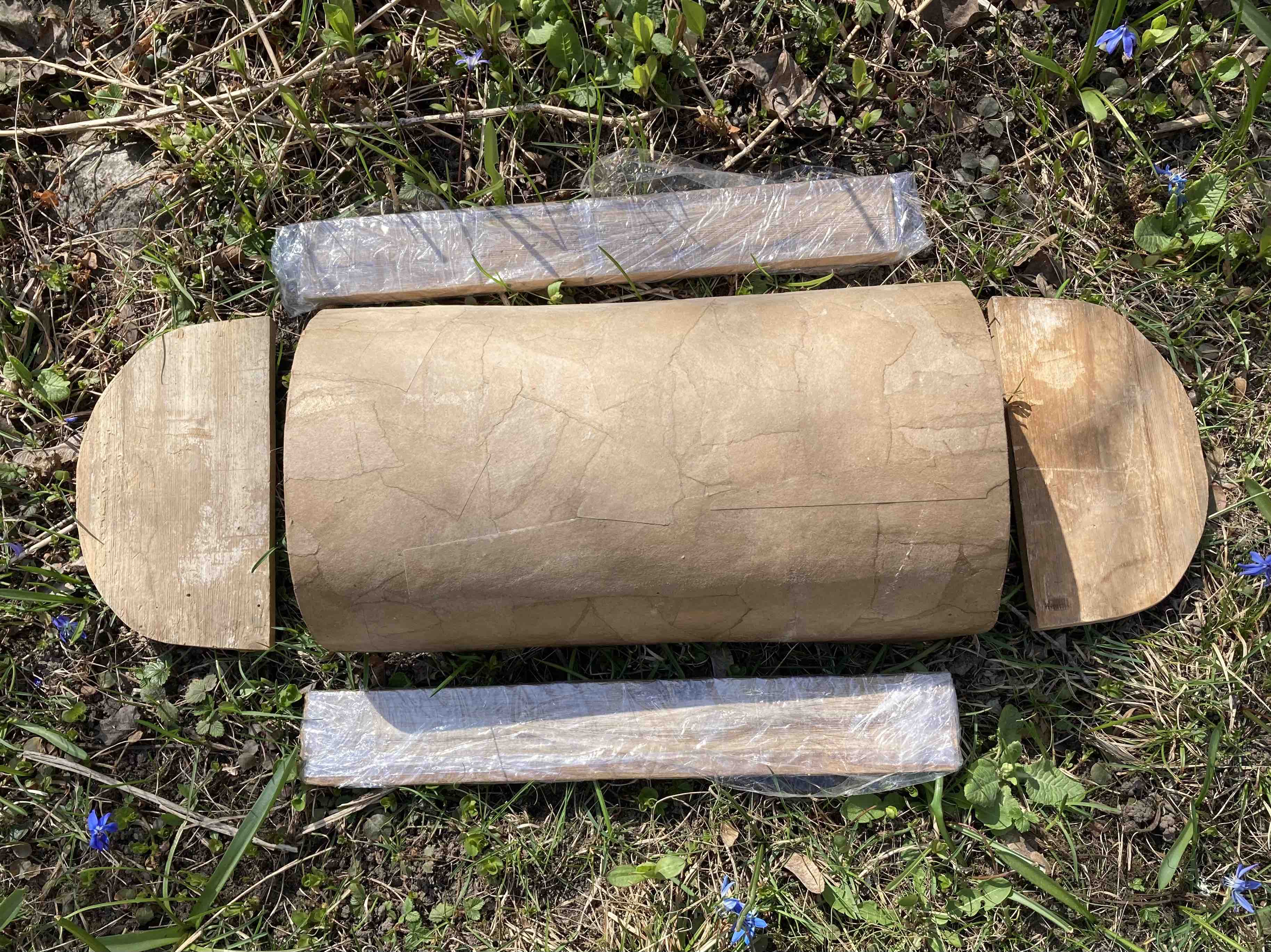
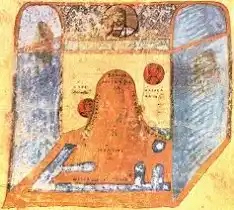
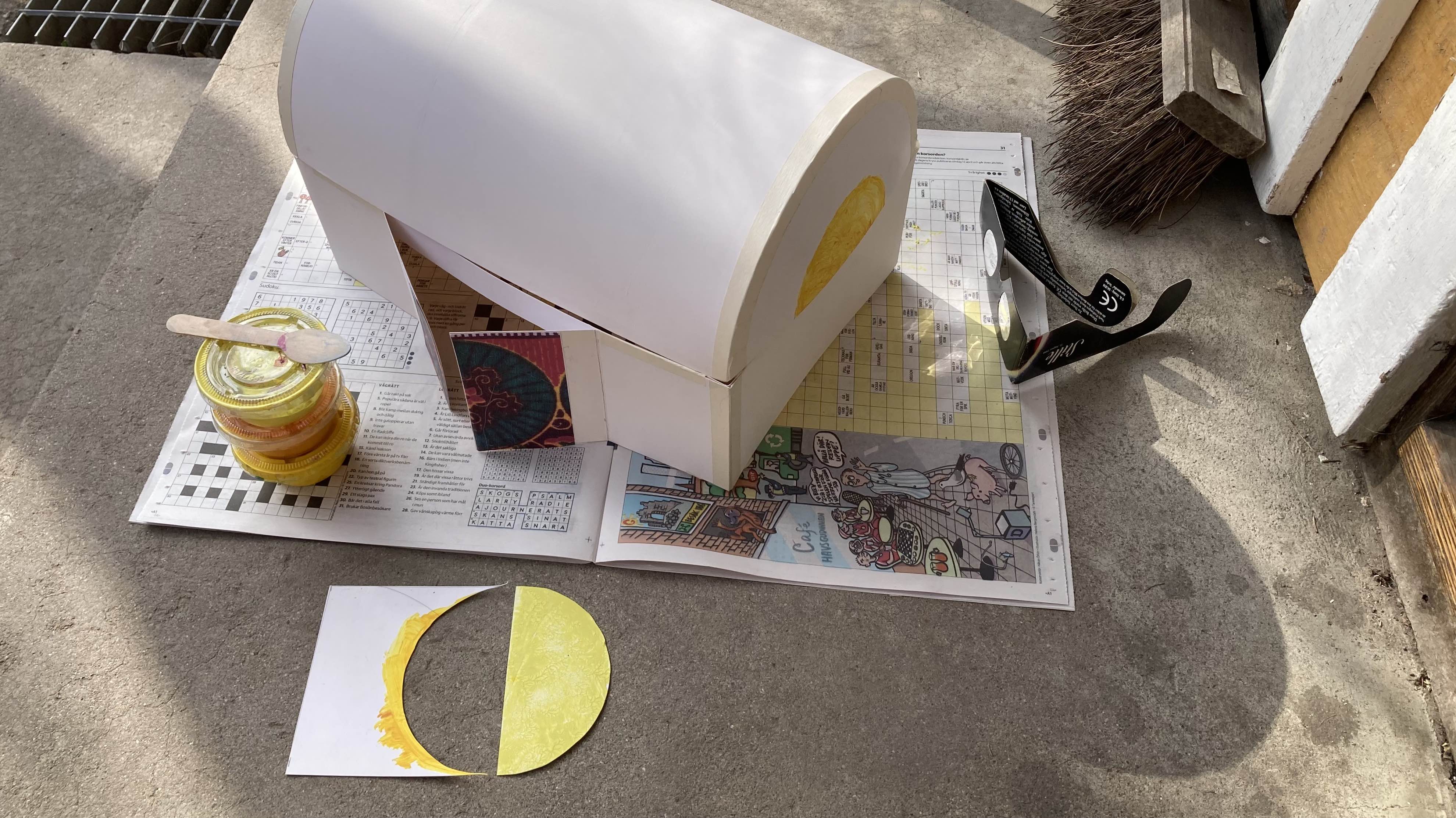
On the last day of the gathering, I was approached by fellow participant Titi, wanting to share her story for another embroidered map – a task that I happily welcomed. I also had the opportunity to reconnect with Obinna, and ask him some complementary questions about his itinerary (which was now next in turn for a visualization). This time, the challenge came explicitly from my partner in dialogue: Obinna’s map had to be a three-dimensional one, since his native place is in the mountainous parts of Southeast Nigeria. Recalling the chest-like world model of the 6th century traveler and Christian monk Cosmas Indicopleustes, I immediately began working with it on returning home. A partial sun eclipse happened on March 29th, and I could watch it while making a cardboard maquette… which sparked the idea of “half a yellow sun” on the gable of the chest (I then hadn’t read the book with the same title by Chimamanda Ngozi Adichie).
This slideshow requires JavaScript.

*


April: a six weeks’ teaching commission began, leaving little time for the Mapping Praxis project. As spring flowers came to bloom, I managed to make the vaulted papier-mâché lid of the chest, though.

And to learn to know the folk high school class was – as always – a joy; this type of education very much promotes care, curiosity and collaborative approaches… My presentation on the institutional theory of art (aka the art world theory) was met with immediate and creative response.

*

In mid-May, the teaching commission was finished, and I could go back to the mappings. Now Obinna’s chest was assembled, and a 3D mountain was made to fit inside. I decided to use egg tempera for the painting, and tried out a floral design, borrowed from an African textile and reminding of a hibiscus flower. It turned out that Obinna highly approved of Chimamande Ngozi Adichie’s novel – and so, the sun was there to stay on his map.  
As the planning for a continuation of the Praxis circle proceeded, I also attended Researching Imaginaries;  an online lecture programme launched by the Centre for Art and the Political Imaginary at HDK-Valand (Gothenburg University) and the Royal Institute of Art (Stockholm). The programme stretched over five days, presenting interfaces between politics and contemporary art ,explored by artistic researchers from Eastern and Southern Europe as well as the Nordics.

*

June is a very busy time in the garden. Nevertheless, the lid of Obinna’s chest got painted, too – in lapis lazuli blue.


*

July: traveling to Jyväskylä for the Nordic Summer University Summer session 2025, where our proposal for a new study circle, under the title of Studies in Remoteness, was finally presented. Initiated by Dr. Lindsey Drury and the working team in early March, the proposal now got approved by the NSU Board, and by the General Assembly of NSU members on July 26th. Along with Lindsey, I found myself study coordinator for the three coming years.

*

In August, I took a day in Åbo / Turku, to meet again with Obinna, Titi and Dorcus of the Praxis circle. Returning home, I had gathered more information to be visualized in the Mapping Praxis itineraries. I could also improve “I’s” itinerary with some tiny animals made out of wood… and finish my reading of Half a Yellow Sun.

*


September: the lapis lazuli lid of Obinna’s itinerary somehow called me back to studio painting; I took a couple of weeks off from the
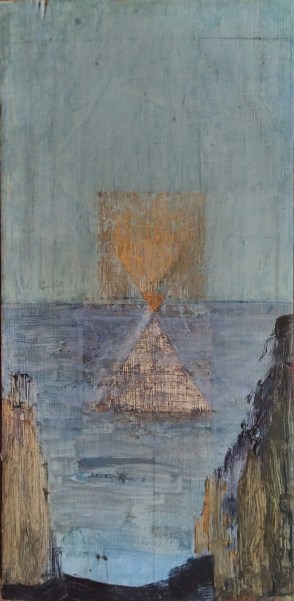
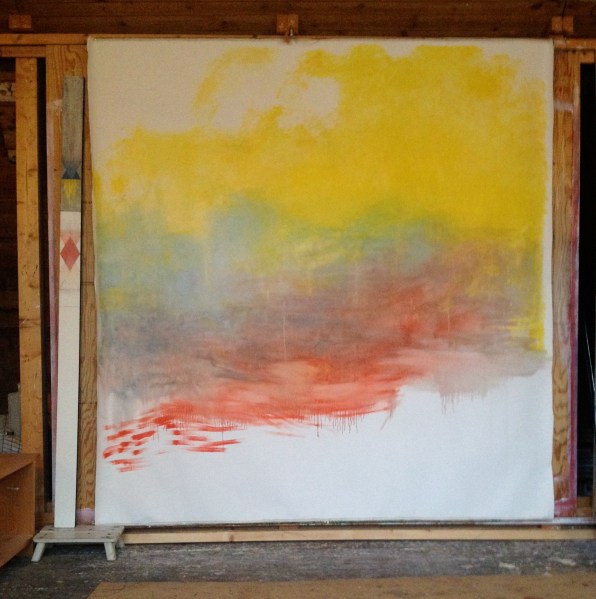
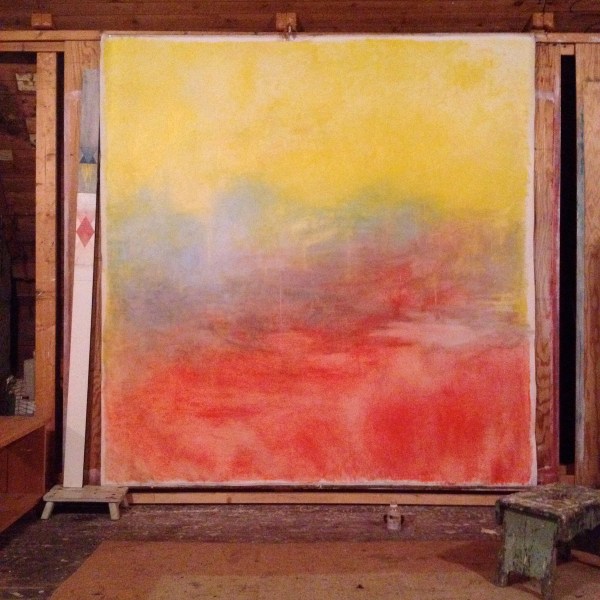
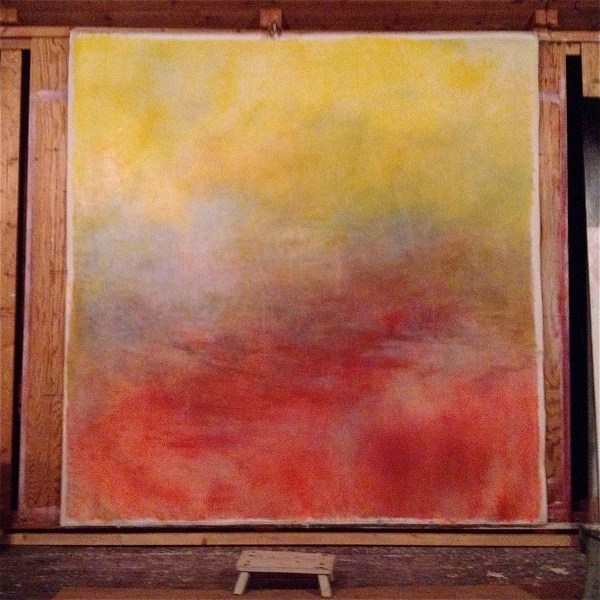
Mapping Praxis project, and spent time with a blue / orange Human Being Image.

*

October: the Remoteness team was gaining momentum, with bi-weekly online meetings. It remains the working group, where study planning and connected tasks are constantly processed; meanwhile, the executive bits are mainly the work of coordinators. In October, we published our very first Call for Participation for the 2026 Winter Session – a three days’ symposium set to happen in Berlin in late January.
The last days of October – during the autumn break – I spent in Igelsta primary school, doing maintenance work on Star Roads, the commission I had for the city of Södertälje in 2018. Seven years later, there’s still no deliberate damage done to it, but quite some wear and tear. (After all, these kids are teenagers!)

The autumn break stretched into the first days in November, and I worked through the weekend to finish my work before school started again. Unexpectedly, I found myself sharing the space with several dozens of young basket players – as it turned out that the city of Södertälje proudly hosted an annual basket cup finale for schoolkids, and Igelsta was one of the venues. We went along well, though, and I accomplished my task in time (more or less).

Sadly,  one of these days a young person was killed nearby the school . No basket player, certainly, but a former student at Igelsta school – one of the kids that may have been sitting in the space that I now was renovating. On the short walk from the school to the train station, I passed a place where candles were lit for him. I stayed a while, sharing the moment with some of his friends.

May peace be upon his memory. May no other kid have to suffer his fate.

*

December: I had three short-term commissions for the folk high school this autumn – the last one being to give an introduction to lino cutting. I took this as an occasion to refresh my experience in lino print, and realized that this technique could be useful for the making of Titi’s itinerary. As for Obinna’s map, I now had to look into the ancient Nigerian Nsibidi scripture, which I knew nothing about before.

*

A year passed. Encounters, conversations, experiences and emotions finding their way into images and objects – while Earth still travels silently and swiftly with the Universe.

Mapping Praxis III: Butterfly Wings

art, painting, recent work

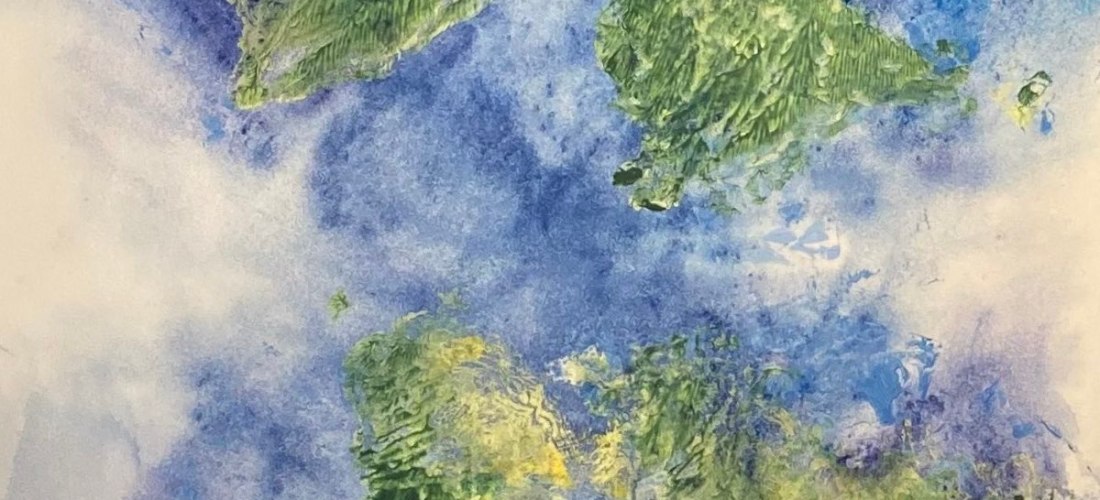
Our precious planet, a fragile butterfly in space. Countless motley facets, an ever-changing kaleidoscope.
Our personal life stories, itineraries meandering through moments and places. How do we blend our voices together beautifully? How do we translate the sounds of winds and waves, birds and trees, humming insects, the singing fishes in the deep? And the animal screams from the slaughterhouses?

Here, some recent ‘work in progress’; watercolour renderings of the octants that together constitute the Waterman butterfly map projection.

This slideshow requires JavaScript.

Eight watercolour paintings, each 18×26 cms; Helena Hildur W. (2024)

Suddenly, I remember Ukrainian artist Alexander Krolikowski, who taps the signals of passing satellites to portray the Earth’s surface… “When you love someone, you take pictures of them, right?”

Yes – in times of war, we do love’s labour.

Screenshot

Screenshot

Screenshot from short documentary Art in the Land of War, episode 7: Alexander Krolikowski by DocNoteFilms (2022)

Homecoming

art, painting

A painting long forgotten. Until, one day, it caught somebody’s attention; a customer, as it turned out.

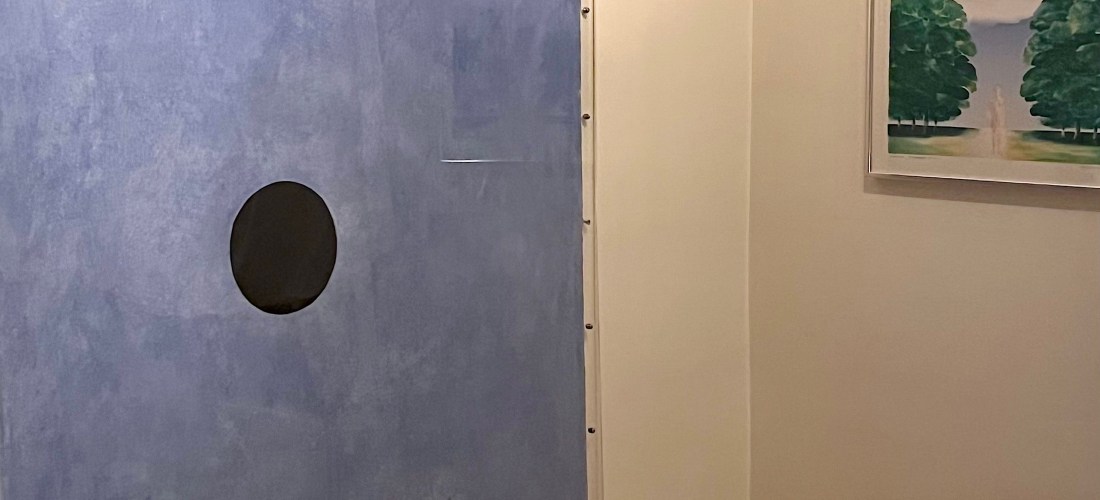
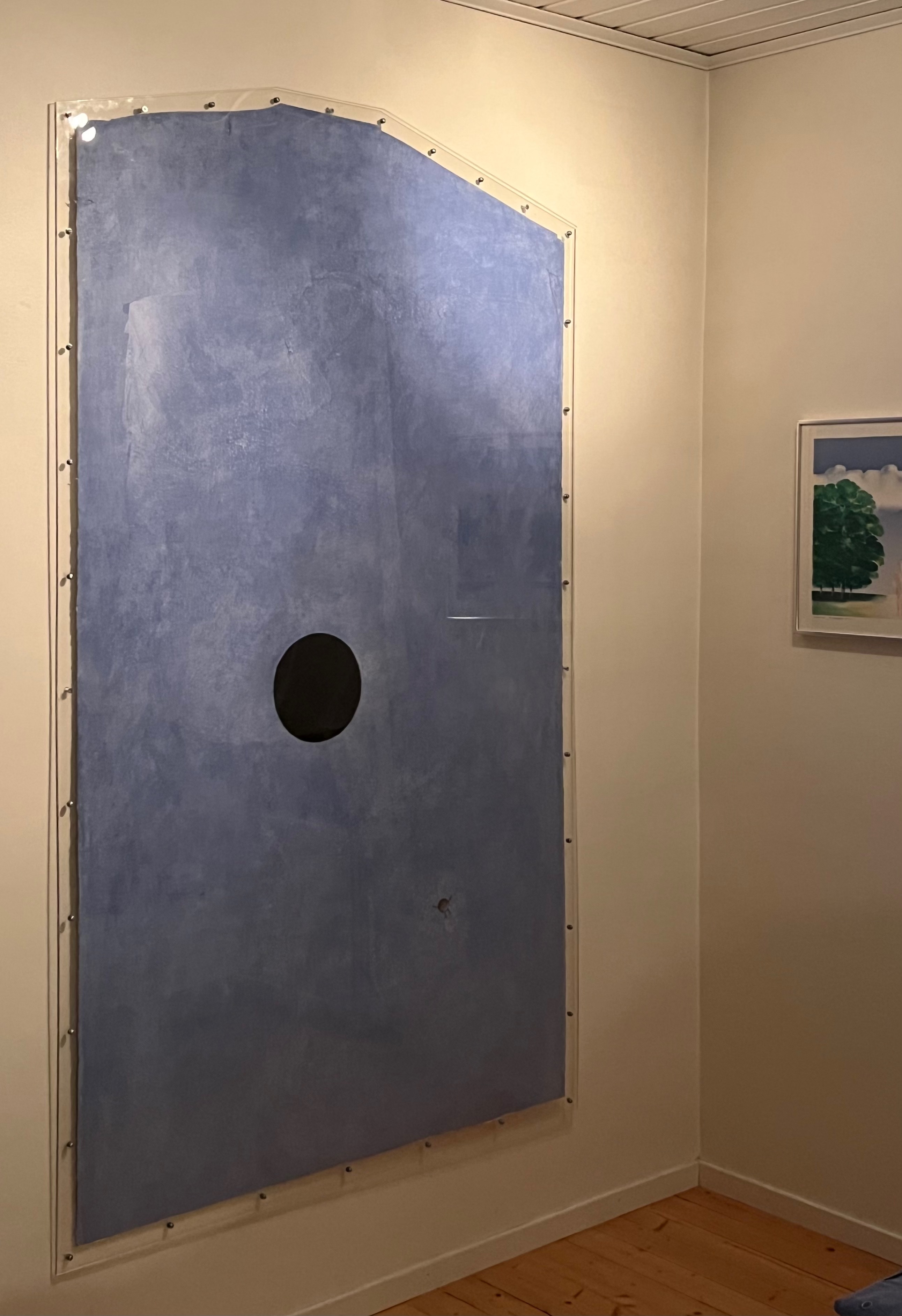
A painting long forgotten, then remembered. Re-membered, integrated: additional lapis lazuli pigment to deepen the colour blue – “light coming into being“. More of the all absorbing, finely ground charcoal for the black circle. The floating tadpole figure outlined anew in charcoal, and graced with gold leaf within. Overall proportions trimmed before mounting between acrylic glass sheets, cut to shape. Then carefully packed for transport…

…and delivered to a private home, situated on an island in the archipelago of Stockholm. Here, a number of smaller artworks were reshuffled along the walls to make space for this one. Good neighbours they will be, for sure… Two windows are providing daylight – one facing east, the other south. Outside, the sky is clear and trees are leafing. Indoors, sunlit rooms still echo from a grand piano long time gone. And so, the painting finally has found its place.

Thank you, B and A, for your hospitality!

This I Know (monterad)

This I Know (final version); tempera, charcoal and gold leaf on paper, 200 x 120 cms

Musical Quarter Interlude: Art and Spirit

art, curating, painting, recent work, time-out

“Art and Spirit – like a twelve-tone scale, the works of eleven artists sound in the Musical Quarter. The exhibition takes place on all floors within the building​ – in the doorway, the entrance hall​ and​ stairwells, ​in the foyers and the concert spaces.”

A one-day-only exhibition at Stockholm’s Musical Quarter, curated by Tobias Sjöberg – up and running from noon at Saturday, March 11th, into the wee hours of the night when the last guests are leaving the party.

230310 05b

Tobias Sjöberg at work; photo HHW.


ART AND SPIRIT
participating artists:


Amanda Cardell

Beata Fransson

Helena Hildur W.


Jakob Sjöstedt 


Jouko Mario


Margrethe Sjöberg


Mats Adelman


Stefan


Tiago Altink


Tobias Sjöberg


Viktor Kopp

– – –

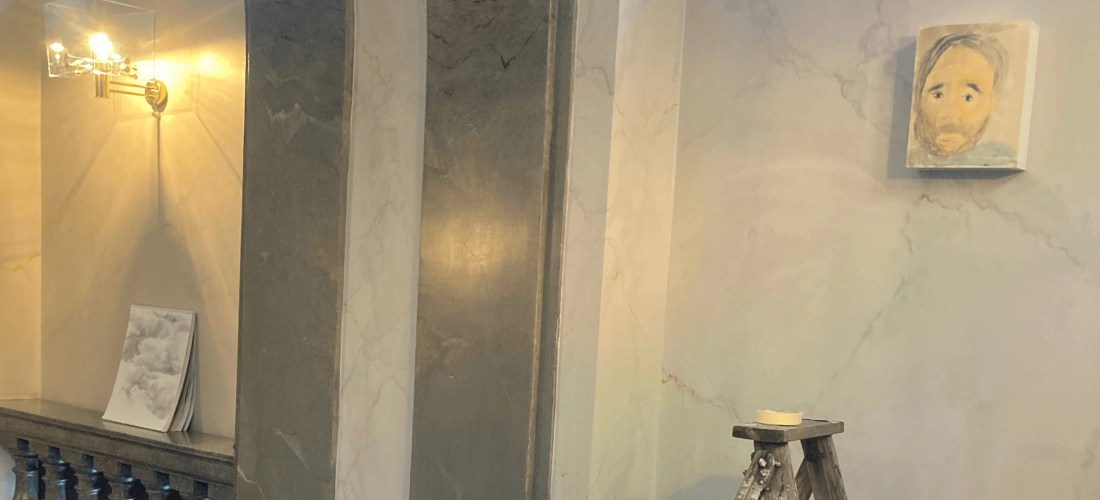
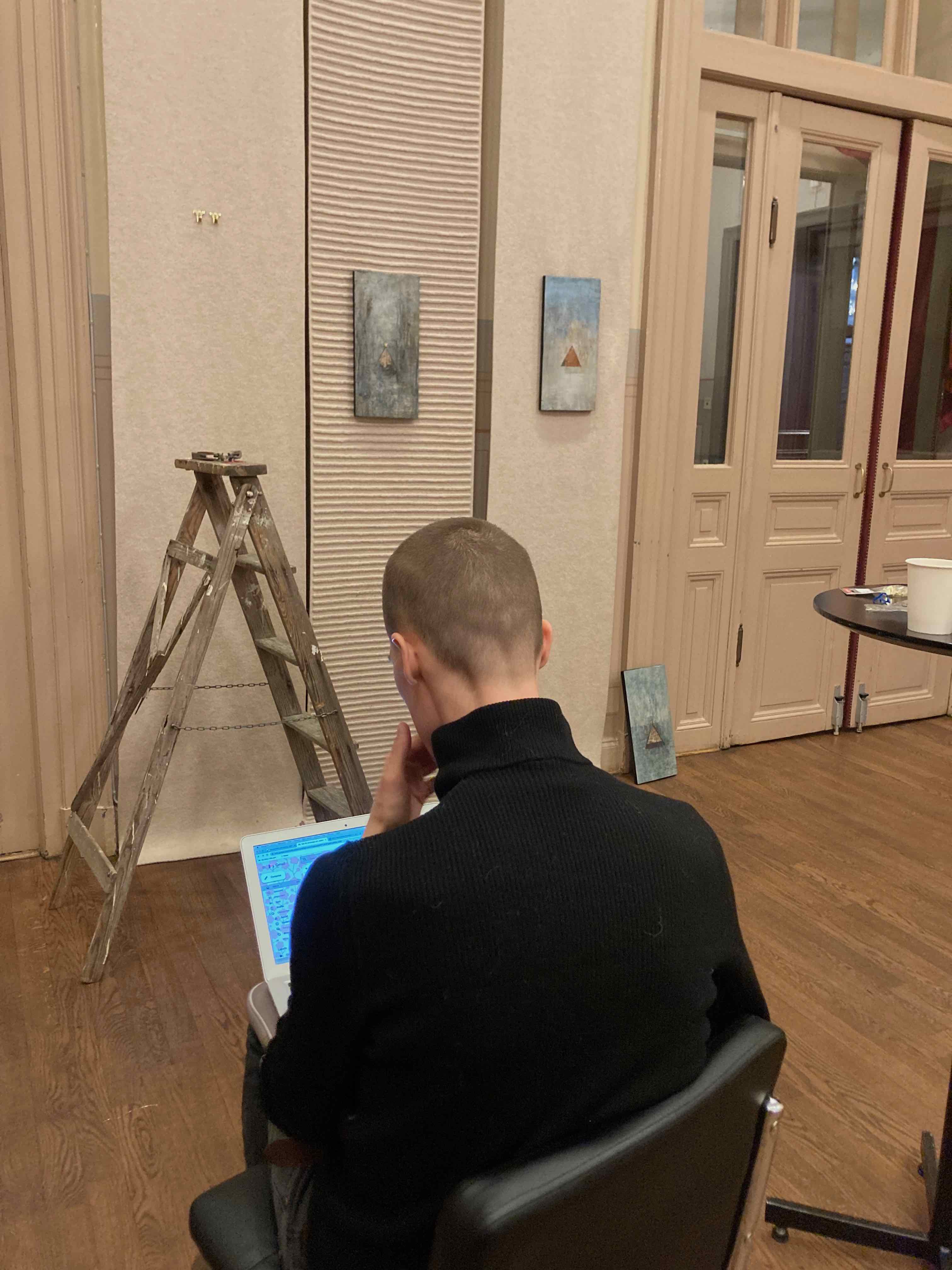
Friday, March 10th: gathering together to hang the artworks. A colourful curtain – made for the occasion by Amanda Cardell – will greet every guest at the main entrance. In the Clara Schumann hall, works by Viktor Kopp and myself have found their place, waiting quietly for tomorrow’s artsy sounds, klezmer swing and late night disco. Manager Andil Dahl always seems to be in the right place to make everything run smoothly.
(below)

(above)
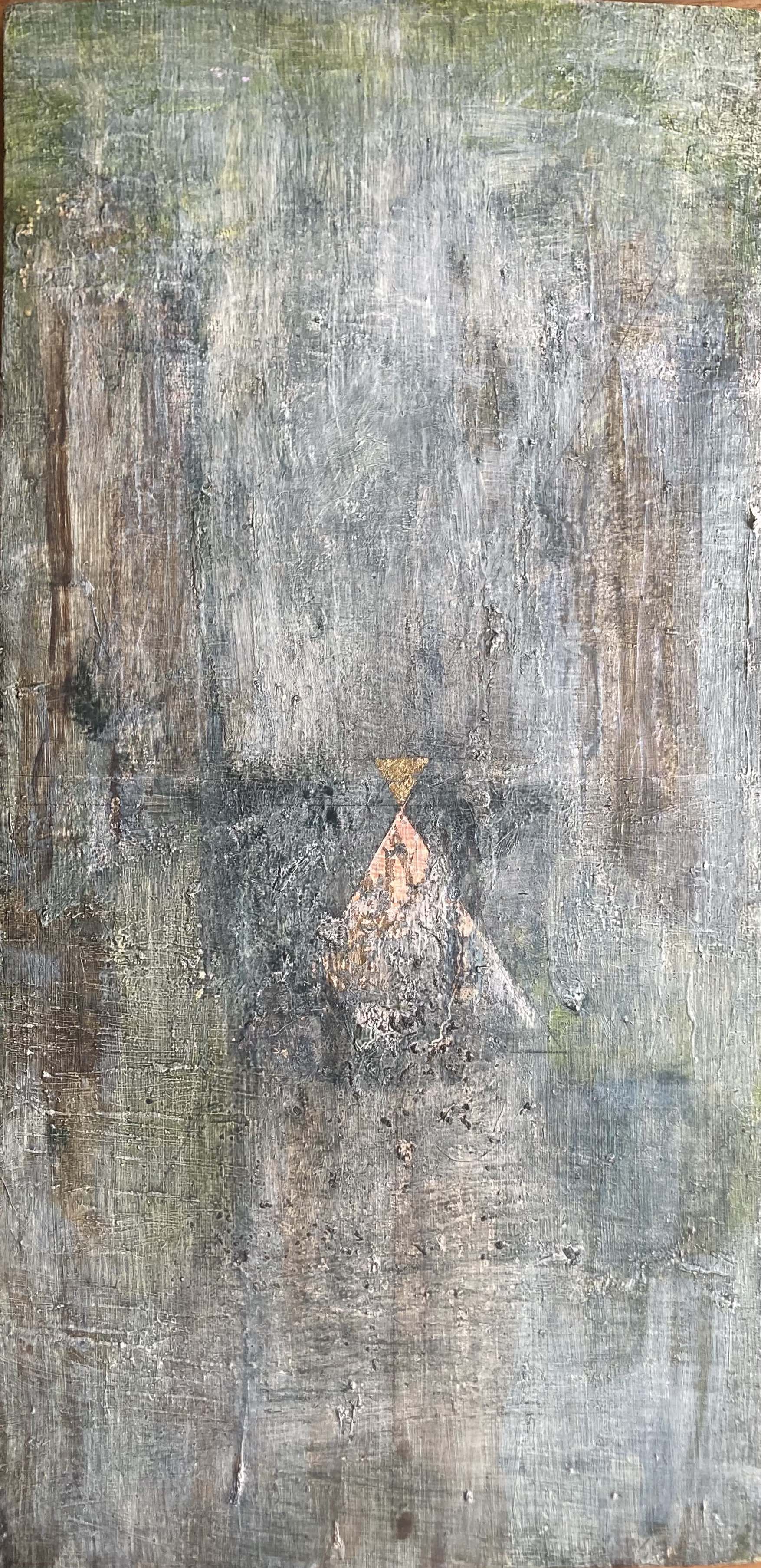
Hanging completed in the Clara Schumann hall; on display from my part are three diary paintings (oil on wood panel) and four monthly pictures (blood, ashes and chinese ink on silk).

In the first floor foyer, painted wood sculptures by Tiago Altink are put on display.  At the second floor, Jakob Sjöstedt’s sculptural sounding objects interplay with scenic elements of the locale. Missing on photo are Margrethe Sjöberg’s embroidered birds of fantasy, and Jouko Mario’s enigmatic paintings opening up to views of strange streets and buildings.
(below)

In the stairwells, Mats Adelman builds exquisite cabinets where the night fly finds rest and the barn owl can be seen flying…  The old and the new meet in the third floor foyer, where Beata Fransson’s  playful photographic sculpture echoes the brick wall of a building across the street.

Halfway down another staircase, Stefan’s self portrait is a world in itself; I’m humbled and grateful to have my cloud drawing placed next to it.

Missing here are Tobias Sjöberg’s Octave – watercolour paintings covering two huge windows, creating a quiet virtual space opening to pure colour; turning the room into a floating vessel, carrying living people and pale plaster muses along outside of time …
(below)

Saturday, March 11th: giving the installations a last finish; then removing tools and ladders, doing a bit of  cleaning up; and, the Art and Spirit exhibition is up by noon. At four o’clock,  the Swedish Wind Ensemble gathers for a sounding parade around the neighbourhood. When they return, guests are already queuing to get inside. Scendödsfestival sets off – let the party begin!


Business

art, painting

The driving force of the Exhibition and Life (reconsidered) may have been about re-imagining an existing body of work, and co-creating in the here-and-now; yet, the creative drift is inseparably followed by a shadow called economy. Landlords and art material dealers rarely give their goods away; artists have basic human needs as well. Most of us therefore work part or full time in parallel professions (salaried). Hence, I feel the importance of recognizing when someone steps up, willing to actually pay for the artist’s work; especially when that someone is an individual with limited resources, who just happens to be touched by what they experience. This post is for you – to acknowledge the importance of your support; for the artist, it means encouragement and economic relief. For the artwork itself, it means fulfillment. 

above: Snowdrop (left); Spring snowflake (right);
charcoal, chalk and watercolour on paper,
each 120 x 175 cms
below: car packed, heading for home

customers

Dear customers from near and far – I’m deeply grateful for our exchanges: for hours spent together under the hot studio roof, meticulously packing two large drawings for a long car transport; for the spirited talk and delicious ice chocolate cake shared in a beautiful 19th century Stockholm apartment; for all your sensitivity and recognition; and for the influx to my bank account, as well as to Médecins Sans Frontiers (as part of a deal). I hope your purchases keep giving you joy, each day to come!

191211 03b diary painting (Miriam Wolff)
diary painting 191211 03,
oil and blackboard paint on wood panel;
40,5 x 20 cms

Art’s Birthday 2022: Bilder från Nysund / New Sound Images

art, curating, painting, recent work, time-out

Art’s Birthday 2022: Bilder från Nysund / New Sound Images in Gnesta’s Old Watertower

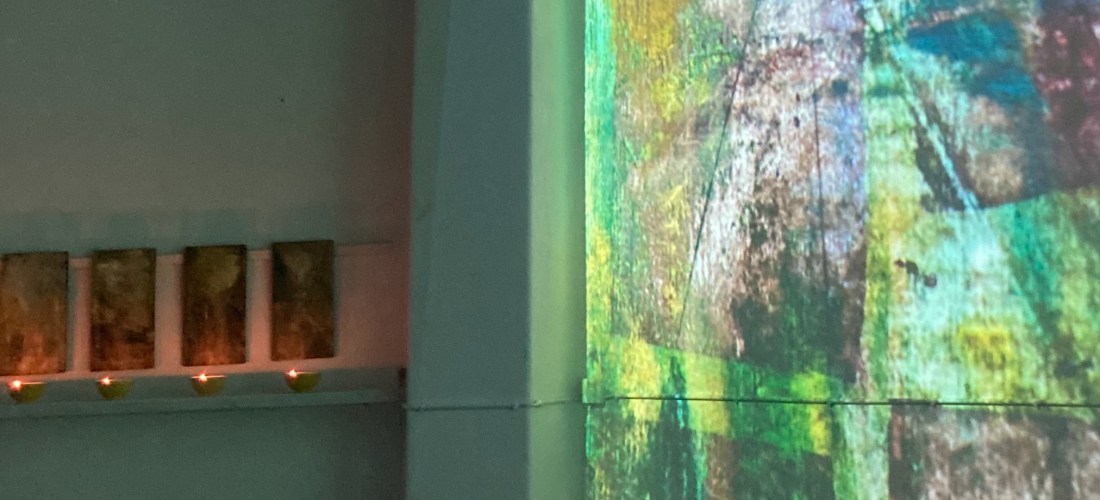
Finally, let’s celebrate! The doors of the Watertower are open; inside, guests are welcomed by an installation of light and ice, glass and water. The green octave paintings – modest in size – are on display along one of the walls. Upon the next three sides of the tower, the pictures transfigure into light projections, opening up to an imaginary summer day.

IMG_0394 (kopia)

the Green Octave, projections by Johannes Ferm Winkler

For myself, this is a process equally wondrous and interesting; from the beginning, years ago, where I take a walk immersed in the light and sounds of the surroundings; next, converting my impressions to a small-sized painting; leading up to this joint venture, where the landscape re-emerges by technical means… or, sprung from the inner nature of human minds. The space floating with light and sound… the landscape transcended.

220116 12b

On Monday, January 17, the Art’s Birthday network* will support a webradio streaming, where 25+ art spaces around the globe – from Tokyo to Vancouver – will share photo and audio streams in an interactive mesh.

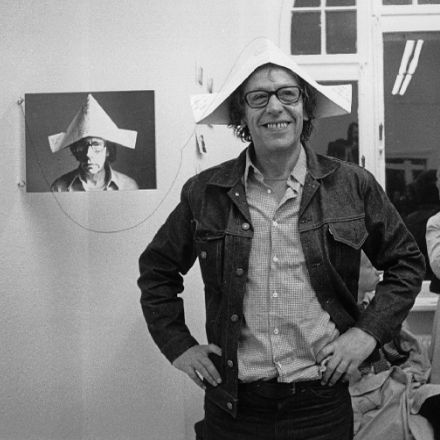
Above: Fold a Hat outside the Watertower, Gnesta 2022; photos by Johanna Dahl and HHW.
Below: Robert Filliou, Rome 1972; photo by Joaquín Romero

filliou

* About Art’s Birthday worldwide: the event was first proposed in 1963 by French artist Robert Filliou, as a public holiday to celebrate the presence of art in our lives. In recent years, the idea has been taken up by a loose network of artists and friends around the world, welcoming new partners working with the ideas of exchange and telecommunications-art. Since 1963, Art’s Birthday has generated parties and gatherings, correspondence and mailart, sound and video art, music composed for telephone lines, radio and (starting in the mid 1990’s) for the Internet – and, following Fillou’s example, the folding of paper hats.