Mapping Futures @ AboAgora II

art, recent work

Mars, the God of War, is pictured as a potent bringer of violence and destruction. Many among us have also experienced the actual pains and traumas of migration, displacement and escape from unbearable circumstances…

Still, there will always be futures beyond warfare.

How do we understand our true needs – and how can they be fulfilled in times of turmoil?
Which values are worth building a future upon?

How could new paths be found, when old ways are lost?

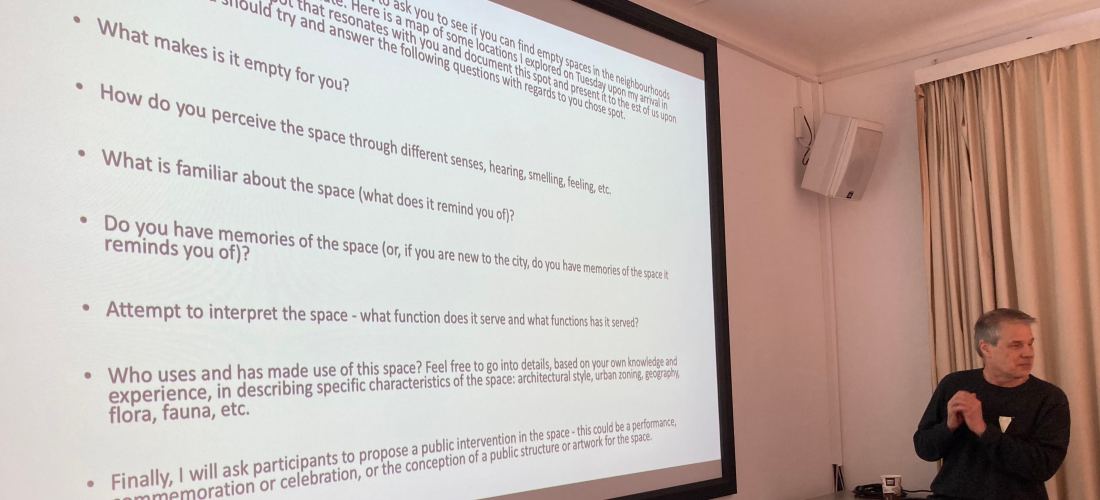
Mapping Futures invites participants to reflect, to share experiences, and to co-create around this theme. We’ll use map-making as a working format, along with movement and listening. And – since play is a very serious business – the workshop will stay open for playfulness, too.

Such was the presentation of Mapping Futures, as it appeared in the programme of AboAgora 2024. I learned that sixteen participants had signed up in advance – a full group. The actual workshop was scheduled on the third and last day – Friday, August 30th – and the plan was to have it outdoors, in the museum’s garden, to connect with nature as well as with the surrounding cityscape… Unfortunately, according to the weather forecast, the floating fluffy morning skies were likely to turn into heavy winds, thunder and rainfall by noon. Project coordinator Petra and I had to take a decision about the locale, and quickly agreed to move all the material inside. An hour later, 40 kilograms of sand was carried indoors along with the hexagon boards, and the “beach” was prepared – complete with pebbles and seashells, bottle caps and plastic rubble, bird feathers and other tiny items (all brought from Sweden in my suitcase).

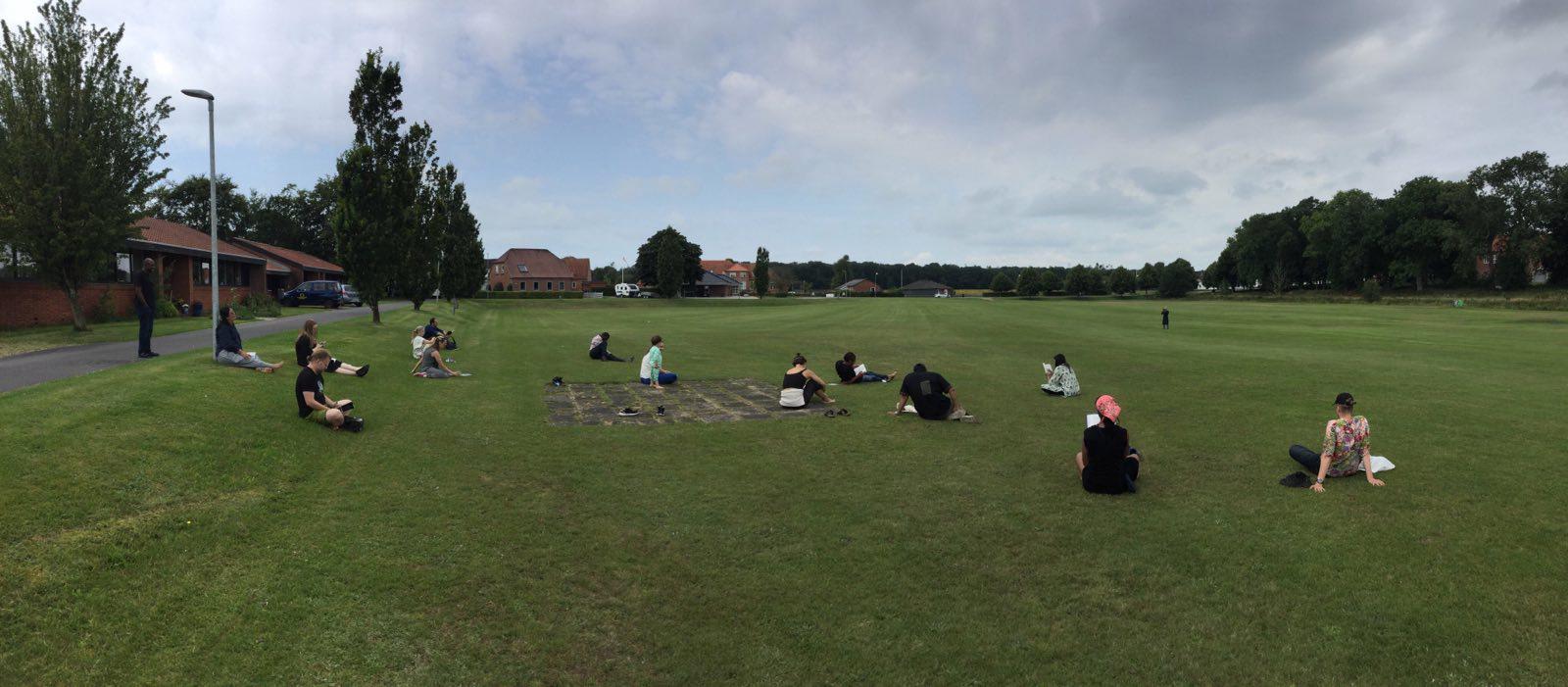
By 10am, a few light clouds occasionally dimmed the warm sunlight. The group of participants gathered in the shadow of the huge oak tree, once planted by Linnaean adept Pehr Kalm – a tree that has survived fire and ice, war and unrest for more than 250 years… After two full days of artistic and scientific perspectives on martial machineries, this seemed to be a good point of departure for a workshop focusing on resilience.

left and right: Pehr Kalm’s oak;
middle: the group assembling, photo credit: Pekko Vasantola

Before leaving, each one of us took a moment to visualize a Stunde Null, such as it might appear in some place familiar: in our home or workplace, in the streets or paths we use to walk…  A Ground Zero not only for humans, but for all structures and living organisms. Bearing this image in mind, we set out for a silent walk to the cobbled square by the cathedral.

Silent moments, photo credit: Pekko Vasantola

Ten minutes went by there, as we quietly stayed with our personal thoughts and feelings; then we gathered again to return to the museum.

In the Zero Hour, what remains for the ones alive – emotions, trauma, weariness? Hope, despair?
And hard work; hours, days, years of toil and labour.

What, then, would remain to build upon? What structures and materials? Which relations? Which values?

On walking back, the participants were invited to share with each other, and also to keep an outlook for objects that could serve as tokens and symbols in the map-making. The sky was already darkening as we entered the museum. The smaller groups, which began to form during the short walk, now clustered around the boards. This was a crucial moment to me; how would these highly qualified individuals feel about playing together, using pebbles and pinecones like little kids in days long gone? and moreover, around such a challenging theme?

above and below: hands-on work and extended connections;
photo credit: Pekko Vasantola

This slideshow requires JavaScript.

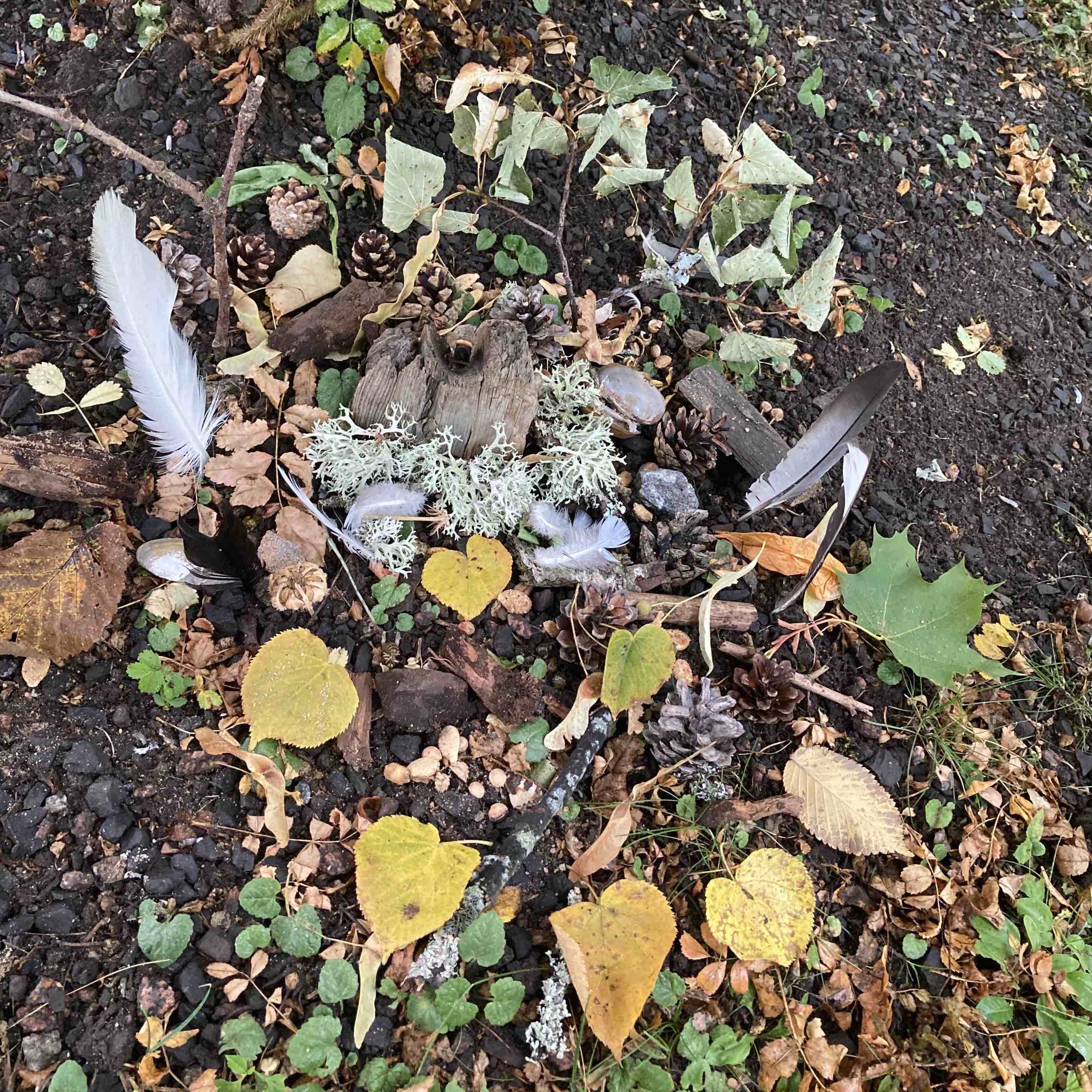
It turned out that there was no need for worries. The groups immediately began projecting their ideas: honouring the dead and caring for the living, constructing shelters and community facilities, preparing the soil for sowing… Plastic waste created problems in some places, while forests, domestic animals, music and insects were generally cherished. In one of the maps, plastic caps were opened up and distributed to represent receptivity, tolerance, and understanding; in another, a grey feather, planted upright, proudly signalled the rejection of black-and-white thinking.

Heart-shaped artwork by Jan Erik Andersson in Pehr Kalm’s garden outside the museum,
and mapped futures by workshop participants inside

One hour and a half passed quickly, but there was still time to share some concluding reflections while the wind slowly dropped and the sky grew clearer. Later in the afternoon, the crafted futures were collected and brought back to where they belonged: non-organic waste to the recycling systems, and the leaves, lichen, feathers, and butterfly wings to the rain wet ground under a rose bush.

I wish to thank all participants, who played along so wholeheartedly, and the staff members of AboAgora 2024 and the Sibelius museum, who welcomed and supported Mapping Futures; and thanks also to all who took part in Mapping on the Beach in 2023, and Alina Kalachova, with whom I developed the original concept.

Praxis of Social Imaginaries, Summer Session 2024 @Løgumkloster II

art, recent work

What stays with me now, from the work of this summer session?

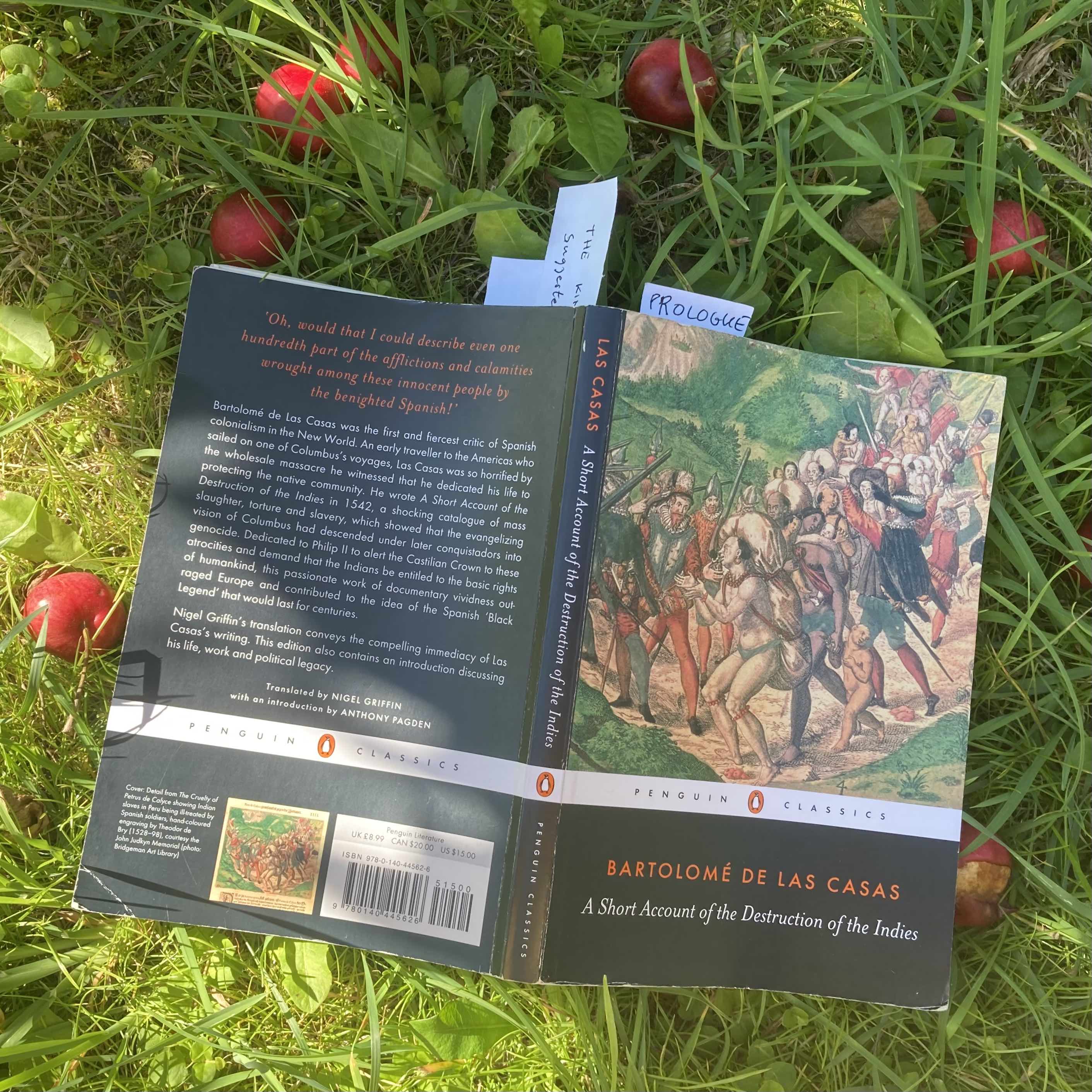
I remember the many scenes of unbearable cruelty, committed by the Spanish conquistadores and described in the book of friar Bartolomé de las Casas; and also the absence, throughout his text, of genuine encounters between the author and men and women of the indigenous. Nevertheless, he advocates their right to human dignity and eternal life through Christ. Maybe las Casas – acting in the name of God – kept his eyes so firmly set on the realms of afterlife that he didn’t really perceive the persons in front of him.

I remember the exercise we carried out in pairs, silently observing each other while recalling our first encounter; the recognition and tenderness of the moment. And then, the following actualization of another first encounter: a recorded reading of a document conceived in 1513, by which the conquistadores proclaimed the authority of the Spanish king over the land they were about to conquer. The very act of reading this Requerimento aloud – in Spanish – on any shore where they set foot was taken as a justification to kill, loot and ravage without restraint.

Excerpt from Guillaume le Testu’s Cosmographie Universelle selon les Navigateurs, tant anciens que modernes
(1555/56); illustrated map of Brazil (left); detail (right)*

I remember the words of my fellow participant from South Africa: colonialism is still here.

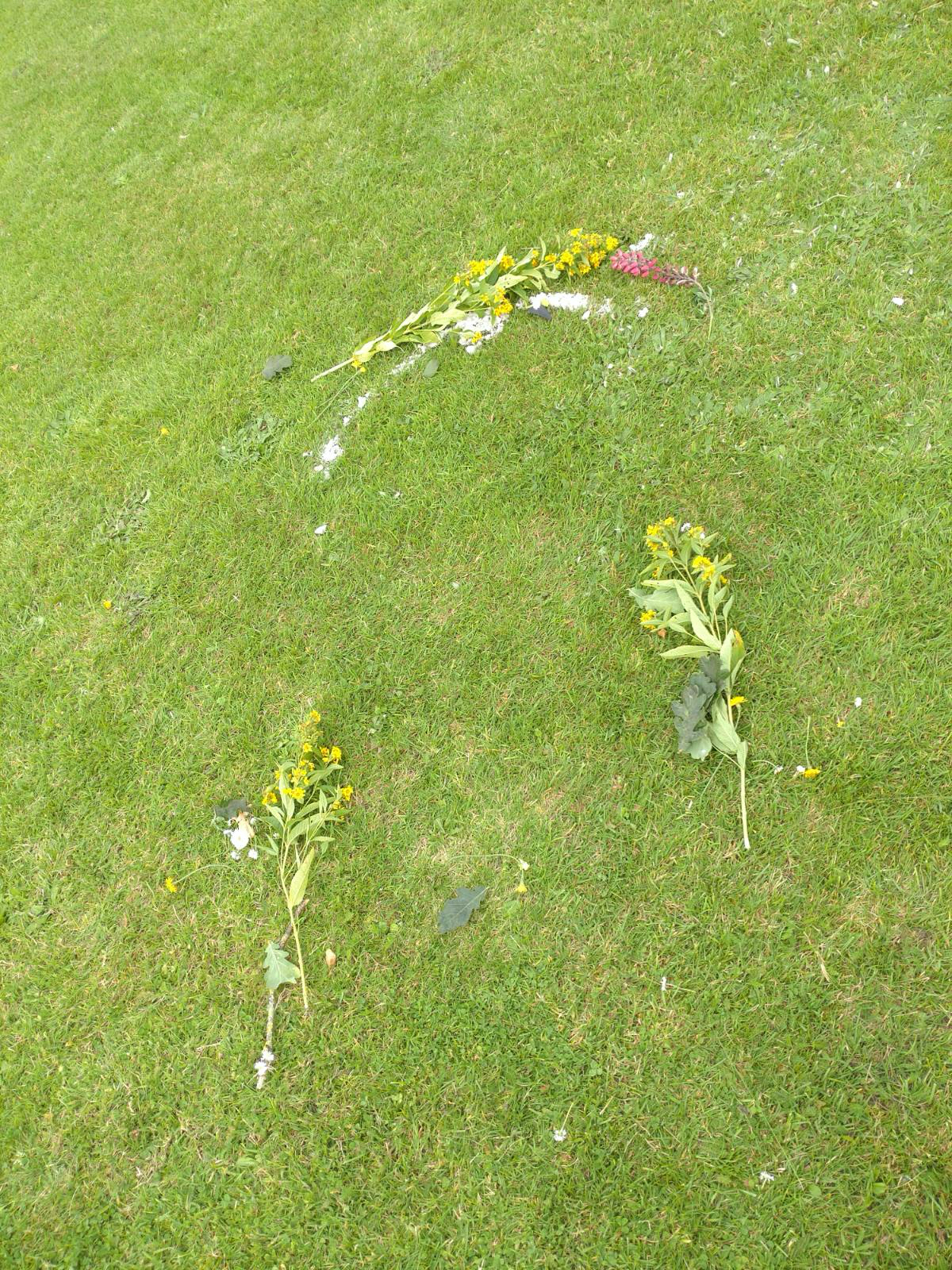
I also remember images from contemporary dance performances in Mexico; the mixture and fusing of traditions, spun around mythical events and historical figures from both sides of the Atlantic – an in-between space of creativity, pride, grief and resistance. And I remember the group’s (re)enactment of a Mexican mourning ritual: one of us acting the deceased, resting on the ground; the others bringing flowers, colourful pieces of fabric, and whatever we could think of to symbolize respect and appreciation; laying the objects down to adorn him, and thereafter weaving him an invisible canopy of words of affection.

2024 07 ES 03
…and now, he’s gone; photo credit Essi Nuutinen


* to see more of Guillaume le Testu’s work, go to: Cosmographie Universelle selon les Navigateurs, tant anciens que modernes

Praxis of Social Imaginaries, Summer Session 2024 @Løgumkloster I

art, recent work, time-out

2024 07 LH 01
the Praxis group at work in Løgumkloster Folkehøjskole, Denmark; photo credit Laura Hellsten

Early August, and I’m landing home after attending the 2024 Summer Session of the Nordic Summer University; after yet another week of working together with the Praxis group (or, more formally:  Circle 3, The Praxis of Social Imaginaries. Cosmologies, Othering and Liminality – one out of ten ongoing study circles within the NSU)… Our focal point this time has been A Short Account of the Destruction of the Indies by Dominican friar Bartolomé de las Casas – a fiery document from the 16th century, intended to alert the Spanish king to innumerable atrocities committed by his conquistadores in the Americas.

A Short Account

Seventeen people came together for this occasion, bringing perspectives from Peru, the US, South Africa, Nigeria, Bangladesh, India, Germany, Portugal, Denmark, Finland and Sweden… Over and over, I feel such a great gratitude for being part of this group – diverse, experienced, and creative as it is; acting together as an instrument for processing the text, even when the subject matter touches on possible conflict lines such as religion, race, or the legacies of colonial history; finding out, along the way, how community research could be conducted in a transdisciplinary setting.

Ever since the study circle began in 2023, co-facilitators Lindsey Drury and Laura Hellsten have offered multiple approaches to the text. This time, participants were actively invited to take the lead for a morning or afternoon class – resulting in reading sessions and workshops staged from very diverse fields of professional experience: for instance, highlighting the text sections about legal structures, or experiences of ‘the first encounter’; introducing complementary texts and imagery from early encyclopedic efforts to document indigenous culture* – thus inviting the group to visual and performative interpretations – as well as movement and mindfulness exercises; not to forget the practises of reading aloud, listening, talking, and writing….

It should also be mentioned, that the Nordic Summer University is open to parents bringing their kids – there’s always a Children’s Circle welcoming the young ones. However, our circle of adults had the great joy of hosting little J. (two years and a half) who preferred staying around his parent. His gentle presence, communicative skills and stunning dance moves gracefully gave us a model for human interplay.

above: dance historian Lindsey Drury presenting documents from the early encounters between the Mesoamericans and the Europeans, along with later and contemporary pictures of mestizo dance cultures;
below: local micro-examples of 20th and 21st century Danish culture

…and if photos are lacking from most working sessions, it may be because then we were all immersed in the actual co-creating of knowledge…


*specifically, the Huexotzinco Codex, the Florentine Codex, the Codex Azcatitlan and the Codex Telleriano Remensis


Mapping Praxis III: Butterfly Wings

art, painting, recent work

Our precious planet, a fragile butterfly in space. Countless motley facets, an ever-changing kaleidoscope.

Our personal life stories, itineraries meandering through moments and places. How do we blend our voices together beautifully? How do we translate the sounds of winds and waves, birds and trees, humming insects, the singing fishes in the deep? And the animal screams from the slaughterhouses?

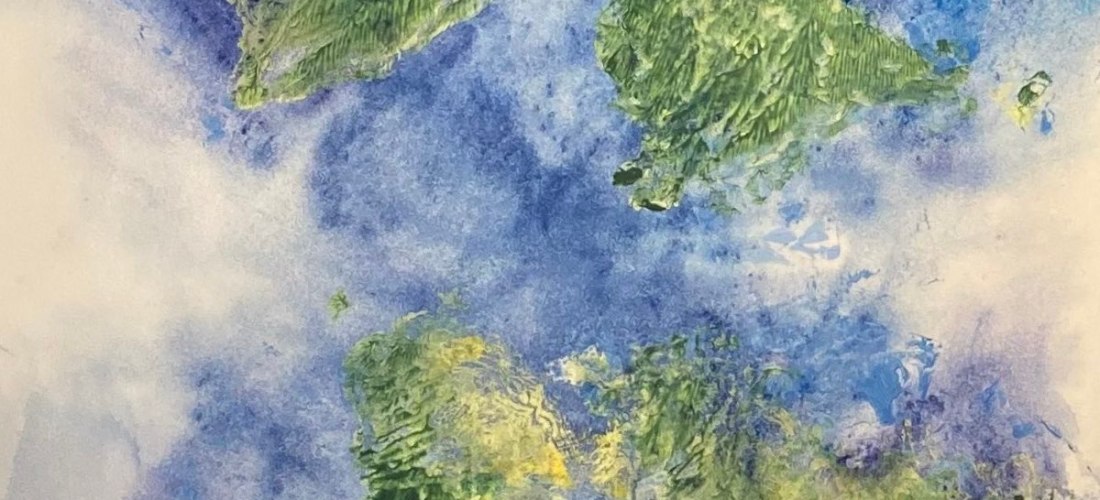
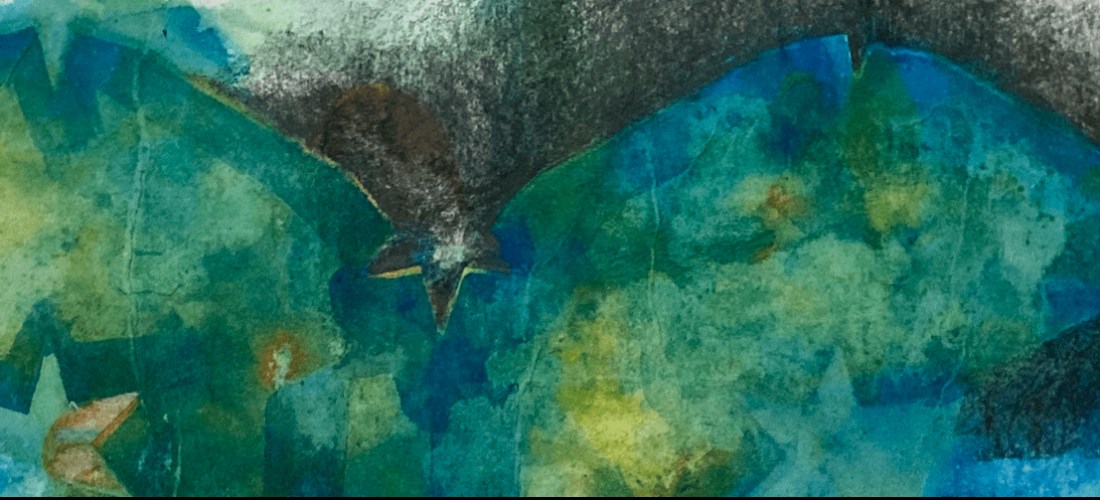
Here, some recent ‘work in progress’; watercolour renderings of the octants that together constitute the Waterman butterfly map projection.

This slideshow requires JavaScript.

Eight watercolour paintings, each 18×26 cms; Helena Hildur W. (2024)

Suddenly, I remember Ukrainian artist Alexander Krolikowski, who taps the signals of passing satellites to portray the Earth’s surface… “When you love someone, you take pictures of them, right?”

Yes – in times of war, we do love’s labour.

Screenshot

Screenshot

Screenshot from short documentary Art in the Land of War, episode 7: Alexander Krolikowski by DocNoteFilms (2022)

Mapping Praxis II: complementary perspectives

art, recent work

Nordic winter days: sparse light, long nights. Preparing for upcoming symposium within the Praxis project at Oulu Art Museum in March. Today, I’m also very happy and grateful for the travel grant approved yesterday by Kulturfonden för Sverige och Finland – kiitos! Tack!!

Hours spent reading, painting, printing, stitching… my mind floating between the concept of (abstract) space – iconized in world maps of various projections – and individual itineraries, tales of personal experiences in specific places…

…representing two complementary perspectives on our lived and living world(s); both wondrously fused together in pictures sent from the crews of NASA’s Apollo space missions.* Here below, the very first photo of planet Earth as viewed from beyond orbit – captured from Apollo 8 on Dec. 21st 1968, by astronaut Bill Anders. Upon returning, Anders commented: “We came all this way to explore the Moon, and the most important thing is that we discovered the Earth.”

02-Apollo-Earth-image-AS08-16-2593-6a6f1d3-e1647940090384Photo credit: NASA / restoration by Toby Ord

* Read more about the Apollo voyages, images and photo restoration project: BBC Sky at Night Magazine (published January 23, 2024)

Mapping Praxis I: threads and butterflies

art, recent work

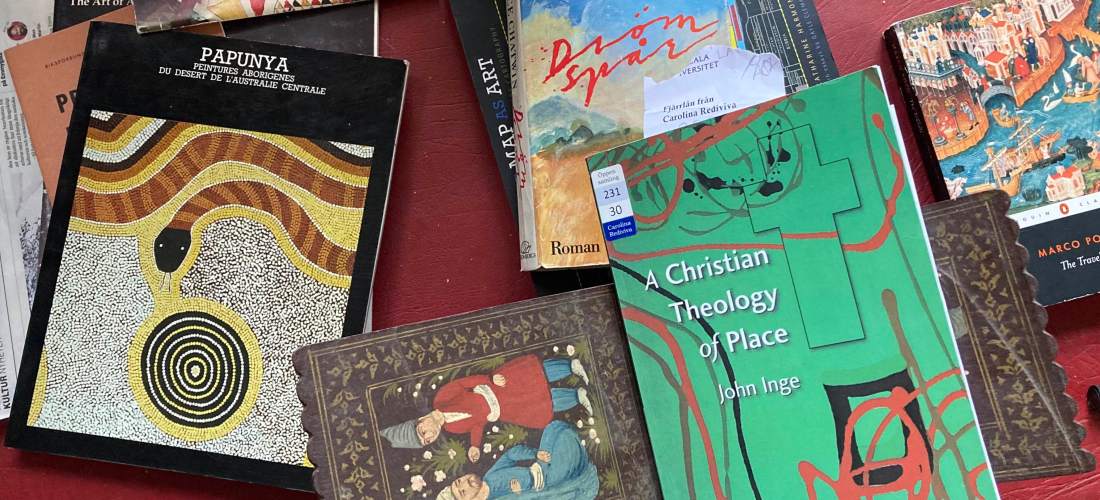
Since the Sigtuna working retreat in November, mapping procedures are on my mind… and all over the place; in books, notes and various materials. Reading and making. Seeking ways, following paths.

One accessible course would be to track the development of map projections, meant to change certain aspects of representation; to advance geodetics, to aestheticize or challenge general understanding – or combinations thereof, such as the “butterfly projection” invented by Bernard Cahill (1909)  and improved  by Gene Keyes (1975), the Dymaxion map by Buckminster Fuller (1943) and the reconsidered butterfly map by Steve Waterman (1996).

This slideshow requires JavaScript.

Three butterfly maps by Cahill and Keyes; Buckminster Fuller’s Dymaxion map; 2013 Waterman butterfly map;
images credit to Wikipedia commons and Gene Keyes’ website

The butterfly map concept provides a starting point. As the Praxis group (and Nordic Summer University) gatherings generally take place in the Nordic-Baltic countries, I have chosen Waterman’s Europe-centered version (1996), reproducing it in varying sizes; A3, 1 x 2 metres and 2 x 2 metres. At the Sigtuna retreat, all participants were invited to mark their own places of special significance on the 1 x 2 metres map. Some persons pinned only one place, others many. Connecting the individual pins with embroidery yarn (remainders from the 2018 Star Roads project) casts a somewhat arbitrary net over the so far colourless cardboard…
Praxis “significant places’ map”; graphite drawing on cardboard, coloured map pins and mercerised cotton threads;
100 x  200 cms; (collaborative work in progress)

Connective threads and pinned places: silver grey: Purmo–Hosaina–Fiji; dark green: Puerto Maldonado (Amazonas)–Madrid–Tartu; greyish brown: København–Reykjavik–Vancouver–Lisboa–Stockholm–Post-Anthropocenic Speculative Diaspora; green: New York City; bright blue: Mariehamn–Lisboa–Åbo–Cottonwood–Kökar–Atupeva/Atupera?; brownish yellow: Herental / de Wimp; dark grey: Nakkila–Åbo–Haifa–North Namibia / Ovamboland; dark red: Alta; warm yellow: Seattle–Taos (New Mexico)–New York–Berlin; light yellow: Tejgadh–Frostviken–Melbourne–Stockholm; light violet: Örebro-Kåvi–Stockholm–Linnés Hammarby–Bern–Kailash–Helgum–Umeå–Lycksele–Visby–Dalhem (Småland).

Before the map, there were the tales of travellers. Before the concept of abstract space, there were a thousand and one places.

Helena Hildur W: two A3 size butterfly maps;
left: graphite pencil on paper; right: monoprint with graphite shading on paper

Praxis of Social Imaginaries, Working Retreat @ Sigtuna II

art, recent work, time-out

The Praxis of Social Imaginaries – an intriguing title* and an inspiring project, launched by Dr. Lindsey Drury and Dr. Laura Hellsten in 2022; still in its first year out of three, the initiative has managed to attract researchers, scholars and artists from six (!) continents, to gather around readings of mediaeval travellers’ tales. Like distant mirrors,** the written accounts of monks and merchants reflect shifting interests, gradually forming a worldview that impacts our lives deeply even today… And we ourselves, as a working group, are a diverse set of mirrors, framed in so many cultural contexts; from the Amazon forest to Berlin and New York City; from Kampala, Singapore and Adelaide to Sápmi… hopefully opening up for developing new modes of understanding; for social imaginaries more appropriate to our own world.

Views from Sigtunastiftelsen: dining room, garden and library

Our contributions to the Praxis project are partly realized within our respective professional settings – but, since the aim is to nurture genuinely transdisciplinary collaborations, ad hoc gatherings will be held over time as sub-projects emerge. So here we are, in the small mediaeval city of Sigtuna some 45 kms from Stockholm, to spend a weekend together in late November… The venue itself provides unique values; we’re hosted by the Sigtuna Foundation – a meeting ground dedicated to dialogue and openness ever since 1917. Nobel Peace Prize laureate Nathan Söderblom, UN general secretary Dag Hammarskjöld and poet Gunnar Ekelöf are some of the notable Swedes historically connected to this place, which still offers a lively spot for cultural, scientific and interreligious exchange. Anders the librarian gives us a guided tour in his sanctuary of books; some of the items are of venerable age, others come fresh off the presses to spark debate or enhance knowledge in current topics. (Due to GDPR issues, you will neither see Anders in action, nor the amazement in our faces here.) Later, we also got the opportunity to attend an opening at artist-run space Slipvillan, where our fellow project contributor Emma Göransson was part of a group show.

Walking and talking in Sigtuna; Sigtuna Foundation and the ruin of S:t Per’s church

Was there any time for actual work during this working session, then? I think it’s fair to say that shared time, shared experiences and shared meals are meaningful elements in work processes like this one. Equally important, of course, are the moments of structured reflection – both individual and common… and yes, there was time for that, too. Even sleep may bring unforeseen revelations…

…to be continued…

This slideshow requires JavaScript.
* “The imaginary (or social imaginary) is the set of values, institutions, laws, and symbols through which people imagine their social whole.” – Wikipedia: Imaginary (sociology)
**A distant mirror is the title of a renowned book by historian Barbara Tuchman. That specific work isn’t part of the Praxis project reading list; however, the title is too good not to be re-used – with due credit!
Praxis of Social Imaginaries, Summer session 2023 (Palanga)

art, recent work, time-out, upcoming

End of July, and a group of scholars and artists meet up to continue the journey that begun in March: studying the Praxis of Social Imaginaries. Observing our own times through the lens of mediaeval travel accounts, this transdisciplinary research project is now turning to William of Rubruck and Marco Polo – both speaking to us from the 13th century.

Summer session readings: the travels of friar William of Rubruck (photo credit Laura Hellsten) and Marco Polo’s Book of the Marvels of the World

A diverse bunch of people we are, actually representing all continents except Oceania; diverse also in age and cultural background, not to mention other kinds of situatedness… Reading under the pine trees in Palanga Botanical Garden brings out knowledge and memories from Sápmi and the Amazonas. Listening to voices from the 13th century brings out concern for the silence(d) in history. The ‘brave space’ of genuine dialogue brings out deep emotions of grief, joy and care… as well as the interchange of intellectual perspectives.

The Praxis project will continue for another two years – partly within the alternating Winter and Summer sessions of the Nordic Summer University, and partly in parallel side projects; next gathering planned in November, at Sigtunastiftelsen north of Stockholm. I’ll  have some mapping work to do before that… For now, I wish to cherish the creative flow that emerged from sitting beside Ilona Blumgrund, and our thinking together swiftly and wordlessly.

With great gratitude to Ilona, Adriana, Jackie, Louie, Emilia, Roberto, Tinka, Eduardo, Dorcus – and, of course, co-facilitators Lindsey Drury and Laura Hellsten – à la prochaine!

Mapping on the beach; how to realize common values in colonizing the future

About the Nordic Summer University
This particular study circle is but one out of a dozen, which together constitute the Nordic Summer University. From July 27th to August 3rd, the NSU Summer session 2023 was held in Palanga, Lithuania. Keynote speakers Ekaterina Kouznetsova, Amanda Valentin and Epp Annus all focused on different aspects of democracy in our time; academic freedom in an authoritarian society, election monitoring, and Russia’s colonial engagements and imaginaries of supremacy. In daytime, study circles worked independently (and sometimes joined). In the evenings, cultural programs were offered – such as music, workshops and multilingual readings (a practice introduced by Lara Hoffman last summer)… Together with Alina Kalachova, I conducted a mapping event which made us think, as well as cry and smile. A valuable experience.

Keynote speaker Epp Annus presenting a poem by late writer Victoria Amelina (killed in Russian strike on Kramatorsk, July 1st); and a joint reading of short stories on the beach

About Palanga and Hotel Vysuris
The venue and the city itself deserve some attention, too. Hotel Vysuris, built under the Soviet regime, stays almost unaltered since the 1970’s; history alive in many aspects, also in the struggle of the kitchen staff to navigate between different instances of need and want. The long applause they got at the final gala dinner was well earned.

(above) Vysuris restaurant and the last evening’s gala dinner
(below) Some features of the labyrinthic, circular building

And finally, some touristic views from walking in  Palanga – and a treasured gift (thank you so much, Dorcus!):

stenen från Dorcus (kopia)

Praxis of Social Imaginaries, Winter session 2023 (Oslo)

art, recent work, time-out, upcoming

Last month’s notes from the conference in Åbo/Turku briefly mentioned a new research project launched by Laura Hellsten. Here’s a little more on that…

Laura’s scientific approach is shaped by her dual competence as a dancer and a Doctor in Systematic Theology. While she holds a position at Åbo Akademi University, part of her current research will be conducted within the framework of the Nordic Summer University (aka the NSU). Actually, this project has already begun; in early March 2023, the first gathering of NSU Circle 3 Praxis of Social Imaginaries; Cosmologies, Othering and Liminality took place in Oslo. Lindsey Drury – post-doc and co-facilitator of this study circle – is an early modernist historian, and an educated dancer as well. Their common work evolves around mediaeval accounts from travels into ‘unknown lands’; aiming at transdisciplinarity, the methodology incorporates reading aloud, various modalities of movement, academic lectures and discussions, and…

1024px-Hereford_Mappa_Mundi
The Hereford Mappa Mundi – a mediaeval world map,
conceived in the very place where Gerald of Wales spent the last part of his life (although nearly a century later) –
presented in a keynote lecture by historian Line Cecilie Engh; picture made available by Wikimedia Commons

…and more? Future will tell.

In this first Praxis session, a number of scholars and artists from different fields and places processed the tales of Gerald of Wales: a monk travelling uncivilized Ireland by the end of the 12th century – reporting back to his learned colleagues and to the English king; picturing Éire and the Irish through a lens of curiosity, religious zeal and practical political thinking.

Here’s my own recap from our five of days walking, talking, listening, disputing and dancing in wintery Oslo:

230304 01b

Domus Theologica (University of Oslo) hosted the event

Streets of Oslo – a signpost pointing the way to a bomb shelter;
Saint Olav guarding sewages and waters underground; icy footway; a cool cat by night

Saint Olaf, king of Norway, accompanies us, as we walk the streets – occasionally trodding along his old pilgrimage path, leading all the way from here to Olaf’s grave in Nidaros (Trondhjem). In his youth, Olaf sailed the Baltic and the North Sea as a fierce warrior, before being baptized and returning to Norway as a Christian king. His image, cast in iron, can be seen on every lid covering the descents to the city’s system of underground sewage pipes. The waters that have cleaned our bodies – or passed through them – is kept from sight and smell in those sewers. Meanwhile, Aker river running through the city, once heavily polluted, is now restored to be the ‘green lung’ of the urban area…

How can one atone for the wrongdoings of history? As we walk and talk, I think this may be the beginning of a pilgrimage.

230305 05b
Limestone wall of Old Aker Church – the oldest existing building in Oslo,
erected by the mediaeval pilgrim route

For the closing summary, I did an ad hoc mapping on a classroom blackboard – picturing our experiences as a group: reading Gerald’s tales, listening to Viveca Servatius’ lecture on Hildegard of Bingen, seeing lovers in a churchyard, meeting dogs friendly and angry, slipping and sliding in a park, dancing between graves… Other participants helped me fill in the empty spots.

230305 06b

Next gathering will take place in Palanga, Lithuania, when July turns August. See you there!

230306 14 (kopia)