A few snaps from preparations, before joining the Praxis project group for a working retreat at Sigtunastiftelsen / Sigtuna Foundation…


More to come soon.


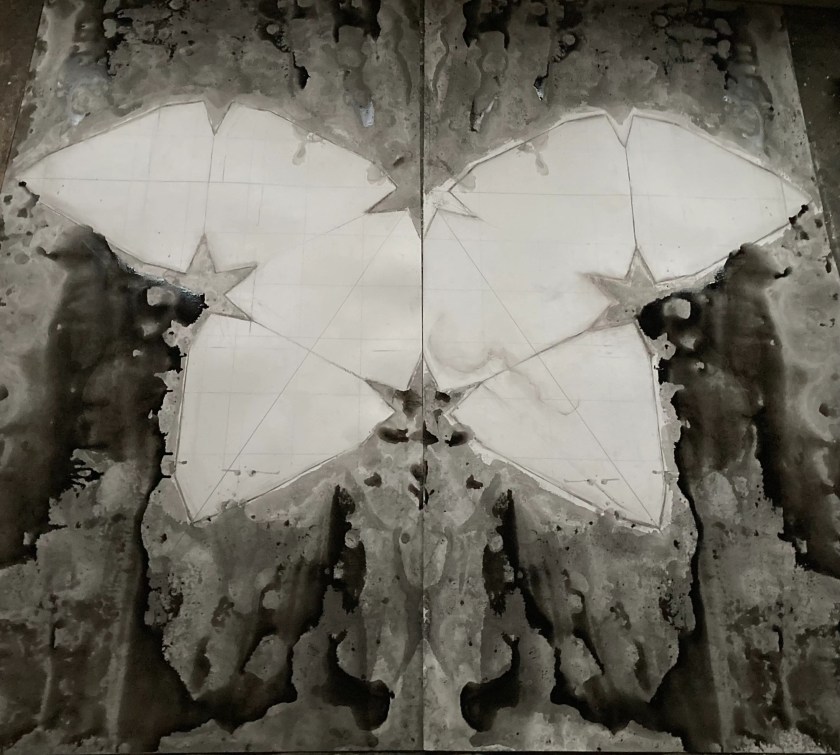
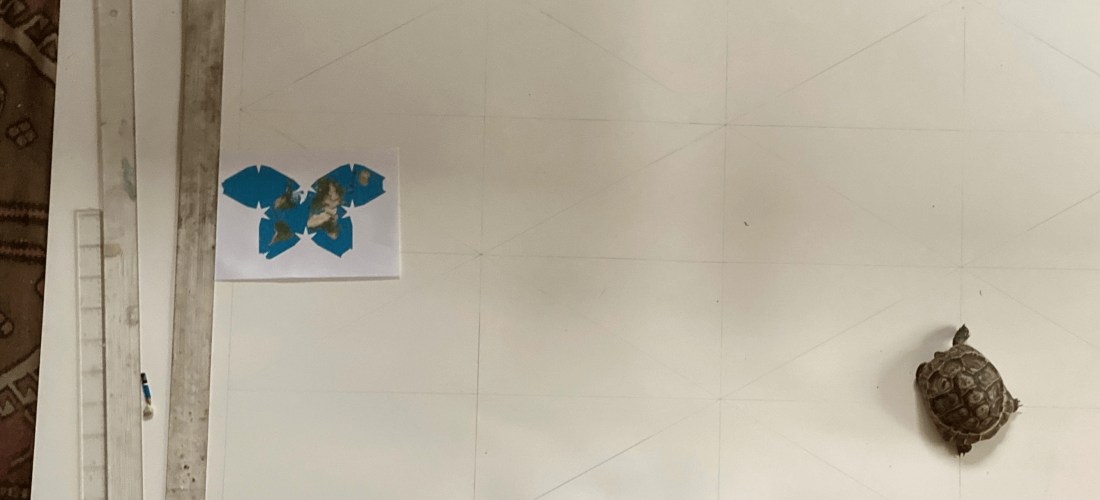
A few snaps from preparations, before joining the Praxis project group for a working retreat at Sigtunastiftelsen / Sigtuna Foundation…
More to come soon.
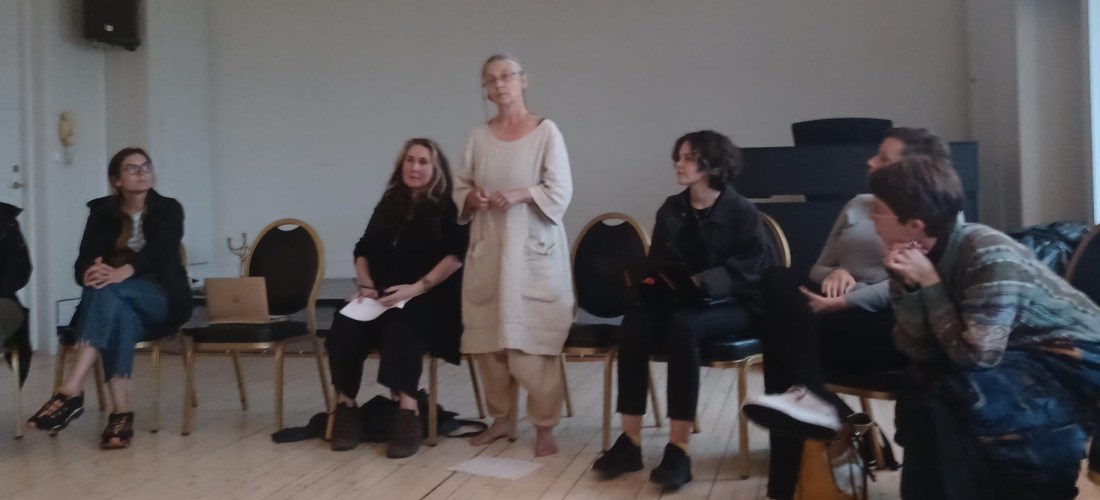
During the week-long NSU session, I got engaged in a couple of ‘ad hoc’ projects (in addition to my presentation within Circle 7, which was the ticket to my participation here). The first one happened in the context of a cultural evening.* Together with a number of courageous persons, I staged an updated performance of a multilingual poetry reading first realized in August 2014.**
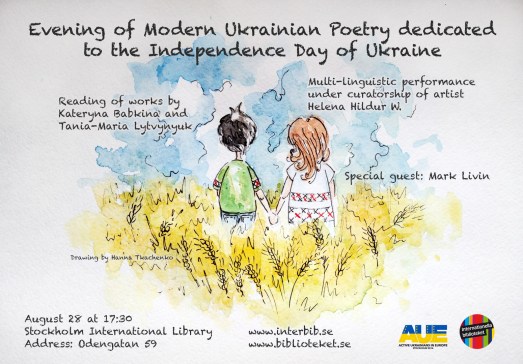
2014 poster – for full story, see Training the Fundamentals of a Democratic Society
The original project sprung from a poem by Ukrainian author Tanya-Mariya Litvinyuk. In this re-staging, Ms. Litvinyuk is actually present through a sound recording sent from Kyiv the day before; her voice is heard from the laptop at the beginning. Then follows an English translation, read by Dr. Lucy Lyons, after which the English reading proceeds with ten words (all singled out from Ms. Litvinyuk’s poem). Back in 2014, those ten words sparked a collective writing process in a group of civil rights activists, and the poetic result of their joined efforts was translated from English into all languages spoken within the group. Here, I’m reading the Swedish version – followed by a fresh translation into Belarusian by NSU participant Alina Kalachova, created for this occasion. Crucial contributions (although not visible on screen) were also made by Maru Mushtrieva.


My second ‘ad hoc’ engagement was in Disa Kamula’s workshop on Co-writing the future, where my contribution was the real-time mapping of an unfolding utopian narrative… From the resulting vision of a bright future, I finally erased all details but three:
…people of all ages…
…essential work… (cleaning up, that is)
…future generations in focus…


What did I gather from this week? Art is knowledge, and artistic research is here to stay. Democratic structures are essential, although never perfect. Disco dancing is fun – thanks, Ami Skånberg Dahlstedt!
And the map is never complete.
—
* The NSU multilingual poetry evening was organized by Lara Hoffman, PhD student at Háskólanum á Akureyri, Iceland; she is also the editor of Ós – The Journal, a magazine which features works of fiction, poetry, creative non-fiction, and artworks in multiple languages.
** The 2014 Evening of Modern Ukrainian Poetry was organized by Yulia Oleksandriv and Julia Shevchenko, in collaboration with Stockholm International Library.
School is closed for a week-long autumn break. I meet up with technician Per-Arne Sträng – who also happens to be an artist in his own right – to mount the map pieces. One and a half day of smooth collaboration…
…and – we nailed it! This is it.
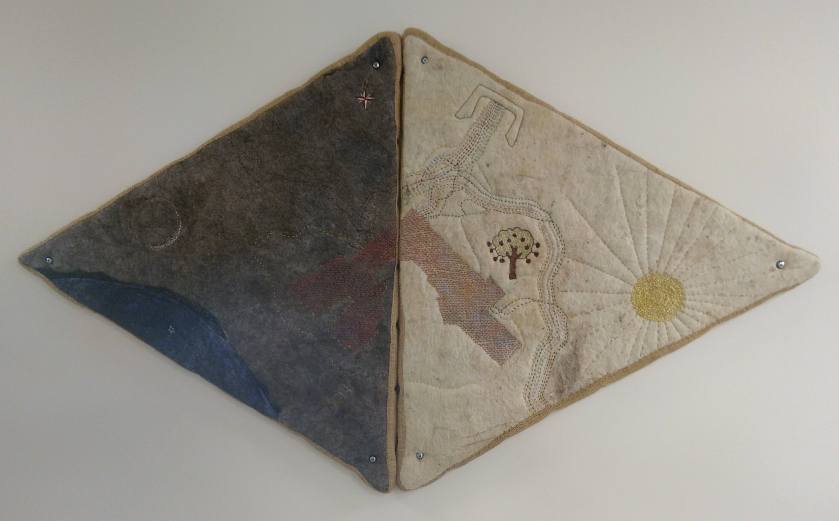 Cluster 1 (1A, 1B): the school building
*
xx
 Cluster 2A – 2D; overview (above) and close-ups (below)


*
xx
xx
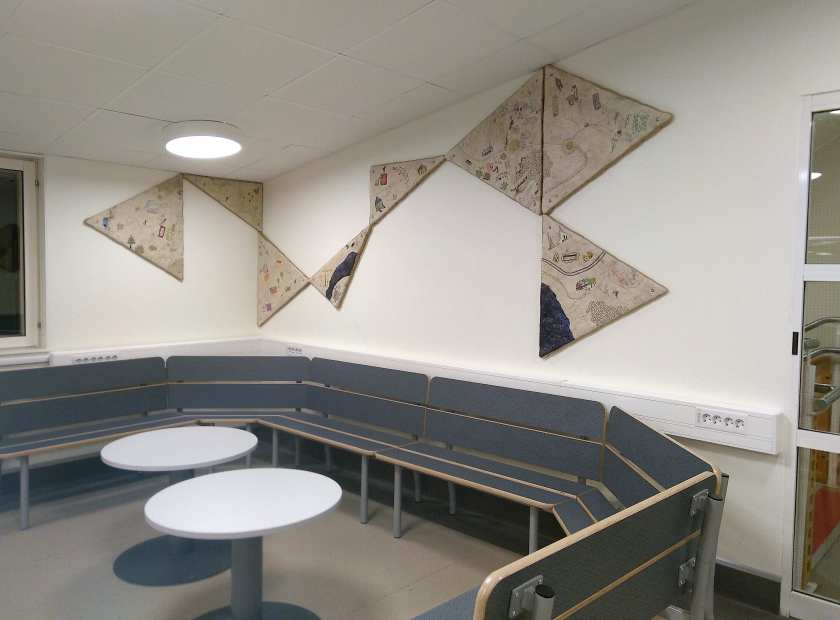 Clusters 3 (3A, 3B) and 4 (4A – 4F), overview


Cluster 3, close-ups


Cluster 4, close-ups
*
xx
xx
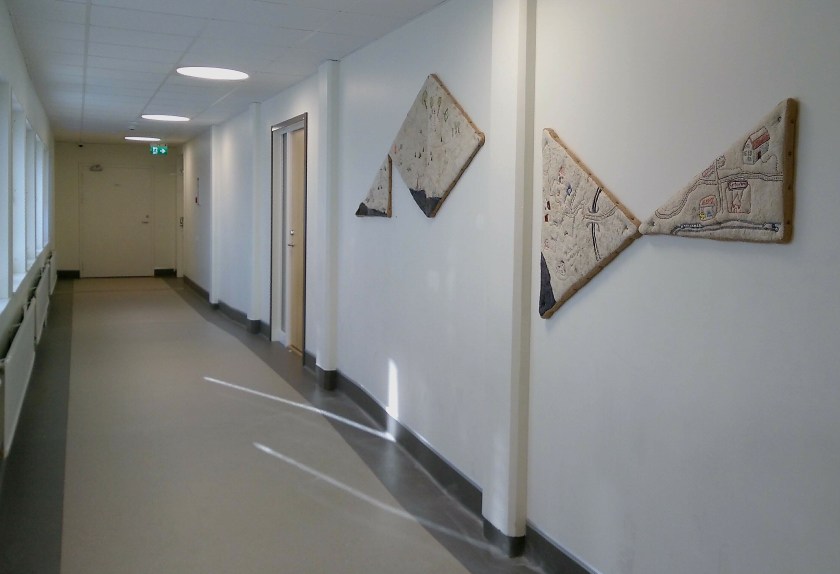 Cluster 5A – 5E, overview (above) and close-ups (below)


*
xx
xx
Cluster 6A, 6B, overview (above) and close-ups (below)


*
xx
xx
On Friday morning, Leif Josefsson – the school librarian – pops by and improvises an interview for the facebook site…
xx
*
xx
xx
So, this is really it; all the map pieces are mounted, the starry sky alcove is glowing, and the light projections are up and running.
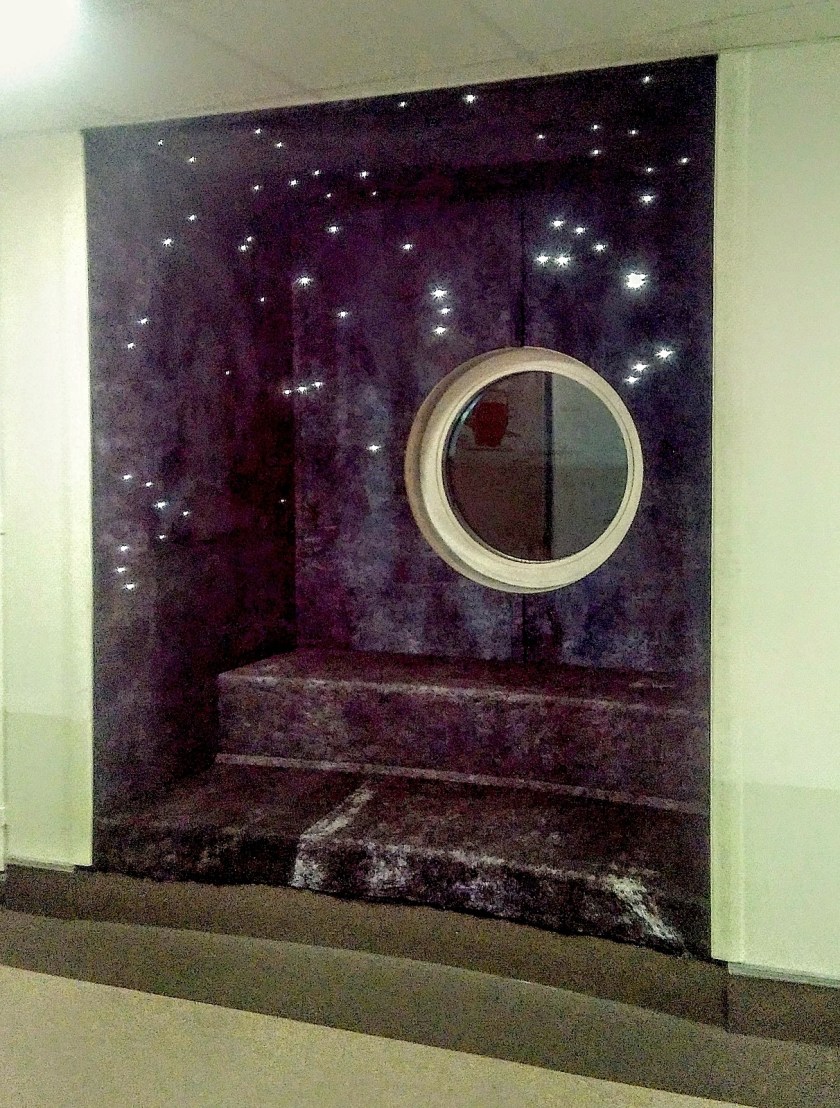


Just one more thing for Monday;

let’s welcome everybody back to school with a surprise opening; snacks, grapes and applejuice… Good morning!
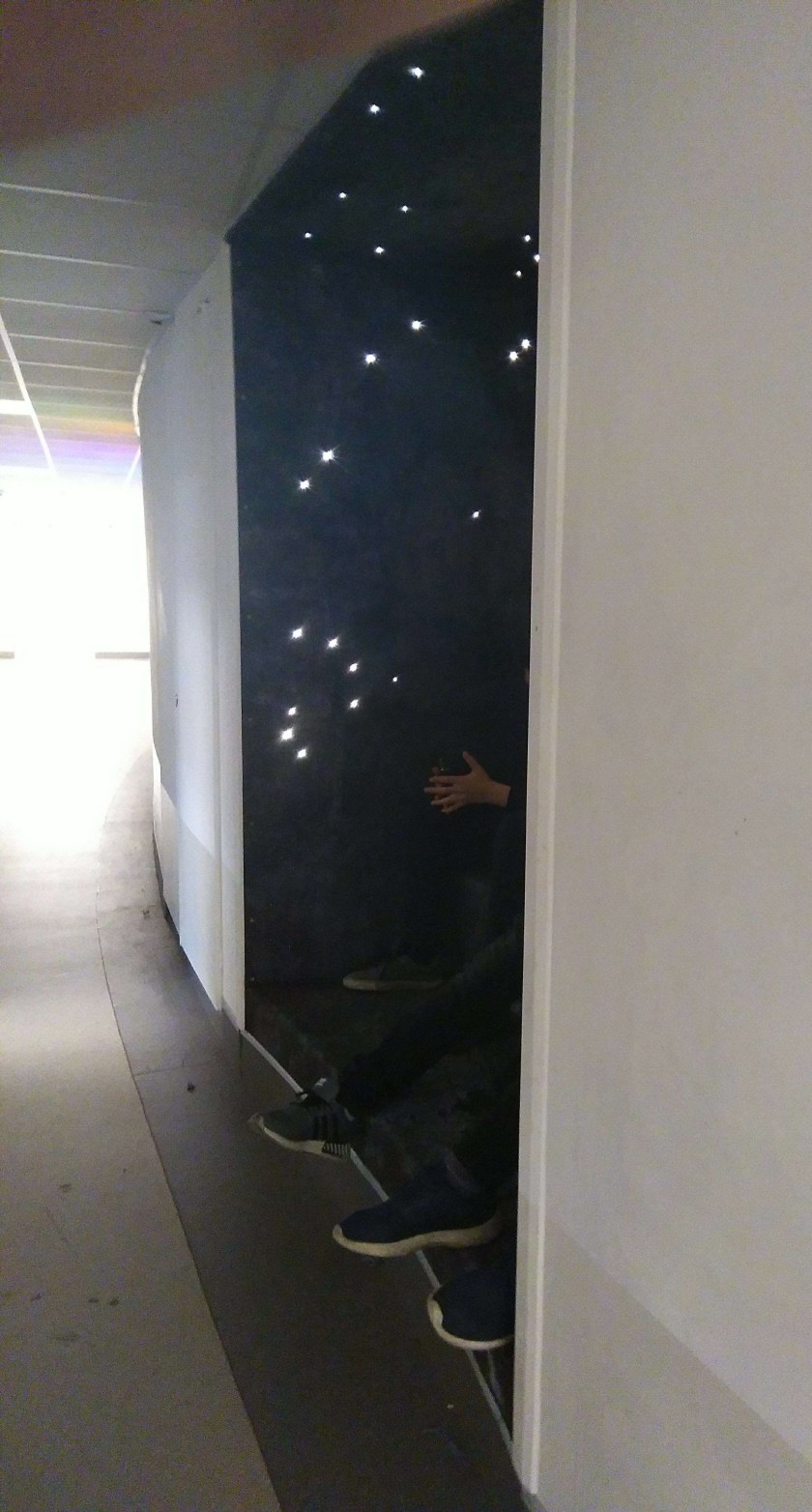
And now, it’s all yours. Enjoy!

With the starry sky alcove and the coloured spotlights set in place, I could return to the third part of the commission: the school road mapping.
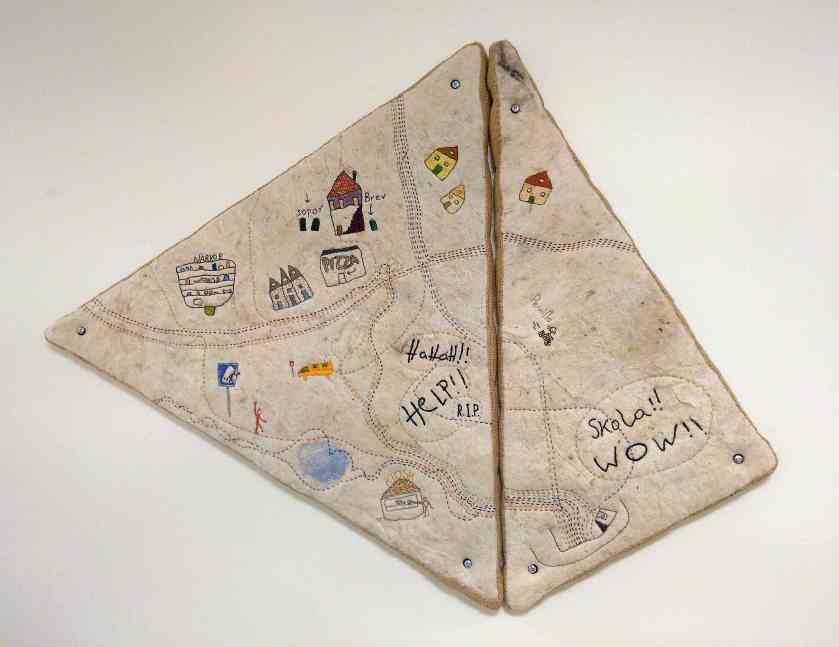
Back in spring this year, schoolkids in two classes presented me with their hand-drawn maps – each one showing their own path from home to school. I began to fuse those forty-something individual images into one collective map. Some related to places that were easily recognizable, and some of their features were obviously identical; a supermarket, a traffic circle, those two water pools and the Thai restaurant. Others were very personal, and sometimes pertaining to different layers of reality; a secret tree-house, an encounter with a friend or a wild animal, or some wildly ambivalent feelings expressed in graffiti style… And there were suns, and moons, and stars.
Having arrived at an overview, I again divided the map in triangular parts and arranged the sketches in clusters designed for five different walls; now with the individual paths intertwined – sometimes interacting – and (almost) all ending up in the central piece with the school building.
Then, twenty-one pieces of felt were cut and prepared with starch. Similarly, twenty-one wooden boards were produced to tauten the felt pieces onto. And the embroidery race started…
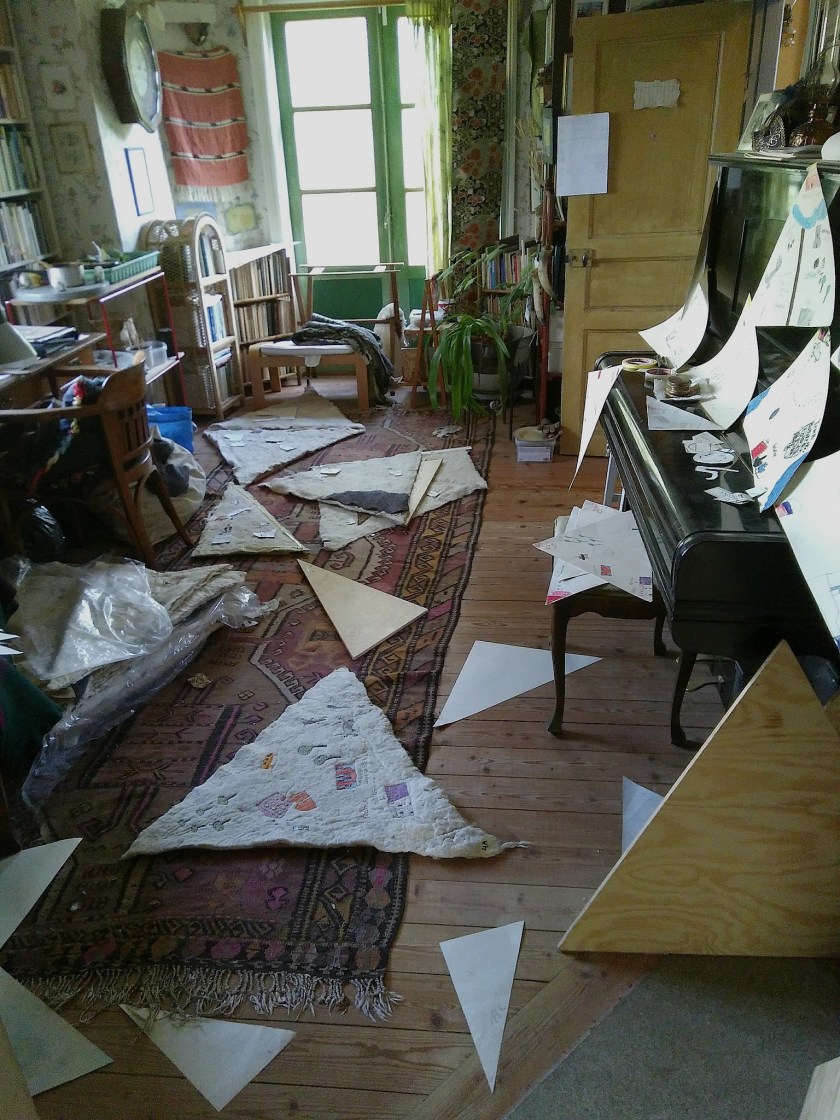
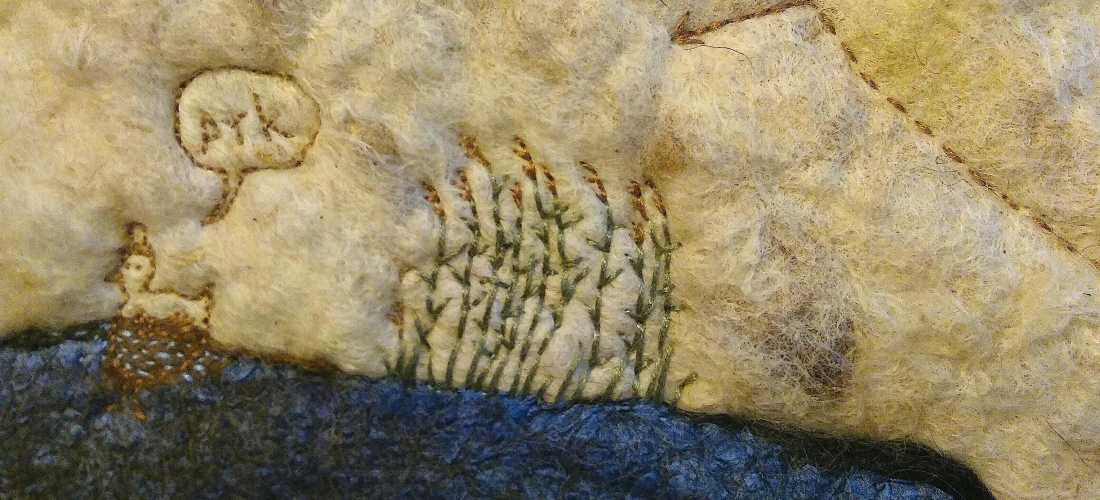
It was pure delight to discover all the details of the kids’ maps; humorous – sometimes cheeky – emotional, colourful, observant and straightforward. In rendering their felt-tip pen drawings into yarn stitches, I did my very best to stay true to the original.


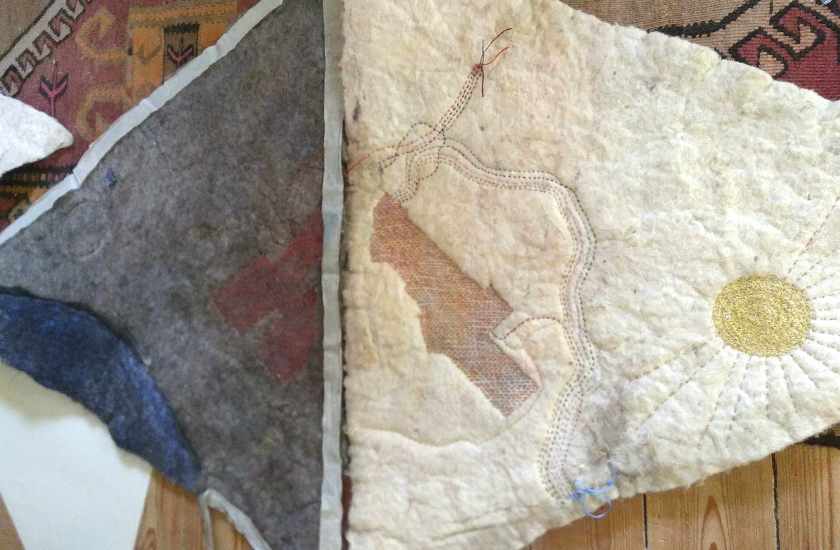
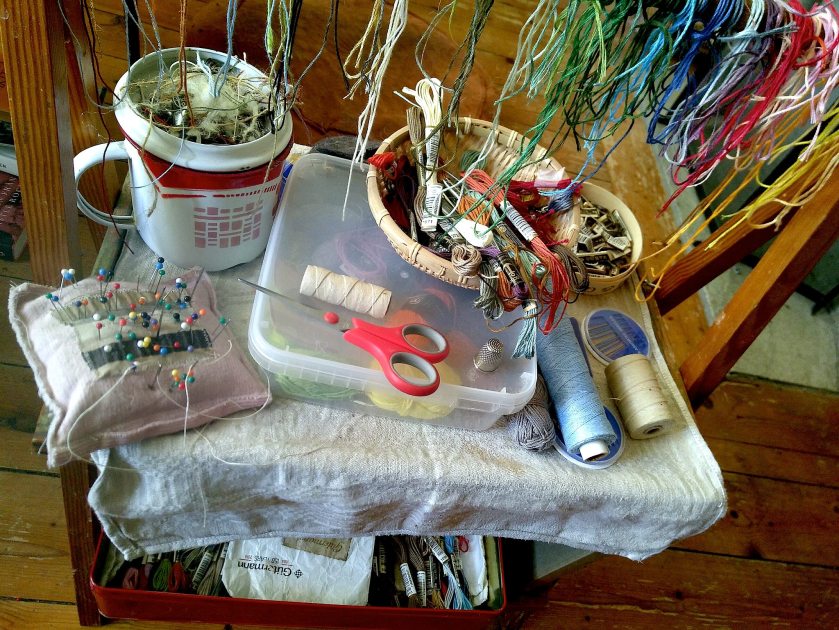
August and September came and went. Stitching, listening to the radio, stitching; pausing only to eat and sleep, and sometimes to go buying more mouliné thread… And slowly, the map took shape. By the end of October, I stowed the embroidery table away. The map was ready to mount.
What does “home” mean to you?
What does “school” mean to you?
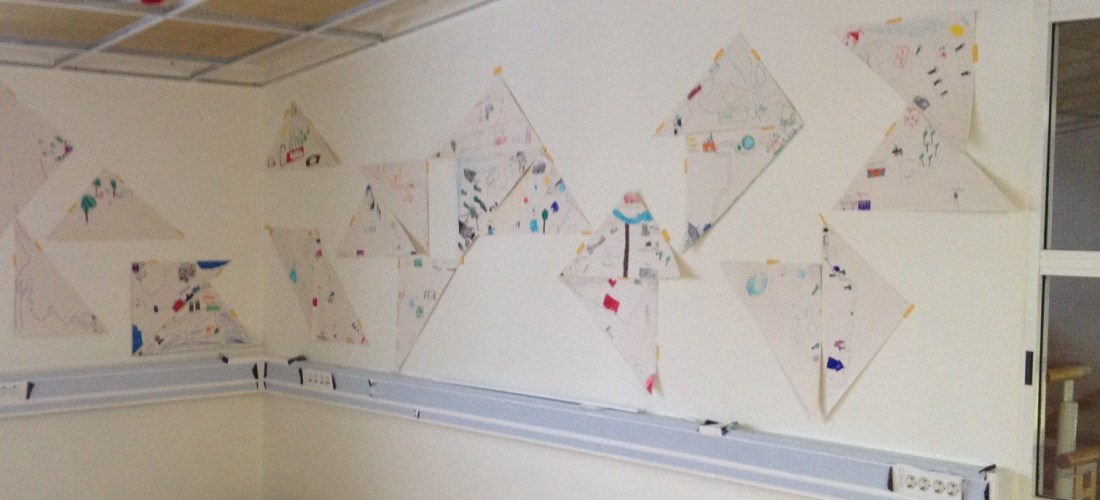
Those were the questions I posed to the schoolkids in grade 2 and grade 5… Their answers? “Home” means family, granma and granpa, an annoying little sister, an easy feeling; a house, spaghetti, chips and snacks; love, memories, a native language; a shopping mall, or a beach – a wide range of emotions, persons, places, cognitions and things. And “school” could be anything between a prison and a safe place, associated with knowledge, effort, fun, weariness and sometimes injustice – and, above all, a place to be with friends.
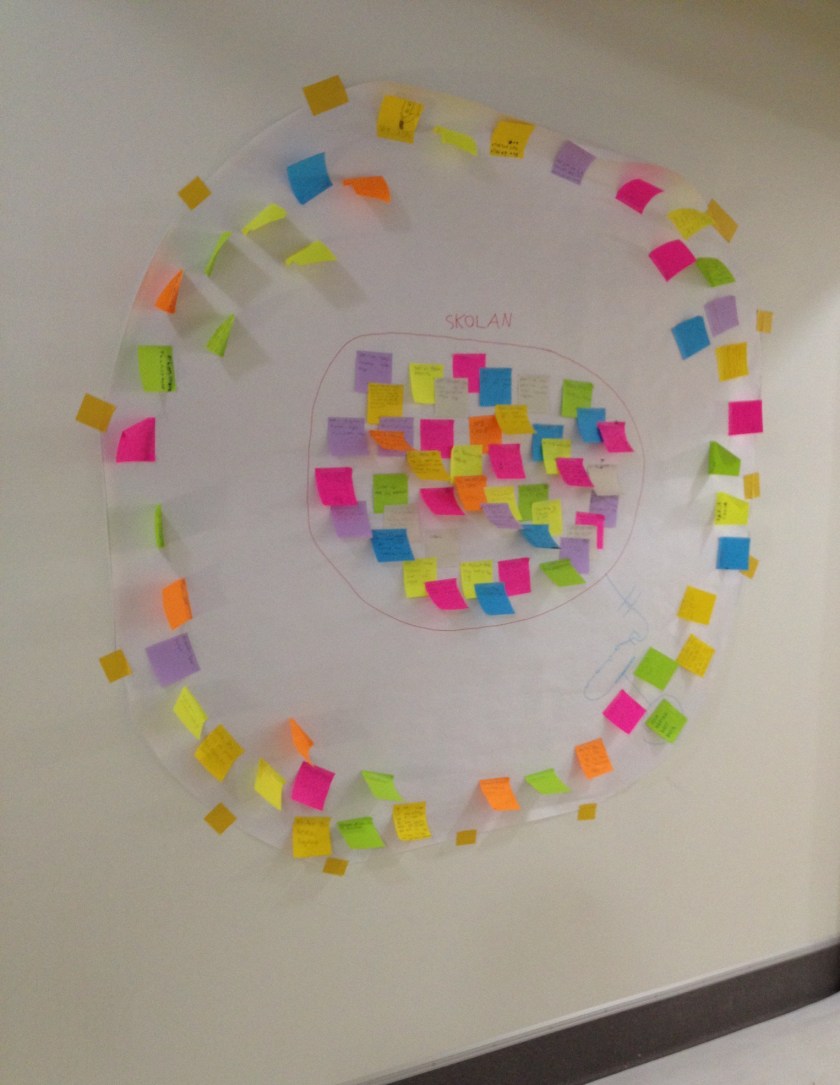
All the answers, written down on post it-notes, were carefully collected. Next time I visited, I presented them arranged in a pattern where “school” was the common centre, while the “home” notes formed a periphery – a proto-map, missing the in-between part; the school road. Which lead us to my next question: could you draw a map showing your way between home and school?
 Bernard J S Cahill: Butterfly Map (conceived in 1909)

Buckminster Fuller: Dymaxion Map (first published in 1943)
Inspired by Bernard Cahill’s “Butterfly Map” and Buckminster Fuller’s “Dymaxion Map”, I offered triangular pieces of drawing paper for the task. What I got in return was a stunning variety of expressions, mirroring individual temperaments and experiences – admirable visualisations and food for thought…
The next step will be the rendering of those school road maps into visual elements to form an aggregated whole, which can be mounted permanently on the walls. In the meantime, enjoy Jasper Johns’version of the Dymaxion map from 1967:

Photo still from Jasper Johns: Take an Object,
a film by Hans Namuth and Judith Wechsler (1990)
 Helena Hildur W.